Paramacrobiotus richtersi
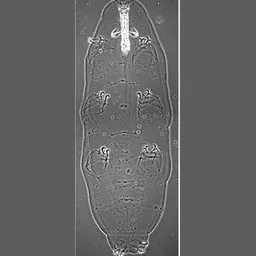
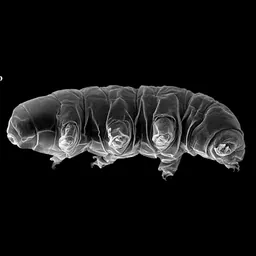
Paramacrobiotus richtersi is a tardigrade in the genus Paramacrobiotus (Macrobiotidae, Parachela), described by Murray in 1911. The parentheses around the authority mean it was first described in another genus.
Where it has been recorded
What we have read about it
Facts we extracted from the literature into our knowledge graph, each with the source and page it came from.
- Paramacrobiotus richtersi (carnivorous, anterior-ventral mouth) has a buccal tube diameter of 23–25%, a ventral lamina of 68–73% and stylet support insertion at 78–83% of buccal tube length, with small placoid margins and wide stylet curvature.Guidetti et al. 2012. Form and function of the feeding apparatus in Eutardigrada (Tardigrada). Zoomorphology. p129, Table 2 row 'Paramacrobiotus richtersi'
- In the three tardigrade species studied the brain is a dorsal, bilaterally symmetric ganglion bearing a central neuropil and a defined number of immunoreactive somata: about 14 serotonin-like and about 26 RFamide-like (Macrobiotus cf. harmsworthi), about 12 allatostatin-like (Paramacrobiotus richtersi) and 2 perisulfakinin-like (Hypsibius dujardini).Mayer et al. 2013. Selective neuronal staining in tardigrades and onychophorans provides insights into the evolution of segmental ganglia in panarthropods. BMC evolutionary biology. p3 right col., Results 'Organisation of the central and peripheral nervous system in the three tardigrade species studied'; Fig. 3 (p4) and its caption
- Allatostatin-like immunoreactivity labels the region surrounding the central brain neuropil in Paramacrobiotus richtersi.Martin et al. 2017. The nervous and visual systems of onychophorans and tardigrades: learning about arthropod evolution from their closest relatives. Journal of comparative physiology. A, Neuroethology, sensory, neural, and behavioral physiology. p574 left col.; Fig. 6e
- Transcriptomes of Paramacrobiotus richtersi and Milnesium tardigradum contain the same set of Hox orthologs as H. dujardini (lab, Hox3, Dfd, ftz, Abd-B) but a single copy of Abd-B each.Smith et al. 2016. The compact body plan of tardigrades evolved by the loss of a large body region. Curr Biol 26:224–229 p224; Fig. 2; Fig. S1B; Table S1 (P. richtersi KT991397–KT991401; M. tardigradum KT991404–KT991408)
- There is no mastication; eutardigrades with wide buccal tubes swallow whole organisms: Milnesium tardigradum (tube > 25 µm wide) sucks in diatoms and rotifers, and the author found a whole nematode in the gut of a Macrobiotus richtersi whose buccal tube was about 12 µm wide. Buccal tube width ranges from about 1 µm (some Diphascon) to over 25 µm (Milnesium).Ramazzotti & Maucci 1983. Il Phylum Tardigrada, 3rd edition (English translation by C. W. Beasley, 1995: The Phylum Tardigrada). Memorie dell'Istituto Italiano di Idrobiologia 41; translation published by the translator, McMurry University, Abilene, Texas. p. 47 (PDF p. 47): "I myself observed a whole nematode in the intestine of a moss-inhabiting Macrobiotus richtersi, the buccal tube of which had a diameter of about 12µ"
- Total fibres in legs I–IV (ventral + lateral + dorsal groups): Milnesium cf. tardigradum 12, 13, 13, 4; Acutuncus antarcticus 14, 13, 13, 5; Bertolanius volubilis 11, 11, 12, 6; Paramacrobiotus richtersi and Dactylobiotus parthenogeneticus 10, 11, 12, 5; Echiniscus testudo 9, 10, 11, 4. Only the ventral group was resolved in Batillipes bullacaudatus (5, 6, 6, 3).Marchioro et al. 2013. Somatic musculature of Tardigrada: phylogenetic signal and metameric patterns. Zoological Journal of the Linnean Society. Table 3 pp. 595–596, rows 'Total fibres within each leg'
- H. exemplaris and H. dujardini need more preconditioning to survive desiccation than M. tardigradum, R. varieornatus or P. richtersi, and H. exemplaris has the largest transcriptional response to desiccation among them, suggesting an induced rather than constitutive programme.Goldstein 2018. The Emergence of the Tardigrade Hypsibius exemplaris as a Model System. Cold Spring Harbor protocols. p862, Related Species (citing Wright 1989; Horikawa et al. 2008; Boothby et al. 2017)
- Evo 2's training data lists five tardigrade nuclear assemblies from NCBI: H. dujardini GCA_001579985.1 (strain Sciento, 182 Mb), R. varieornatus Rvar_4.0, P. metropolitanus GCF_019649055.1, P. richtersi GCA_034698045.1 and I. dastychi GCA_034696485.1; and three tardigrade mitochondrial genomes (H. dujardini, Thulinius sp., R. varieornatus). The card does not say how much of each genome was sampled: eukaryotic data went in as mRNAs, stitched 5 kb windows and, in the long-context phase, tagged whole genomes.OpenGenome2, the training data of Evo 2 (Arc Institute): dataset card and species_metadata.csv species_metadata.csv rows with phylum Tardigrada; dataset card, Data Sources and Training Data Composition
- TARSE: Paramacrobiotus richtersi (as Macrobiotus richtersi), dry and hydrated, flew 12 days inside FOTON-M3; microgravity and radiation (about 1.9 mGy) did not affect survival or DNA integrity of active animals, which moulted and laid eggs that hatched.Rebecchi et al. 2009. Tardigrade Resistance to Space Effects: first results of experiments on the LIFE-TARSE mission on FOTON-M3 (September 2007). Astrobiology 9:581–591. abstract; Jönsson KI, Levine EB, Wojcik A, Haghdoost S, Harms-Ringdahl M 2018. Environmental Adaptations: Radiation Tolerance. In: Schill RO (ed.) Water Bears: The Biology of Tardigrades. Zoological Monographs 2, pp. 311–330 p. 322 (PDF p. 324)
- Ventral commissures within the trunk ganglia are present in both heterotardigrade and eutardigrade species, including Mesobiotus cf. harmsworthi and H. dujardini, and are therefore ancestral for Tardigrada; their absence in Macrobiotus hufelandi (Zantke et al. 2008) is the exception rather than the rule. Extra-ganglionic interpedal commissures are likewise present in H. dujardini, M. cf. harmsworthi, Paramacrobiotus richtersi and Echiniscus testudo, taxa spanning the basal split of Tardigrada, so they too are ancestral components of the tardigrade nervous system.Smith & Jockusch 2014. The metameric pattern of Hypsibius dujardini(Eutardigrada) and its relationship to that of other panarthropods. Frontiers in Zoology. Frontiers in Zoology 11:66, p12, Discussion
- Dutta et al. extend the scenario for pdf evolution: one pdf gene in the protostome ancestor, duplicated to pdf-I and pdf-II in the ecdysozoan ancestor (both retained in priapulids, nematodes and onychophorans), with pdf-II lost and pdf-I retained and independently duplicated in tardigrades and arthropods. Screening found two to three pdf homologues per eutardigrade species (two in Ramazzottius varieornatus, Mesobiotus philippinicus and Milnesium tardigradum; three in Richtersius coronifer, Paramacrobiotus richtersi and Paramacrobiotus metropolitanus), and parachelan PDFs fall into two clades (PDF-1 and PDF-2/3), suggesting the eutardigrade ancestor had two pdf-I paralogues, one of which duplicated again in Parachela with later losses. Eutardigrade PDFs nest within the arthropod PDF/PDH clade.Dutta et al. 2025. Pigment-dispersing factor neuropeptides act as multifunctional hormones and modulators in tardigrades. Open biology. Open Biology 15:240242 section 2.1, p2 and section 3.1, p11; figure 1a,b; electronic supplementary material figure S1
- In P. richtersi, EDX area analysis detected calcium in every analysed site (5 apparatuses): buccal ring in 33% of specimens and all other sites in 100%; concentrations relative to the piercing stylet were buccal ring 5%, anterior, middle and terminal buccal tube 13%, 16% and 8%, ventral lamina 20%, stylet furca 15% and pharyngeal lining 6%.Guidetti et al. 2012. Form and function of the feeding apparatus in Eutardigrada (Tardigrada). Zoomorphology. p130, Table 3; p139 text; p129 methods (five apparatuses per species)
- The outer connectives (lateral brain to trunk ganglion 1) are weakly labelled by anti-serotonin, anti-RFamide and anti-allatostatin and are considered an autapomorphy of Tardigrada.Martin et al. 2017. The nervous and visual systems of onychophorans and tardigrades: learning about arthropod evolution from their closest relatives. Journal of comparative physiology. A, Neuroethology, sensory, neural, and behavioral physiology. p574 left col.; Fig. 6b,c
- Most tardigrades feed on plant cell contents, piercing moss or algal cells with the stylets and sucking them out; also algae, fungi and detritus. Echiniscidae feed exclusively on moss chlorophyll cells. Milnesium tardigradum is perhaps the only normally (not exclusively) carnivorous species; its gut often holds bdelloid rotifer mastax (three in one animal). Macrobiotus richtersi and M. hufelandi sometimes take animal food; Diphascon bullatum from a Pallanza field had Scenedesmus in the gut.Ramazzotti & Maucci 1983. Il Phylum Tardigrada, 3rd edition (English translation by C. W. Beasley, 1995: The Phylum Tardigrada). Memorie dell'Istituto Italiano di Idrobiologia 41; translation published by the translator, McMurry University, Abilene, Texas. pp. 46–47 (PDF pp. 46–47): "Milnesium tardigradum is perhaps the only species which is normally, though not exclusively, carnivorous and one can fairly frequently observe specimens belonging to this species whose intestines contain mastax from bdelloid rotifers: I actually saw three in one tardigrade found in Austria."
- The dorsal region of each leg receives fibres only from the dorsal group, the ventral region from all three groups. Legs I–III have similar fibre numbers (e.g. Bertolanius volubilis: three ventral, two lateral, six or seven dorsal per leg). Leg IV has only two attachment points, P1 and P2, reached by two or three fibres: one or two dorsal (to P2) and one lateral (to P1).Marchioro et al. 2013. Somatic musculature of Tardigrada: phylogenetic signal and metameric patterns. Zoological Journal of the Linnean Society. pp. 592–596, 'General remarks on leg musculature'; Table 3
- The pharyngeal cuticular lining continues into the narrow cylindrical oesophagus, and folds at the pharynx–oesophagus transition work as a valve.Guidetti et al. 2012. Form and function of the feeding apparatus in Eutardigrada (Tardigrada). Zoomorphology. p136, first paragraph; Fig. 16g
Showing 16 of 46, taking the best-supported facts from each source in turn.
Genomes and sequencing
Genome assemblies
| Accession | Name | Level | Released | Scaffold N50 (bp) |
|---|---|---|---|---|
| GCA_034698045.1 | ASM3469804v1 | Contig | 2023-12-27 | 6,203 |
Raw sequencing data
6 runs (29.7 Gb) in 2 projects: 5 RNA-Seq, 1 WGS. Browse them in the SRA.
Papers
17 works in our corpus of 5,137 tardigrade papers name it in the title or abstract (4 in the title), from 2009. This is by exact name match, so it misses papers that use an older name or only the genus.
- Antioxidant defences in hydrated and desiccated states of the tardigrade Paramacrobiotus richtersi (2010, Comparative Biochemistry and Physiology Part B Biochemistry and Molecular Biology) doi
- Resistance of the anhydrobiotic eutardigrade Paramacrobiotus richtersi to space flight (LIFE–TARSE mission on FOTON‐M3) (2011, Journal of Zoological Systematics & Evolutionary Research) doi
- Superoxide Anion Radical Production in the Tardigrade Paramacrobiotus richtersi, the First Electron Paramagnetic Resonance Spin-Trapping Study (2015, Physiological and Biochemical Zoology) doi
- Diversified bet-hedging strategy in the desiccation tolerant tardigrade Paramacrobiotus richtersi (2012, IRIS UNIMORE (University of Modena and Reggio Emilia))
- Selective neuronal staining in tardigrades and onychophorans provides insights into the evolution of segmental ganglia in panarthropods (2013, BMC Evolutionary Biology) doi
- Ultraviolet radiation tolerance in hydrated and desiccated eutardigrades (2011, Journal of Zoological Systematics & Evolutionary Research) doi
Classification
| class | Eutardigrada |
|---|---|
| order | Parachela |
| superfamily | Macrobiotoidea |
| family | Macrobiotidae |
| genus | Paramacrobiotus |
Synonyms: Macrobiotus schultzei Cuénot, 1932 according to Marcus 1936.
Changes: Transferred from Macrobiotus by Guidetti et al. 2009; Amended by Guidetti et al. 2019a.
Other species of Paramacrobiotus: P. alekseevi, P. arduus, P. areolatus, P. bengalensis, P. beotiae, P. bifrons, P. celsus, P. centesimus, P. chieregoi, P. corgatensis, P. csotiensis, P. danielae, P. danielisae, P. depressus, P. derkai, P. experimentalis, P. fairbanksi, P. filipi, P. gadabouti, P. garynahi, P. gerlachae, P. halei, P. hapukuensis, P. huziori, P. intii, P. kenianus, P. klymenki, P. lachowskae, P. lorenae, P. magdalenae, P. marchelmoni, P. mariettae, P. metropolitanus, P. palaui, P. peteri, P. pius, P. puma, P. priviterae, P. rioplatensis, P. sagani, and 9 more.
Look it up
GBIF · NCBI Taxonomy · GenBank sequences · iNaturalist · Google Scholar
Classification, authority and notes: Degma & Guidetti 2026, Actual checklist of Tardigrada species, 45th edition (CC BY 4.0), which asks users also to cite Guidetti & Bertolani 2005 (Zootaxa 845: 1–46) and Degma & Guidetti 2007 (Zootaxa 1579: 41–53).
Records: GBIF.org, accessed 2026-09-20 through the GBIF API; each record belongs to the dataset that published it. The map shows only records released under CC0 or CC BY, with coordinates and no geospatial issue flag.
Sequence data: NCBI Assembly, Nucleotide and SRA, searched September 2026.
Papers: our corpus of tardigrade literature from OpenAlex.
How this is built
- Data
- Classification, authority and notes from Degma & Guidetti's 2026 world checklist. Records from GBIF, genomes and sequencing runs from NCBI, papers from our OpenAlex corpus of tardigrade literature, photos from Wikimedia Commons and iNaturalist (CC0 or CC BY), and facts from our knowledge graph, each with its source and page. A page shows only the parts we hold for that species.
- Built with
build_species.pywrites every species page from the checklist, joining each name by exact match to the other collections. Facts are ranked by confidence and evidence, and taken from each source in turn so no single paper fills the list. The records map is drawn as SVG from thinned GBIF coordinates.- Checked
- Only exact matches to accepted names bring in GBIF records, and fossil entries were read against their papers. The pages themselves are not tested against data.
- Limits
- Exact name matching misses papers and sequences filed under older names or only the genus. GBIF identifications are as their publishers made them. A short page means we hold little yet, not that little is known.
- More
- How the whole project is built