Life on pause
A drying tardigrade pulls in its legs, shrinks into a barrel called a tun, and stops, with no measurable metabolism, until water returns. We gathered what is measured about how that works: the states, the proteins, the sugar tardigrades mostly do without, and how long a pause can last.
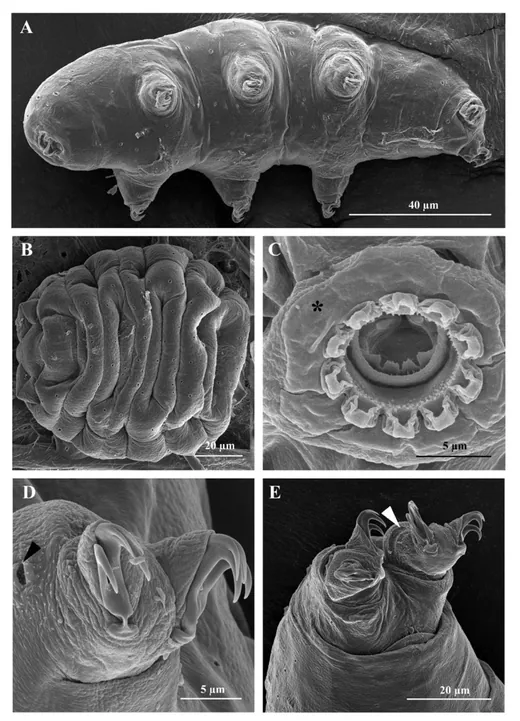
Schematic. Muscles contract the body and withdraw the legs; in Richtersius coronifer the tun has 87% less volume than the active animal (Møbjerg et al. 2018, p. 83, after Halberg et al. 2013).
Five ways to stop, and a sixth
David Keilin defined cryptobiosis in 1959 as the state in which an organism "shows no visible signs of life and when its metabolic activity becomes hardly measurable, or comes reversibly to a standstill", and named its causes (Schill & Hengherr 2018, p. 274). Tardigrades have been tested for each.
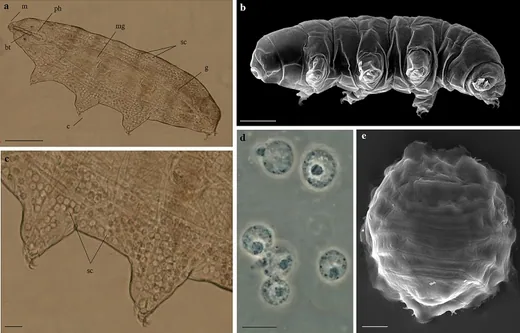
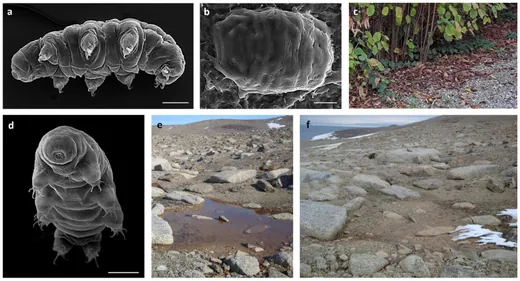
The tun. Almost all body water goes; the best-known state, and the one behind most extreme-tolerance records.
Hydrated animals tolerate ice forming in their bodies. R. coronifer survives −196 °C; active H. exemplaris about 98% at −10 °C, 45% after 24 h at −20 °C.
Hydrated animals recover from hours without oxygen, but not from a day (chart below).
The marine Echiniscoides sigismundi forms a tun in saturated seawater, and in seawater with a mitochondrial poison (chemobiosis).
Moss dries and freezes; the 30-year Antarctic record was in frozen moss.
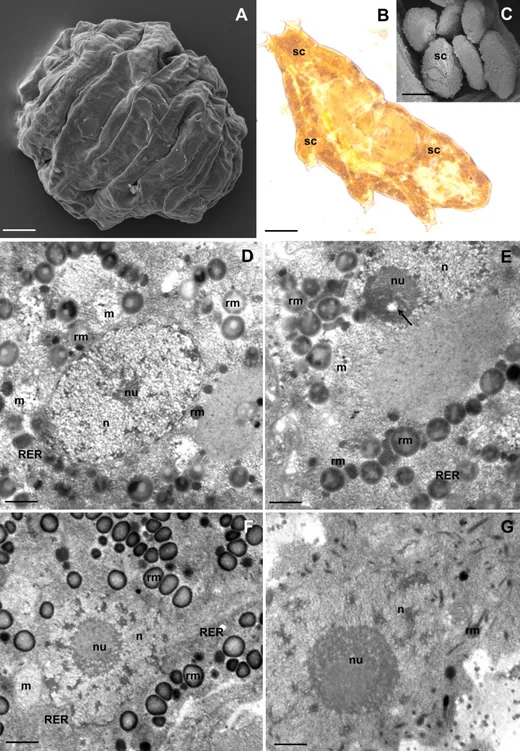
Not a tun: the animal shrinks inside one or more retained cuticles, keeps its water and breathes at about a quarter of its active rate. In Dactylobiotus dispar the first cyst wall forms in 12 hours and is black by 96; cysts last months without breaking down, but die at 60 °C, which a tun survives (Węglarska, in Ramazzotti & Maucci 1983, pp. 90–94).
Sources: Hengherr & Schill 2018 pp. 296–298; Lyons et al. 2024 (preprint, abstract); Hvidepil & Møbjerg 2023 (abstract); Tsujimoto et al. 2016 (abstract).
Drying slowly is the trick
A moss tardigrade stays active only while a film of water at least as thick as its body covers it; when the film thins further it pulls in its legs and head and becomes a tun. Measured tuns of Ramazzottius oberhaeuseri were 90 × 80 × 40 µm against 290 × 90 × 75 µm when active, about 15% of the volume on our arithmetic. Spallanzani found in the 1770s that animals dried fast on glass died, and that sand around them, which slows drying the way moss does, let them revive. On rewetting, water enters through the cuticle first, then the body stretches out and the legs start moving, usually from the back forwards: minutes after a few days dry, three or four hours after years (Marcus and others, in Ramazzotti & Maucci 1983, pp. 82–87).
A tun made in a hurry can die. The lab species Hypsibius exemplaris is a freshwater animal and a moderate cryptobiont: it survives drying only if it dries slowly first, and it needs to make new RNA and protein while it does. That gives an experiment: compare animals drying slowly with hydrated ones and see what they make.
What H. exemplaris makes as it dries
- Dried slowly at 95% relative humidity, animals then survive fast drying at 70%, which kills them without that first step.
- 11 of its 17 CAHS genes rise 4–22-fold during drying.
- Knocking down two strongly induced CAHS genes, or one SAHS gene, by RNAi lowers survival of drying, but not the survival of hydrated animals.
- Freezing is different: only 2 of the 17 CAHS genes rise, and the same knockdowns do not lower survival of freezing.
- Its genome has no gene for making trehalose (no trehalose-6-phosphate phosphatase or TPS–TPP).
Named H. dujardini in these papers (the same lab strain). Boothby et al. 2017, pp. 976–978; Hara et al. 2021.
The molecules
CAHS proteins
cytoplasm · tardigrade-onlyCytoplasmic abundant heat-soluble proteins, found by boiling tardigrade extracts and keeping what stayed dissolved. Unstructured in water, they turn helical as water leaves, and dried CAHS forms a glass-like solid.
Yamaguchi et al. 2012 (abstract, R. varieornatus); Boothby et al. 2017
SAHS proteins
secreted · tardigrade-onlySecretory abundant heat-soluble proteins, rich in β-structure when hydrated, also helical when dry. In H. exemplaris 19 are expressed, several constantly.
Yamaguchi et al. 2012 (abstract); Boothby et al. 2017 p. 976
MAHS and RvLEAM
mitochondriaTwo heat-soluble proteins inside the mitochondria of R. varieornatus: MAHS, unique to tardigrades, and RvLEAM, a group 3 LEA protein. Both made human cells more tolerant of strong salt.
Tanaka et al. 2015 (abstract)
Dsup
nucleus · on the DNADamage suppressor binds nucleosomes and shields DNA from hydroxyl radicals. In human cultured cells it cut X-ray DNA damage by about 40%. Found in R. varieornatus; the H. exemplaris version works the same way.
Hashimoto et al. 2016 (abstract); Chavez et al. 2019 (abstract)
Antioxidants
everywhereDrying and radiation both make reactive oxygen. Dried tardigrades raise superoxide dismutase, glutathione peroxidase and glutathione, and R. varieornatus carries 16 superoxide dismutase genes.
Heat-shock proteins
cytoplasmChaperones. In Milnesium tardigradum one of three Hsp70 forms rises during drying and persists in the tun; Hsp90 is expressed mainly in the tun.
Schill & Hengherr 2018 pp. 279–280
Hardly any trehalose
Brine shrimp cysts, midge larvae and nematodes dry out full of the sugar trehalose, which is thought to stand in for water around proteins and membranes and to set into a glass. Tardigrades have little, and some have none: Milnesium tardigradum survives drying with no trehalose detected, and H. exemplaris lacks the genes to make it. Where tardigrades do make it, the small amounts may still help: trehalose and CAHS protect better together than apart (Nguyen et al. 2022, abstract).
Trehalose in the dry state, % of dry weight
Bars run to the highest reported value; the fainter part of a bar is the reported range. Values from Schill & Hengherr 2018, pp. 281–282 (Westh & Ramløv 1991; Hengherr et al. 2008, whose method gave lower values than the earlier one); H. exemplaris from Hara et al. 2021.
What replaces it may be the proteins. Tuns of Paramacrobiotus and Macrobiotus form a glass that softens at about 80 °C, and their heat survival collapses above that. Milnesium and two Echiniscus species showed no glass transition and tolerated more heat (Schill & Hengherr 2018, p. 283).
Without oxygen
We averaged the per-replicate counts Hagelbäck & Jönsson 2023 published: active adults held in water bubbled with nitrogen to under 1 ppm oxygen, 7 samples of 10 animals per point, scored 10 hours after oxygen returned.
Animals moving 10 h after hypoxia
Share with regular or irregular movement. Controls kept in normal water: 97–100% (H. exemplaris), 87–100% (R. cf. coronifer). Data: Table S1 of Hagelbäck & Jönsson 2023 (CC BY 4.0).
Both species recover from hours without oxygen and almost none from a day, and H. exemplaris declines steadily with time while the moss-dwelling Richtersius holds up to 12 hours. Hypoxia in water is not the tun: these animals stayed hydrated, and as oxygen was lowered gradually, irregular movements began at 3–4 ppm.
Older accounts are more generous: animals sealed in oxygen-poor water swell, stiffen and lie still, and were reported to recover after up to 4–5 days (Ramazzotti & Maucci 1983, pp. 80–81). The controlled 2023 counts above find almost none recovering after 24 hours; the species, temperature and how completely the oxygen was removed all differ.
How long a pause lasts
Time in the tun doesn't count as age. Milnesium tardigradum kept active lived 82.7 days; animals dried for a week at a time lived 79.7 active days, 133 days in all (Schill & Hengherr 2018, p. 276, after Hengherr et al. 2008).
Lifespan of M. tardigradum, days
But the pause is not free. DNA in the storage cells of dry M. tardigradum breaks more the longer they stay dry, and repair can only start after rehydration (Schill & Hengherr 2018, pp. 285–286, after Neumann et al. 2009).
Broken DNA (% in comet tail) after time dry, M. tardigradum
The records: 20 years dry for Echiniscus testudo, the longest reliably documented; eggs of Ramazzottius oberhaeuseri that hatched after 9 years (4 of 13); and 30.5 years for Acutuncus antarcticus in moss kept frozen at −20 °C, which the authors link to little oxidative damage under stable frozen storage (Tsujimoto et al. 2016, abstract). The often-quoted 120 years is a 1948 report of a leg twitching once, probably from water uptake; see extremes.
What a tun can take
The dry state is where the famous records come from: hours at 7.5 GPa, 10 days of space vacuum, an hour at 100 °C. We checked each against its source and set them beside what kills active animals on the extremes page.
Limits: most mechanisms here come from two or three species (R. varieornatus, H. exemplaris, M. tardigradum), and species differ widely. Several sources we could read only as abstracts, marked where cited; Keilin's definition and the older experiments are quoted from the 2018 monograph Water Bears.
How this is built
- Data
- Published measurements, each read in its source: the survival chapters of Water Bears (Schill 2018), Ramazzotti & Maucci's 1983 monograph, open-access papers, and abstracts where that is all we could read (marked where cited). The oxygen chart uses the per-replicate counts in Table S1 of Hagelbäck & Jönsson 2023 (CC BY 4.0). The figure strip shows openly licensed figures from PubMed Central, each with its credit and licence.
- Built with
- We recorded the numbers as claims in our knowledge graph, each with its page. The charts are drawn in the page as SVG from those values; for the oxygen chart we averaged the seven samples of ten animals behind each point. The tun animation is a schematic.
- Checked
- Each value by hand against its source page. Nothing here is yet a test against a model.
- Limits
- Species, temperatures and scoring differ between studies, so values in one chart come from different set-ups. The R. oberhaeuseri tun volume (about 15%) is our arithmetic from the published dimensions.
- More
- How the whole project is built · the claims in the graph