Paramacrobiotus metropolitanus
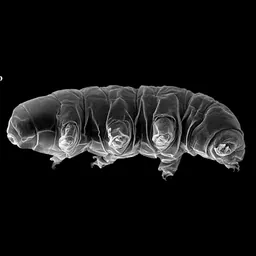
Paramacrobiotus metropolitanus is a tardigrade in the genus Paramacrobiotus (Macrobiotidae, Parachela), described by Sugiura, Matsumoto & Kunieda in 2022.
Records
GBIF holds 12 records of it, none of them both georeferenced and openly licensed, so there is no map. See them on GBIF.
What we have read about it
Facts we extracted from the literature into our knowledge graph, each with the source and page it came from.
- H. exemplaris has two Sp6-9 paralogues (He-Sp6-9A, proteins OQV18298/OQV18299, two isoforms; He-Sp6-9B, OQV18301), one Sp1-4 candidate and no Sp5. R. varieornatus and P. metropolitanus each have one Sp6-9, P. metropolitanus two Sp1-4 paralogues (a lineage-specific duplication), and none of the three tardigrades has Sp5, so Sp5 was lost in the tardigrade lineage.Game & Smith 2025. An Sp6-9 ortholog is expressed in developing legs in the tardigrade Hypsibius exemplaris. Arthropod structure & development. p. 3 (Results 3.1); p. 7 (Discussion 4.1); Fig. 1; Table S1
- Evo 2's training data lists five tardigrade nuclear assemblies from NCBI: H. dujardini GCA_001579985.1 (strain Sciento, 182 Mb), R. varieornatus Rvar_4.0, P. metropolitanus GCF_019649055.1, P. richtersi GCA_034698045.1 and I. dastychi GCA_034696485.1; and three tardigrade mitochondrial genomes (H. dujardini, Thulinius sp., R. varieornatus). The card does not say how much of each genome was sampled: eukaryotic data went in as mRNAs, stitched 5 kb windows and, in the long-context phase, tagged whole genomes.OpenGenome2, the training data of Evo 2 (Arc Institute): dataset card and species_metadata.csv species_metadata.csv rows with phylum Tardigrada; dataset card, Data Sources and Training Data Composition
- Searches of genomes and transcriptomes found two putative pdfr homologues in the eutardigrade Paramacrobiotus metropolitanus and one each in the heterotardigrades Echiniscus testudo, Echiniscoides sigismundi and an unpublished Batillipes sp. genome; a maximum-likelihood tree of about 1,000 class B GPCRs places all of them, and both H. exemplaris splice variants, inside the protostome PDF receptor clade, sister to the corticotropin-releasing hormone receptors.Dutta et al. 2025. Pigment-dispersing factor neuropeptides act as multifunctional hormones and modulators in tardigrades. Open biology. Open Biology 15:240242 section 2.2, p4; figure 1c; electronic supplementary material figure S2 and table S2
- Dutta et al. extend the scenario for pdf evolution: one pdf gene in the protostome ancestor, duplicated to pdf-I and pdf-II in the ecdysozoan ancestor (both retained in priapulids, nematodes and onychophorans), with pdf-II lost and pdf-I retained and independently duplicated in tardigrades and arthropods. Screening found two to three pdf homologues per eutardigrade species (two in Ramazzottius varieornatus, Mesobiotus philippinicus and Milnesium tardigradum; three in Richtersius coronifer, Paramacrobiotus richtersi and Paramacrobiotus metropolitanus), and parachelan PDFs fall into two clades (PDF-1 and PDF-2/3), suggesting the eutardigrade ancestor had two pdf-I paralogues, one of which duplicated again in Parachela with later losses. Eutardigrade PDFs nest within the arthropod PDF/PDH clade.Dutta et al. 2025. Pigment-dispersing factor neuropeptides act as multifunctional hormones and modulators in tardigrades. Open biology. Open Biology 15:240242 section 2.1, p2 and section 3.1, p11; figure 1a,b; electronic supplementary material figure S1
Genomes and sequencing
Genome assemblies
| Accession | Name | Level | Released | Scaffold N50 (bp) |
|---|---|---|---|---|
| GCF_019649055.1 | Prichtersi_v1.0 | Scaffold | 2021-08-17 | 1,033,953 |
Raw sequencing data
26 runs (124.6 Gb) in 3 projects: 17 RNA-Seq, 9 WGS. Browse them in the SRA.
Papers
5 works in our corpus of 5,137 tardigrade papers name it in the title or abstract (2 in the title), from 2022. This is by exact name match, so it misses papers that use an older name or only the genus.
- Description of a model tardigrade Paramacrobiotus metropolitanus sp. nov. (Eutardigrada) from Japan with a summary of its life history, reproduction and genomics (2022, Zootaxa) doi
- Sexual dimorphism in the tardigrade Paramacrobiotus metropolitanus transcriptome (2024, Zoological Letters) doi
- Integrative bioinformatics analysis of potential convergent evolution in tardigrade stress-response proteins (2026, Stress Biology) doi
- Lineage-specific expansions of the Dicer gene family in tardigrades (2025, BMC Genomics) doi
- 幼若ホルモンによる緩歩動物クマムシの性決定メカニズム (2022, KeiO Associated Repository of Academic Resources (Keio University))
Classification
| class | Eutardigrada |
|---|---|
| order | Parachela |
| superfamily | Macrobiotoidea |
| family | Macrobiotidae |
| genus | Paramacrobiotus |
Other species of Paramacrobiotus: P. alekseevi, P. arduus, P. areolatus, P. bengalensis, P. beotiae, P. bifrons, P. celsus, P. centesimus, P. chieregoi, P. corgatensis, P. csotiensis, P. danielae, P. danielisae, P. depressus, P. derkai, P. experimentalis, P. fairbanksi, P. filipi, P. gadabouti, P. garynahi, P. gerlachae, P. halei, P. hapukuensis, P. huziori, P. intii, P. kenianus, P. klymenki, P. lachowskae, P. lorenae, P. magdalenae, P. marchelmoni, P. mariettae, P. palaui, P. peteri, P. pius, P. puma, P. priviterae, P. richtersi, P. rioplatensis, P. sagani, and 9 more.
Look it up
GBIF · NCBI Taxonomy · GenBank sequences · iNaturalist · Google Scholar
Classification, authority and notes: Degma & Guidetti 2026, Actual checklist of Tardigrada species, 45th edition (CC BY 4.0), which asks users also to cite Guidetti & Bertolani 2005 (Zootaxa 845: 1–46) and Degma & Guidetti 2007 (Zootaxa 1579: 41–53).
Records: GBIF.org, accessed 2026-09-20 through the GBIF API; each record belongs to the dataset that published it. The map shows only records released under CC0 or CC BY, with coordinates and no geospatial issue flag.
Sequence data: NCBI Assembly, Nucleotide and SRA, searched September 2026.
Papers: our corpus of tardigrade literature from OpenAlex.
How this is built
- Data
- Classification, authority and notes from Degma & Guidetti's 2026 world checklist. Records from GBIF, genomes and sequencing runs from NCBI, papers from our OpenAlex corpus of tardigrade literature, photos from Wikimedia Commons and iNaturalist (CC0 or CC BY), and facts from our knowledge graph, each with its source and page. A page shows only the parts we hold for that species.
- Built with
build_species.pywrites every species page from the checklist, joining each name by exact match to the other collections. Facts are ranked by confidence and evidence, and taken from each source in turn so no single paper fills the list. The records map is drawn as SVG from thinned GBIF coordinates.- Checked
- Only exact matches to accepted names bring in GBIF records, and fossil entries were read against their papers. The pages themselves are not tested against data.
- Limits
- Exact name matching misses papers and sequences filed under older names or only the genus. GBIF identifications are as their publishers made them. A short page means we hold little yet, not that little is known.
- More
- How the whole project is built