Paramacrobiotus fairbanksi
Paramacrobiotus fairbanksi is a tardigrade in the genus Paramacrobiotus (Macrobiotidae, Parachela), described by Schill, Förster, Dandekar & Wolf in 2010.
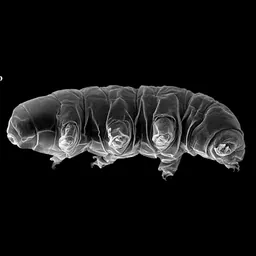
Where it has been recorded
What we have read about it
Facts we extracted from the literature into our knowledge graph, each with the source and page it came from.
- Active life span of tardigrades has been estimated at 18–30 months (Ramazzotti and Maucci 1983); the longest laboratory record is 518 days (ca. 17 months) in a clonal strain of Paramacrobiotus fairbanksi, and 18 months is reported for the pseudosimplex 1 stage of Halobiotus crispae (Kristensen 1982).Altiero T, Suzuki AC, Rebecchi L 2018. Reproduction, Development and Life Cycles. In: Schill RO (ed.) Water Bears: The Biology of Tardigrades. Zoological Monographs 2, pp. 211–248 p. 235, §8.9.1
- In non-marine heterotardigrades and in limnic and terrestrial eutardigrades oocytes develop synchronously and are laid in groups of 2 to more than 40 eggs (shown in Paramacrobiotus richtersi, now attributable to P. fairbanksi); most marine heterotardigrades mature oocytes asynchronously and lay one egg at a time.Altiero T, Suzuki AC, Rebecchi L 2018. Reproduction, Development and Life Cycles. In: Schill RO (ed.) Water Bears: The Biology of Tardigrades. Zoological Monographs 2, pp. 211–248 p. 219, §8.3.1
- Two clones of Paramacrobiotus fairbanksi at 14 °C: CGMr01 life span 194.9 ± 164.4 days (max 518), first oviposition 76.9 ± 16.4 days, 11.0 ± 7.1 eggs per clutch, 37.8 ± 29.3 eggs per animal, hatching 83.1 ± 12.7% after 41.0 ± 9.5 days; CGMr02 137.3 ± 136.4 days (max 457), 70.7 ± 19.4, 8.0 ± 6.2, 17.8 ± 16.0, 51.0 ± 36.0% after 60.0 ± 16.7 days.Altiero T, Suzuki AC, Rebecchi L 2018. Reproduction, Development and Life Cycles. In: Schill RO (ed.) Water Bears: The Biology of Tardigrades. Zoological Monographs 2, pp. 211–248 p. 239, Table 8.2 (ref. 14 = Altiero et al. 2006, 2010)
- In laboratory cultures of Paramacrobiotus fairbanksi (leaf litter) fewer than 10% of eggs are resting eggs that need dehydration followed by rehydration to hatch; over 58% are subitaneous eggs hatching in 30–40 days, ca. 30% are delayed-hatching eggs completing development in 41–62 days, and a very small fraction abort; the egg types look the same.Altiero T, Suzuki AC, Rebecchi L 2018. Reproduction, Development and Life Cycles. In: Schill RO (ed.) Water Bears: The Biology of Tardigrades. Zoological Monographs 2, pp. 211–248 p. 241, §8.9.3
- Paramacrobiotus fairbanksi protocol: small plastic dishes 15 mm in diameter and 7 mm high with Bacto agar (Difco) 1.2% w/v in water and a few drops of natural mineral water (San Benedetto); food is the nematodes Pristionchus iheritieri, Panagrolaimus rigidus and Caenorhabditis elegans grown on Escherichia coli; newborns are fed algae; the diploid strain seemed to prefer 20 °C and the triploid 14 °C.Altiero T, Suzuki AC, Rebecchi L 2018. Reproduction, Development and Life Cycles. In: Schill RO (ed.) Water Bears: The Biology of Tardigrades. Zoological Monographs 2, pp. 211–248 p. 242, §8.9.4
Genomes and sequencing
Raw sequencing data
22 runs (171.5 Gb) in 2 projects: 8 FL-cDNA, 8 RNA-Seq, 6 AMPLICON. Browse them in the SRA.
Papers
12 works in our corpus of 5,137 tardigrade papers name it in the title or abstract (2 in the title), from 2019. This is by exact name match, so it misses papers that use an older name or only the genus.
- New Records of Antarctic Tardigrada with Comments on Interpopulation Variability of the Paramacrobiotus fairbanksi Schill, Förster, Dandekar and Wolf, 2010 (2020, Diversity) doi
- Morphological and genetic variability in cosmopolitan tardigrade species—Paramacrobiotus fairbanksi Schill, Förster, Dandekar & Wolf, 2010 (2023, Scientific Reports) doi
- Dietary preferences and diet effects on life-history traits of tardigrades (2019, Zoological Journal of the Linnean Society) doi
- First faunistic investigation of semiterrestrial tardigrade fauna of North-West Russia using the method of DNA barcoding (2022, Invertzool) doi
- Comparative transcriptomics reveal a novel tardigrade specific DNA binding protein induced in response to ionizing radiation (2023, bioRxiv (Cold Spring Harbor Laboratory)) doi
- eLife Assessment: Comparative transcriptomics reveal a novel tardigrade specific DNA binding protein induced in response to ionizing radiation (2024) doi
Classification
| class | Eutardigrada |
|---|---|
| order | Parachela |
| superfamily | Macrobiotoidea |
| family | Macrobiotidae |
| genus | Paramacrobiotus |
Changes: Amended by Guidetti et al. 2019a.
Notes: The species had been initally diagnosed based on genetic data only.
Other species of Paramacrobiotus: P. alekseevi, P. arduus, P. areolatus, P. bengalensis, P. beotiae, P. bifrons, P. celsus, P. centesimus, P. chieregoi, P. corgatensis, P. csotiensis, P. danielae, P. danielisae, P. depressus, P. derkai, P. experimentalis, P. filipi, P. gadabouti, P. garynahi, P. gerlachae, P. halei, P. hapukuensis, P. huziori, P. intii, P. kenianus, P. klymenki, P. lachowskae, P. lorenae, P. magdalenae, P. marchelmoni, P. mariettae, P. metropolitanus, P. palaui, P. peteri, P. pius, P. puma, P. priviterae, P. richtersi, P. rioplatensis, P. sagani, and 9 more.
Look it up
GBIF · NCBI Taxonomy · GenBank sequences · iNaturalist · Google Scholar
Classification, authority and notes: Degma & Guidetti 2026, Actual checklist of Tardigrada species, 45th edition (CC BY 4.0), which asks users also to cite Guidetti & Bertolani 2005 (Zootaxa 845: 1–46) and Degma & Guidetti 2007 (Zootaxa 1579: 41–53).
Records: GBIF.org, accessed 2026-09-20 through the GBIF API; each record belongs to the dataset that published it. The map shows only records released under CC0 or CC BY, with coordinates and no geospatial issue flag.
Sequence data: NCBI Assembly, Nucleotide and SRA, searched September 2026.
Papers: our corpus of tardigrade literature from OpenAlex.
How this is built
- Data
- Classification, authority and notes from Degma & Guidetti's 2026 world checklist. Records from GBIF, genomes and sequencing runs from NCBI, papers from our OpenAlex corpus of tardigrade literature, photos from Wikimedia Commons and iNaturalist (CC0 or CC BY), and facts from our knowledge graph, each with its source and page. A page shows only the parts we hold for that species.
- Built with
build_species.pywrites every species page from the checklist, joining each name by exact match to the other collections. Facts are ranked by confidence and evidence, and taken from each source in turn so no single paper fills the list. The records map is drawn as SVG from thinned GBIF coordinates.- Checked
- Only exact matches to accepted names bring in GBIF records, and fossil entries were read against their papers. The pages themselves are not tested against data.
- Limits
- Exact name matching misses papers and sequences filed under older names or only the genus. GBIF identifications are as their publishers made them. A short page means we hold little yet, not that little is known.
- More
- How the whole project is built