Paramacrobiotus areolatus
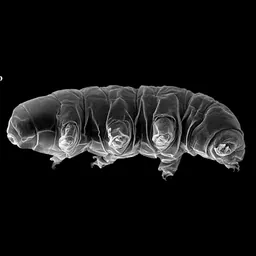
Paramacrobiotus areolatus is a tardigrade in the genus Paramacrobiotus (Macrobiotidae, Parachela), described by Murray in 1907. The parentheses around the authority mean it was first described in another genus.
Where it has been recorded
What we have read about it
Facts we extracted from the literature into our knowledge graph, each with the source and page it came from.
- In 1983 tardigrades were traditionally counted among animals with constant cell number (Martini 1908; Plate, Basse, Baumann), but Marcus found cell number constant only in some organs, with fluctuating numbers in the claw (pedal) glands and storage cells, and Bertolani (1970) saw somatic mitoses in several organs of Macrobiotus hufelandi, M. areolatus and M. richtersi and concluded that tardigrades do not have constant cell number.Ramazzotti & Maucci 1983. Il Phylum Tardigrada, 3rd edition (English translation by C. W. Beasley, 1995: The Phylum Tardigrada). Memorie dell'Istituto Italiano di Idrobiologia 41; translation published by the translator, McMurry University, Abilene, Texas. p. 46 (PDF p. 46): "Recently R. Bertolani (1970) has observed somatic mitosis in various organs of Macrobiotus hufelandi, M. areolatus, and M. richtersi, deduced that the Tardigrada do not have constant cell number, and that many of their tissues are composed of cells of limited life cycle."
- Paramacrobiotus (Macrobiotus) areolatus, X-rays: LD50 one day after irradiation 5.7 kGy for desiccated and 5.4 kGy for hydrated animals (May et al. 1964).Jönsson KI, Levine EB, Wojcik A, Haghdoost S, Harms-Ringdahl M 2018. Environmental Adaptations: Radiation Tolerance. In: Schill RO (ed.) Water Bears: The Biology of Tardigrades. Zoological Monographs 2, pp. 311–330 p. 314 (PDF p. 316), Fig. 12.1
- The number of moults in a lifetime was unsettled: about six in many species by some authors; about twelve for M. hufelandi, D. dispar and H. oberhaeuseri (Marcus 1929) and for M. hufelandi (Franceschi-Crippa & Lattes 1967); seven for about 800 Macrobiotus islandicus in Colorado from size-frequency (Higgins 1959); Ramazzotti’s measurements of over 1,000 M. areolatus in Pallanza suggested close to twelve. Summary: probably 6–12 in some Macrobiotus and Hypsibius. Size-frequency methods depend on class width and are confounded by sexes and cryptic races.Ramazzotti & Maucci 1983. Il Phylum Tardigrada, 3rd edition (English translation by C. W. Beasley, 1995: The Phylum Tardigrada). Memorie dell'Istituto Italiano di Idrobiologia 41; translation published by the translator, McMurry University, Abilene, Texas. pp. 77–78 (PDF pp. 77–78): "To sum up our present knowledge on the number of molts during the tardigrade’s life, one can say that it is probably somewhere between six and twelve in certain species of Macrobiotus and Hypsibius"
- Species can be classed by habitat wetness: xerophilous (dry mosses IV–V: most Echiniscus including E. testudo, Adorybiotus coronifer, Macrobiotus islandicus, Hypsibius oberhaeuseri, Milnesium tardigradum); eurytopic (all categories: Macrobiotus areolatus, M. hufelandi, M. richtersi, M. harmsworthi and others); hygrophilous (moist mosses II–III: Hypsibius dujardini, H. convergens, most Diphascon); hydrophilous (wet mosses and water: all Dactylobiotus and Pseudobiotus). Physiological races of one species may occupy different habitats. About 80% of known species and varieties are found in moss.Ramazzotti & Maucci 1983. Il Phylum Tardigrada, 3rd edition (English translation by C. W. Beasley, 1995: The Phylum Tardigrada). Memorie dell'Istituto Italiano di Idrobiologia 41; translation published by the translator, McMurry University, Abilene, Texas. pp. 109–111 (PDF pp. 109–111): "Hygrophilous species: - Macrobiotus hibernicus, M. intermedius. - Hypsibius pallidus, H. convergens, H. microps, H. dujardini."
- Many "naked" eutardigrades have cuticular pores, larger and denser dorsally and caudally, up to 2–2.2 µm wide (e.g. Macrobiotus intermedius, M. spallanzanii) and 6–7 µm in M. pustulatus; M. areolatus and M. richtersi lack them.Ramazzotti & Maucci 1983. Il Phylum Tardigrada, 3rd edition (English translation by C. W. Beasley, 1995: The Phylum Tardigrada). Memorie dell'Istituto Italiano di Idrobiologia 41; translation published by the translator, McMurry University, Abilene, Texas. p. 31 (PDF p. 31): "these pores are very visible (with diameters up to 2-2.2µ, and even as much as 6-7µ, in Macrobiotus pustulatus). In other species (M. areolatus, M. richtersi) the pores are absent."
- Tuns withstood atmospheres of CO₂, H₂S and illuminating gas (Baumann 1922) but not SO₂ (Lance 1896); strong acid solutions, osmic acid, alcohol and 0.1% sublimate (Rahm 1921); and an hour of ultraviolet light, whereas active animals in moss 5–10 mm from a cooled quartz lamp died within 10 min (Rahm 1921). May, Maria & Guimard (1964) showed high UV resistance of Macrobiotus areolatus in both states.Ramazzotti & Maucci 1983. Il Phylum Tardigrada, 3rd edition (English translation by C. W. Beasley, 1995: The Phylum Tardigrada). Memorie dell'Istituto Italiano di Idrobiologia 41; translation published by the translator, McMurry University, Abilene, Texas. p. 86 (PDF p. 86): "The "barrels" also withstood an atmosphere of CO2, H2S, illuminating gas (Baumann, 1922), but not of SO2 (Lance, 1896)"
- Weekly quantitative sampling of moss Macrobiotus hufelandi for about two years (Franceschi, Loi & Pierantoni 1962–63) showed population changes closely tied to humidity, rain and temperature over the 10–20 days before sampling, rapid spring growth and more young in spring than winter; Ramazzotti (1977) found more young in summer than winter in a large moss population of M. areolatus in Pallanza. Freshwater psammon populations peak perhaps in winter and spring and nearly vanish in some months.Ramazzotti & Maucci 1983. Il Phylum Tardigrada, 3rd edition (English translation by C. W. Beasley, 1995: The Phylum Tardigrada). Memorie dell'Istituto Italiano di Idrobiologia 41; translation published by the translator, McMurry University, Abilene, Texas. pp. 99–104 (PDF pp. 99–104): "demonstrated the close correlation between the quantitative variations in the populations and meteorological factors (relative humidity, showers, temperature), which mark the situation for the 10-20 days preceding the removal of the tardigrades for study"
Genomes and sequencing
Raw sequencing data
2 runs (0.0 Gb) in 1 projects: 2 AMPLICON. Browse them in the SRA.
Papers
6 works in our corpus of 5,137 tardigrade papers name it in the title or abstract (1 in the title), from 2011. This is by exact name match, so it misses papers that use an older name or only the genus.
- Untangling systematics of the Paramacrobiotus areolatus species complex by an integrative redescription of the nominal species for the group, with multilocus phylogeny and species delineation in the genus Paramacrobiotus (2019, Zoological Journal of the Linnean Society) doi
- Evaluación de la diversidad en comunidades de tardígrados (Ecdysozoa: Tardigrada) en hábitats urbano y rural de la ciudad de Salta (Argentina) (2016, Iheringia Série Zoologia) doi
- Tardigrada of Grand Cayman, West Indies, with descriptions of two new species of eutardigrade, Doryphoribius tessellatus (Hypsibiidae) and Macrobiotus caymanensis (Macrobiotidae) (2011, Zootaxa) doi
- Water Bears From The Caribbean Island Of Antigua, With The Description Of A New Macrobiotus Species (Tardigrada: Eutardigrada: Macrobiotidae) (2017, Zenodo (CERN European Organization for Nuclear Research)) doi
- PRELIMINARY DATA ON TARDIGRADA FROM THE ARMENIAN FORESTED AREA (2025, Bulletin of The Iraq Natural History Museum) doi
- Bursa İli limnokarasal tardigrada faunası (2017, Bursa Uludag University - AVESIS)
Classification
| class | Eutardigrada |
|---|---|
| order | Parachela |
| superfamily | Macrobiotoidea |
| family | Macrobiotidae |
| genus | Paramacrobiotus |
Synonyms: Paramacrobiotus crenatus (Maucci, 1991), previously transferred from Macrobiotus by Guidetti et al. 2009, according to Stec et al. 2020c.
Changes: Transferred from Macrobiotus by Guidetti et al. 2009; Amended by Stec et al. 2020c.
Other species of Paramacrobiotus: P. alekseevi, P. arduus, P. bengalensis, P. beotiae, P. bifrons, P. celsus, P. centesimus, P. chieregoi, P. corgatensis, P. csotiensis, P. danielae, P. danielisae, P. depressus, P. derkai, P. experimentalis, P. fairbanksi, P. filipi, P. gadabouti, P. garynahi, P. gerlachae, P. halei, P. hapukuensis, P. huziori, P. intii, P. kenianus, P. klymenki, P. lachowskae, P. lorenae, P. magdalenae, P. marchelmoni, P. mariettae, P. metropolitanus, P. palaui, P. peteri, P. pius, P. puma, P. priviterae, P. richtersi, P. rioplatensis, P. sagani, and 9 more.
Look it up
GBIF · NCBI Taxonomy · GenBank sequences · iNaturalist · Google Scholar
Classification, authority and notes: Degma & Guidetti 2026, Actual checklist of Tardigrada species, 45th edition (CC BY 4.0), which asks users also to cite Guidetti & Bertolani 2005 (Zootaxa 845: 1–46) and Degma & Guidetti 2007 (Zootaxa 1579: 41–53).
Records: GBIF.org, accessed 2026-09-20 through the GBIF API; each record belongs to the dataset that published it. The map shows only records released under CC0 or CC BY, with coordinates and no geospatial issue flag.
Sequence data: NCBI Assembly, Nucleotide and SRA, searched September 2026.
Papers: our corpus of tardigrade literature from OpenAlex.
How this is built
- Data
- Classification, authority and notes from Degma & Guidetti's 2026 world checklist. Records from GBIF, genomes and sequencing runs from NCBI, papers from our OpenAlex corpus of tardigrade literature, photos from Wikimedia Commons and iNaturalist (CC0 or CC BY), and facts from our knowledge graph, each with its source and page. A page shows only the parts we hold for that species.
- Built with
build_species.pywrites every species page from the checklist, joining each name by exact match to the other collections. Facts are ranked by confidence and evidence, and taken from each source in turn so no single paper fills the list. The records map is drawn as SVG from thinned GBIF coordinates.- Checked
- Only exact matches to accepted names bring in GBIF records, and fossil entries were read against their papers. The pages themselves are not tested against data.
- Limits
- Exact name matching misses papers and sequences filed under older names or only the genus. GBIF identifications are as their publishers made them. A short page means we hold little yet, not that little is known.
- More
- How the whole project is built