Hypsibius dujardini
Hypsibius dujardini is a tardigrade in the genus Hypsibius (Hypsibiidae, Parachela), described by Doyère in 1840. The parentheses around the authority mean it was first described in another genus.
Where it has been recorded
What we have read about it
Facts we extracted from the literature into our knowledge graph, each with the source and page it came from.
Includes populations recorded as Hypsibius cf. dujardini.
- Uncorrected p-distances between H. dujardini s.s. and H. exemplaris are 12.6% for ITS-2, 22.8% for COI, 3.2% for 28S rRNA and 2.0% for 18S rRNA.GĄsiorek et al. 2018. An integrative redescription of Hypsibius dujardini (Doyère, 1840), the nominal taxon for Hypsibioidea (Tardigrada: Eutardigrada). Zootaxa. p55 (ITS-2 12.6%, COI 22.8%, 28S 3.2%); Supplementary Material 3 sheets 18S rRNA (0.0198), 28S rRNA (0.0324), COI (0.2280)
- A male of Hypsibius cf. dujardini is figured, with a testis, one of two vasa deferentia and seminal vesicles full of spermatozoa (orcein, DIC).Altiero T, Suzuki AC, Rebecchi L 2018. Reproduction, Development and Life Cycles. In: Schill RO (ed.) Water Bears: The Biology of Tardigrades. Zoological Monographs 2, pp. 211–248 p. 216, Fig. 8.4b
- A species-level key for the Hypsibius dujardini species group is Gąsiorek et al. 2018; the tardigrade species checklist is maintained online and continuously updated (Degma et al. 2018), and keys must be checked against it for missing taxa.Degma P 2018. Field and Laboratory Methods. In: Schill RO (ed.) Water Bears: The Biology of Tardigrades. Zoological Monographs 2, pp. 349–370 p. 360, §14.5
- Spermatozoa of Hypsibius dujardini (Marcus 1929) are very thin, 80–90 µm long, with a spiral head of 7–8 coils about 11–12 (occasionally 16) µm long; the haploid chromosome number is 5. Macrobiotus hufelandi sperm are of the same type; Tetrakentron synaptae has 35 µm sperm in a 105 µm male; Isohypsibius nodosus sperm are about 80 µm.Ramazzotti & Maucci 1983. Il Phylum Tardigrada, 3rd edition (English translation by C. W. Beasley, 1995: The Phylum Tardigrada). Memorie dell'Istituto Italiano di Idrobiologia 41; translation published by the translator, McMurry University, Abilene, Texas. p. 65 (PDF p. 65): "Those of Hypsibius dujardini (Marcus, 1929) are very thin, 80 to 90µ long, with a spirally-shaped head (7 to 8 coils) about 11 to 12µ long, or occasionally even 16µ; the haploid chromosome number is 5."
- Hypsibius dujardini (as named), frozen in water for 48 h and fired from a light gas gun into sand in vacuum, 2–3 animals per shot: all survived 0.728 km/s (0.86 GPa peak shock), none survived 0.901 km/s (1.14 GPa) or 1.00 km/s; animals were intact up to 0.825 km/s and fragmented above. Frozen, unfired controls: 20 of 20 revived within 8–9 h.Traspas & Burchell 2021. Tardigrade survival limits in high-speed impacts: implications for panspermia and collection of samples from plumes emitted by ice worlds. Astrobiology 21:845–852. Methods; Results; Table 1; Figs 1–3
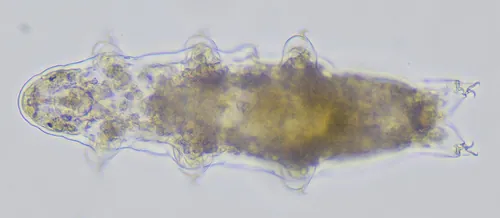
- Body length of Hoyer's-mounted H. dujardini s.s. neotype specimens is 289 ± 45 µm (range 134–339 µm, n = 30; neotype 289 µm), and the body is stubby.GĄsiorek et al. 2018. An integrative redescription of Hypsibius dujardini (Doyère, 1840), the nominal taxon for Hypsibioidea (Tardigrada: Eutardigrada). Zootaxa. p52, Table 4 (Hoyer's-mounted neotype series of H. dujardini s.s.), row Body length; p51 'Body stubby'
- Table 8.2 row for Hypsibius dujardini (Ammermann 1962, 1967): age at first oviposition 14 days, 3–10 eggs per clutch, hatching time 5 days, at 21–23 °C, parthenogenetic; fed green algae (Chlorella sp.?, Table 8.1).Altiero T, Suzuki AC, Rebecchi L 2018. Reproduction, Development and Life Cycles. In: Schill RO (ed.) Water Bears: The Biology of Tardigrades. Zoological Monographs 2, pp. 211–248 p. 238, Table 8.2 (ref. 2 = Ammermann 1962, 1967)
- Parthenogenetic and bisexual "biotypes", possibly sibling species distinguished by reproduction and karyotype, can coexist in one habitat (Bertolani): Macrobiotus hufelandi and M. richtersi have diploid bisexual (2n = 12) and triploid parthenogenetic (3n = 18) biotypes; Hypsibius oberhaeuseri has a diploid bisexual (2n = 12), a triploid (3n = 18) and a tetraploid (4n = 24) parthenogenetic biotype; Hypsibius dujardini (2n = 10) and Dactylobiotus dispar (2n = 10) are diploid parthenogens.Ramazzotti & Maucci 1983. Il Phylum Tardigrada, 3rd edition (English translation by C. W. Beasley, 1995: The Phylum Tardigrada). Memorie dell'Istituto Italiano di Idrobiologia 41; translation published by the translator, McMurry University, Abilene, Texas. p. 68 (PDF p. 68): "In Hypsibius oberhaeuseri there are three biotypes, one diploid bisexual (2n= 12) and two parthenogenetic, one triploid (3n= 18), the other tetraploid (4n=24)."
- Stylet supports insert on the H. dujardini s.s. buccal tube at 15.1 ± 1.7 µm (9.1–17.4 µm), pt 61.5 ± 1.5 (57.2–64.2), n = 30; buccal tube length 24.5 ± 2.4 µm (15.9–27.5).GĄsiorek et al. 2018. An integrative redescription of Hypsibius dujardini (Doyère, 1840), the nominal taxon for Hypsibioidea (Tardigrada: Eutardigrada). Zootaxa. p52, Table 4 (Hoyer's-mounted neotype series of H. dujardini s.s.), rows Buccal tube length, Stylet support insertion point
- Table 8.1 lists Hypsibius dujardini from freshwater reared on green algae (Chlorella sp.?, Ammermann 1962, 1967; Chlorococcum sp., Gabriel et al. 2007), and Hypsibius cf. dujardini from leaves in a pond reared on green algae and rotifers (Chlorococcum sp., Chlorella sp.; Lecane inermis; Kosztyła et al. 2016).Altiero T, Suzuki AC, Rebecchi L 2018. Reproduction, Development and Life Cycles. In: Schill RO (ed.) Water Bears: The Biology of Tardigrades. Zoological Monographs 2, pp. 211–248 pp. 236–237, Table 8.1
- Ammermann raised Hypsibius dujardini for more than six years (to 1967) at 21–23 °C on sessile Chlorococcales algae (probably Chlorella) in a dilute soil decoction (after Hämmerling); it reproduced by obligatory parthenogenesis and males never appeared. The authors found this surprising because natural H. dujardini populations include males. Parthenogenesis was also shown in Milnesium tardigradum (Baumann 1964) and Dactylobiotus dispar (Ammermann, unpublished), and excluded in H. convergens (Baumann 1961).Ramazzotti & Maucci 1983. Il Phylum Tardigrada, 3rd edition (English translation by C. W. Beasley, 1995: The Phylum Tardigrada). Memorie dell'Istituto Italiano di Idrobiologia 41; translation published by the translator, McMurry University, Abilene, Texas. pp. 67–68 (PDF pp. 67–68): "Ammermann observed that H. dujardini, in culture conditions, presents obligatory parthenogenesis: males never appeared (the culture lasted six years, when these results were given in 1967)."
- In H. dujardini s.s. macroplacoid 1 is 4.1 ± 0.6 µm, macroplacoid 2 3.1 ± 0.5 µm, septulum 1.3 ± 0.3 µm (0.7–1.7; pt 3.3–6.5), external buccal tube width 2.1 ± 0.3 µm (pt 6.9–10.2), and the leg-IV posterior claw primary branch 12.2 ± 1.6 µm (6.5–14.0, n = 25), n = 30 unless stated.GĄsiorek et al. 2018. An integrative redescription of Hypsibius dujardini (Doyère, 1840), the nominal taxon for Hypsibioidea (Tardigrada: Eutardigrada). Zootaxa. p52, Table 4 (Hoyer's-mounted neotype series of H. dujardini s.s.)
- Species can be classed by habitat wetness: xerophilous (dry mosses IV–V: most Echiniscus including E. testudo, Adorybiotus coronifer, Macrobiotus islandicus, Hypsibius oberhaeuseri, Milnesium tardigradum); eurytopic (all categories: Macrobiotus areolatus, M. hufelandi, M. richtersi, M. harmsworthi and others); hygrophilous (moist mosses II–III: Hypsibius dujardini, H. convergens, most Diphascon); hydrophilous (wet mosses and water: all Dactylobiotus and Pseudobiotus). Physiological races of one species may occupy different habitats. About 80% of known species and varieties are found in moss.Ramazzotti & Maucci 1983. Il Phylum Tardigrada, 3rd edition (English translation by C. W. Beasley, 1995: The Phylum Tardigrada). Memorie dell'Istituto Italiano di Idrobiologia 41; translation published by the translator, McMurry University, Abilene, Texas. pp. 109–111 (PDF pp. 109–111): "Hygrophilous species: - Macrobiotus hibernicus, M. intermedius. - Hypsibius pallidus, H. convergens, H. microps, H. dujardini."
- Recomputing stylet support insertion pt from the per-specimen supplementary data of the H. dujardini neotype series gives mean 61.8 ± 1.7 and range 57.2–65.5 (n = 30): specimen 28 (16.7/25.5 µm) is 65.5% and specimen 4 (16.7/25.6 µm) 65.2%, above the 64.2% maximum printed in Table 4.GĄsiorek et al. 2018. An integrative redescription of Hypsibius dujardini (Doyère, 1840), the nominal taxon for Hypsibioidea (Tardigrada: Eutardigrada). Zootaxa. Supplementary Material 1, workbook for population FR.055 (file _23407-Article Text-13409-15022-10-20180427.xlsx), sheet 'animals', rows 5–6 (buccal tube length, stylet support insertion point), specimen columns 4 and 28; the sheet's own summary gives pt range 57.232–65.490
- Long-term cultures by 1983: Baumann (1961) kept Hypsibius convergens for months in small crucibles on Chlorella pyrenoidosa, which grows as a carpet on the bottom; Baumann (1964) kept Milnesium tardigradum for three months in Petri dishes with Kolkwitz plant nutrient solution 1 cm deep, C. pyrenoidosa, a 4 mm³ piece of Brassica rapa, rotifers as extra food and enough bacteria; Ammermann raised H. dujardini for over six years on sessile Chlorococcales in dilute soil decoction; Higgins cultured eutardigrades on nematodes. Echiniscidae had never been cultured; the authors suggest lichen pieces in outdoor crucibles with simulated wet–dry cycles, which kept Echiniscus alive longer than bell jars.Ramazzotti & Maucci 1983. Il Phylum Tardigrada, 3rd edition (English translation by C. W. Beasley, 1995: The Phylum Tardigrada). Memorie dell'Istituto Italiano di Idrobiologia 41; translation published by the translator, McMurry University, Abilene, Texas. pp. 137–138 (PDF pp. 137–138): "Baumann, again (1964), was able to culture Milnesium tardigradum for three months, using a culture medium, in petri dishes, composed of the following: a plant nutrient solution (as prescribed by Kolkwitz) 1 cm deep, Chlorella pyrenoidosa, a small piece (4mm3) of Brassica rapa, rotifers as a supplementary food"
- H. dujardini s.s. eggs are roundish and smooth and laid in exuviae; up to twelve per clutch were isolated from the moss sample.GĄsiorek et al. 2018. An integrative redescription of Hypsibius dujardini (Doyère, 1840), the nominal taxon for Hypsibioidea (Tardigrada: Eutardigrada). Zootaxa. p53, 'Eggs'
Showing 16 of 33, taking the best-supported facts from each source in turn.
Genomes and sequencing
Genome assemblies
| Accession | Name | Level | Released | Scaffold N50 (bp) |
|---|---|---|---|---|
| GCA_001579985.1 | ASM157998v1 | Scaffold | 2016-03-03 | 17,214 |
| GCA_001455005.1 | ASM145500v1 | Scaffold | 2015-12-01 | 15,907 |
Mitochondrial genomes
- NC_014848.1, 15,169 bp: Hypsibius dujardini mitochondrion, complete genome
- FR749884.1, 15,169 bp: Hypsibius dujardini mitochondrion, complete genome
Raw sequencing data
248 runs (407.4 Gb) in 11 projects: 225 RNA-Seq, 13 WGS, 6 Synthetic-Long-Read, 2 Hi-C, 2 ncRNA-Seq. Browse them in the SRA.
The Hypsibius laboratory strain used in most studies was published as H. dujardini until 2018, when it was described as H. exemplaris (Gąsiorek et al. 2018). Genomes, runs and papers filed under H. dujardini are mostly that strain; see H. exemplaris and H. dujardini.
Papers
92 works in our corpus of 5,137 tardigrade papers name it in the title or abstract (31 in the title), from 1967. This is by exact name match, so it misses papers that use an older name or only the genus.
- No evidence for extensive horizontal gene transfer in the genome of the tardigrade Hypsibius dujardini (2016, Proceedings of the National Academy of Sciences) doi
- Comparative genomics of the tardigrades Hypsibius dujardini and Ramazzottius varieornatus (2017, PLoS Biology) doi
- The tardigrade Hypsibius dujardini, a new model for studying the evolution of development (2007, Developmental Biology) doi
- An integrative redescription of Hypsibius dujardini (Doyère, 1840), the nominal taxon for Hypsibioidea (Tardigrada: Eutardigrada) (2018, Zootaxa) doi
- Analysis of DNA Repair and Protection in the Tardigrade Ramazzottius varieornatus and Hypsibius dujardini after Exposure to UVC Radiation (2013, PLoS ONE) doi
- Genome sequencing of a single tardigrade Hypsibius dujardini individual (2016, Scientific Data) doi
Classification
| class | Eutardigrada |
|---|---|
| order | Parachela |
| superfamily | Hypsibioidea |
| family | Hypsibiidae |
| subfamily | Hypsibiinae |
| genus | Hypsibius |
Synonyms: Macrobiotus palustris Dujardin, 1851; Macrobiotus lacustris Dujardin, 1851; Macrobiotus tetradactylus Lance, 1896; Macrobiotus samoanus Richters, 1908; Macrobiotus breckneri Richters, 1910; Macrobiotus ursellus Della Valle, 1915; Hypsibius murrayi Marcus, 1929.
Changes: Amended by Gąsiorek et al. 2018a.
Other species of Hypsibius: H. allisoni, H. antonovae, H. choucoutiensis, H. convergens, H. conwentzii, H. exemplaris, H. fuhrmanni, H. giusepperamazzotti, H. henanensis, H. hypostomus, H. iskandarovi, H. kunmingensis, H. maculatus, H. marcelli, H. microps, H. montanus, H. morikawai, H. multituberculatus, H. murrayi, H. nivalis, H. novaezeelandiae, H. pachyunguis, H. pallidus, H. pedrottii, H. pradellii, H. repentinus, H. septulatus, H. seychellensis, H. shaanxiensis, H. valentinae, H. vaskelae.
Look it up
GBIF · NCBI Taxonomy · GenBank sequences · iNaturalist · Google Scholar
Classification, authority and notes: Degma & Guidetti 2026, Actual checklist of Tardigrada species, 45th edition (CC BY 4.0), which asks users also to cite Guidetti & Bertolani 2005 (Zootaxa 845: 1–46) and Degma & Guidetti 2007 (Zootaxa 1579: 41–53).
Records: GBIF.org, accessed 2026-09-20 through the GBIF API; each record belongs to the dataset that published it. The map shows only records released under CC0 or CC BY, with coordinates and no geospatial issue flag.
Sequence data: NCBI Assembly, Nucleotide and SRA, searched September 2026.
Papers: our corpus of tardigrade literature from OpenAlex.
How this is built
- Data
- Classification, authority and notes from Degma & Guidetti's 2026 world checklist. Records from GBIF, genomes and sequencing runs from NCBI, papers from our OpenAlex corpus of tardigrade literature, photos from Wikimedia Commons and iNaturalist (CC0 or CC BY), and facts from our knowledge graph, each with its source and page. A page shows only the parts we hold for that species.
- Built with
build_species.pywrites every species page from the checklist, joining each name by exact match to the other collections. Facts are ranked by confidence and evidence, and taken from each source in turn so no single paper fills the list. The records map is drawn as SVG from thinned GBIF coordinates.- Checked
- Only exact matches to accepted names bring in GBIF records, and fossil entries were read against their papers. The pages themselves are not tested against data.
- Limits
- Exact name matching misses papers and sequences filed under older names or only the genus. GBIF identifications are as their publishers made them. A short page means we hold little yet, not that little is known.
- More
- How the whole project is built