Hypsibius convergens
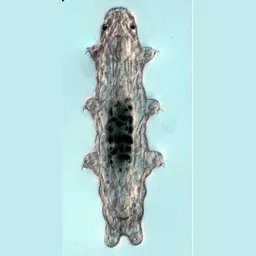
Hypsibius convergens is a tardigrade in the genus Hypsibius (Hypsibiidae, Parachela), described by Urbanowicz in 1925. The parentheses around the authority mean it was first described in another genus.
Where it has been recorded
What we have read about it
Facts we extracted from the literature into our knowledge graph, each with the source and page it came from.
- Hypsibius convergens reared from eggs first moulted 3–6 days after hatching, a second time at about 9 days and a third at about 17 days (Baumann 1961); well-fed females laid eggs after the second moult. H. oberhaeuseri moults first within four days of hatching and likewise lays early (Baumann 1966).Ramazzotti & Maucci 1983. Il Phylum Tardigrada, 3rd edition (English translation by C. W. Beasley, 1995: The Phylum Tardigrada). Memorie dell'Istituto Italiano di Idrobiologia 41; translation published by the translator, McMurry University, Abilene, Texas. pp. 76–77 (PDF pp. 76–77): "Baumann (1961) observed that specimens of H. convergens which had hatched out of their eggs during rearing had their first molt after three to six days, their second after about nine days, and their third after about 17 days."
- Egg development time: minimum five days in Hypsibius convergens at 18 °C (mean of 100 eggs from 10 exuviae; Marcus 1929); maximum about 30–40 days for eggs of several Macrobiotus species and Hypsibius oberhaeuseri; Milnesium tardigradum 7–12 days at an unstable temperature (Baumann 1964); H. oberhaeuseri 8–20 days (Baumann 1966). Development time varies within a species even at constant temperature.Ramazzotti & Maucci 1983. Il Phylum Tardigrada, 3rd edition (English translation by C. W. Beasley, 1995: The Phylum Tardigrada). Memorie dell'Istituto Italiano di Idrobiologia 41; translation published by the translator, McMurry University, Abilene, Texas. pp. 69–70 (PDF pp. 69–70): "the minimum development time, observed in tardigrades, reared at a temperature of 18°C, was five days for Hypsibius convergens (average time for 100 eggs taken from 10 old cuticles (Marcus, 1929), whereas the maximum was about 30 to 40 days for eggs from several species of Macrobiotus and Hypsibius oberhaeuseri"
- Ammermann raised Hypsibius dujardini for more than six years (to 1967) at 21–23 °C on sessile Chlorococcales algae (probably Chlorella) in a dilute soil decoction (after Hämmerling); it reproduced by obligatory parthenogenesis and males never appeared. The authors found this surprising because natural H. dujardini populations include males. Parthenogenesis was also shown in Milnesium tardigradum (Baumann 1964) and Dactylobiotus dispar (Ammermann, unpublished), and excluded in H. convergens (Baumann 1961).Ramazzotti & Maucci 1983. Il Phylum Tardigrada, 3rd edition (English translation by C. W. Beasley, 1995: The Phylum Tardigrada). Memorie dell'Istituto Italiano di Idrobiologia 41; translation published by the translator, McMurry University, Abilene, Texas. pp. 67–68 (PDF pp. 67–68): "Ammermann observed that H. dujardini, in culture conditions, presents obligatory parthenogenesis: males never appeared (the culture lasted six years, when these results were given in 1967)."
- Species can be classed by habitat wetness: xerophilous (dry mosses IV–V: most Echiniscus including E. testudo, Adorybiotus coronifer, Macrobiotus islandicus, Hypsibius oberhaeuseri, Milnesium tardigradum); eurytopic (all categories: Macrobiotus areolatus, M. hufelandi, M. richtersi, M. harmsworthi and others); hygrophilous (moist mosses II–III: Hypsibius dujardini, H. convergens, most Diphascon); hydrophilous (wet mosses and water: all Dactylobiotus and Pseudobiotus). Physiological races of one species may occupy different habitats. About 80% of known species and varieties are found in moss.Ramazzotti & Maucci 1983. Il Phylum Tardigrada, 3rd edition (English translation by C. W. Beasley, 1995: The Phylum Tardigrada). Memorie dell'Istituto Italiano di Idrobiologia 41; translation published by the translator, McMurry University, Abilene, Texas. pp. 109–111 (PDF pp. 109–111): "Hygrophilous species: - Macrobiotus hibernicus, M. intermedius. - Hypsibius pallidus, H. convergens, H. microps, H. dujardini."
- Long-term cultures by 1983: Baumann (1961) kept Hypsibius convergens for months in small crucibles on Chlorella pyrenoidosa, which grows as a carpet on the bottom; Baumann (1964) kept Milnesium tardigradum for three months in Petri dishes with Kolkwitz plant nutrient solution 1 cm deep, C. pyrenoidosa, a 4 mm³ piece of Brassica rapa, rotifers as extra food and enough bacteria; Ammermann raised H. dujardini for over six years on sessile Chlorococcales in dilute soil decoction; Higgins cultured eutardigrades on nematodes. Echiniscidae had never been cultured; the authors suggest lichen pieces in outdoor crucibles with simulated wet–dry cycles, which kept Echiniscus alive longer than bell jars.Ramazzotti & Maucci 1983. Il Phylum Tardigrada, 3rd edition (English translation by C. W. Beasley, 1995: The Phylum Tardigrada). Memorie dell'Istituto Italiano di Idrobiologia 41; translation published by the translator, McMurry University, Abilene, Texas. pp. 137–138 (PDF pp. 137–138): "Baumann, again (1964), was able to culture Milnesium tardigradum for three months, using a culture medium, in petri dishes, composed of the following: a plant nutrient solution (as prescribed by Kolkwitz) 1 cm deep, Chlorella pyrenoidosa, a small piece (4mm3) of Brassica rapa, rotifers as a supplementary food"
- Active life span was estimated at 18–30 months for Macrobiotus harmsworthi and Hypsibius convergens (Marcus 1929, 1936); for some freshwater Macrobiotus and Hypsibius 12–24 months (Pollock proposed 3–4 months from Franceschi and co-workers’ 1962–63 data); the authors stress that all life-span estimates are theoretical and unreliable.Ramazzotti & Maucci 1983. Il Phylum Tardigrada, 3rd edition (English translation by C. W. Beasley, 1995: The Phylum Tardigrada). Memorie dell'Istituto Italiano di Idrobiologia 41; translation published by the translator, McMurry University, Abilene, Texas. pp. 78–80 (PDF pp. 78–80): "Marcus (1929 and 1936) reached the conclusion that active life (in M. harmsworthi and H. convergens) ranges over 18 to 30 months"
- Phototaxis results conflicted: positive in Hypsibius dujardini (von Erlanger 1895); positive in diffuse and negative in intense light in Pseudobiotus augusti (von Wenck 1914); indifferent in others; distinct, nearly immediate negative phototaxis in Dactylobiotus dispar (Marcus 1928). Newly hatched H. convergens are positively phototactic, which is lost after the second moult (Baumann 1961). Interstitial Batillipes show thigmotaxis among sand grains and rheotaxis to strong water movement.Ramazzotti & Maucci 1983. Il Phylum Tardigrada, 3rd edition (English translation by C. W. Beasley, 1995: The Phylum Tardigrada). Memorie dell'Istituto Italiano di Idrobiologia 41; translation published by the translator, McMurry University, Abilene, Texas. p. 63 (PDF p. 63): "in certain cases tardigrades have shown positive phototropism (Von Erlanger, 1895, for Hypsibius dujardini) in others it was positive under diffuse lighting and negative under intense lighting (Von Wenck, 1914, for Pseudobiotus augusti)"
Papers
10 works in our corpus of 5,137 tardigrade papers name it in the title or abstract (0 in the title), from 2007. This is by exact name match, so it misses papers that use an older name or only the genus.
- New records of Tardigrada from Bulgaria with the description of Macrobiotus binieki sp. nov. (Eutardigrada: Macrobiotidae) and a key to the species of the harmsworthi group (2011, Zootaxa) doi
- Horizontal distribution of moisture and Tardigrada in a single moss cushion (2011, Journal of Zoological Systematics & Evolutionary Research) doi
- Tardigrades from Nahuel Huapi National Park (Argentina, South America) with descriptions of two new Macrobiotidae species (2016, Zootaxa) doi
- New tardigrade records for the Baltic states with a description of Minibiotus formosus sp. n. (Eutardigrada, Macrobiotidae) (2014, ZooKeys) doi
- The Tardigrada of Southern Africa, with the Description ofMinibiotus harrylewisi, a New Species from KwaZulu-Natal, South Africa (Eutardigrada: Macrobiotidae) (2009, African Invertebrates) doi
- Energy allocation in two species of Eutardigrada (2007, Journal of Limnology) doi
Classification
| class | Eutardigrada |
|---|---|
| order | Parachela |
| superfamily | Hypsibioidea |
| family | Hypsibiidae |
| subfamily | Hypsibiinae |
| genus | Hypsibius |
Other species of Hypsibius: H. allisoni, H. antonovae, H. choucoutiensis, H. conwentzii, H. dujardini, H. exemplaris, H. fuhrmanni, H. giusepperamazzotti, H. henanensis, H. hypostomus, H. iskandarovi, H. kunmingensis, H. maculatus, H. marcelli, H. microps, H. montanus, H. morikawai, H. multituberculatus, H. murrayi, H. nivalis, H. novaezeelandiae, H. pachyunguis, H. pallidus, H. pedrottii, H. pradellii, H. repentinus, H. septulatus, H. seychellensis, H. shaanxiensis, H. valentinae, H. vaskelae.
Look it up
GBIF · NCBI Taxonomy · GenBank sequences · iNaturalist · Google Scholar
Classification, authority and notes: Degma & Guidetti 2026, Actual checklist of Tardigrada species, 45th edition (CC BY 4.0), which asks users also to cite Guidetti & Bertolani 2005 (Zootaxa 845: 1–46) and Degma & Guidetti 2007 (Zootaxa 1579: 41–53).
Records: GBIF.org, accessed 2026-09-20 through the GBIF API; each record belongs to the dataset that published it. The map shows only records released under CC0 or CC BY, with coordinates and no geospatial issue flag.
Papers: our corpus of tardigrade literature from OpenAlex.
How this is built
- Data
- Classification, authority and notes from Degma & Guidetti's 2026 world checklist. Records from GBIF, genomes and sequencing runs from NCBI, papers from our OpenAlex corpus of tardigrade literature, photos from Wikimedia Commons and iNaturalist (CC0 or CC BY), and facts from our knowledge graph, each with its source and page. A page shows only the parts we hold for that species.
- Built with
build_species.pywrites every species page from the checklist, joining each name by exact match to the other collections. Facts are ranked by confidence and evidence, and taken from each source in turn so no single paper fills the list. The records map is drawn as SVG from thinned GBIF coordinates.- Checked
- Only exact matches to accepted names bring in GBIF records, and fossil entries were read against their papers. The pages themselves are not tested against data.
- Limits
- Exact name matching misses papers and sequences filed under older names or only the genus. GBIF identifications are as their publishers made them. A short page means we hold little yet, not that little is known.
- More
- How the whole project is built