Ramazzottius varieornatus
Ramazzottius varieornatus is a tardigrade in the genus Ramazzottius (Ramazzottiidae, Parachela), described by Bertolani & Kinchin in 1993.
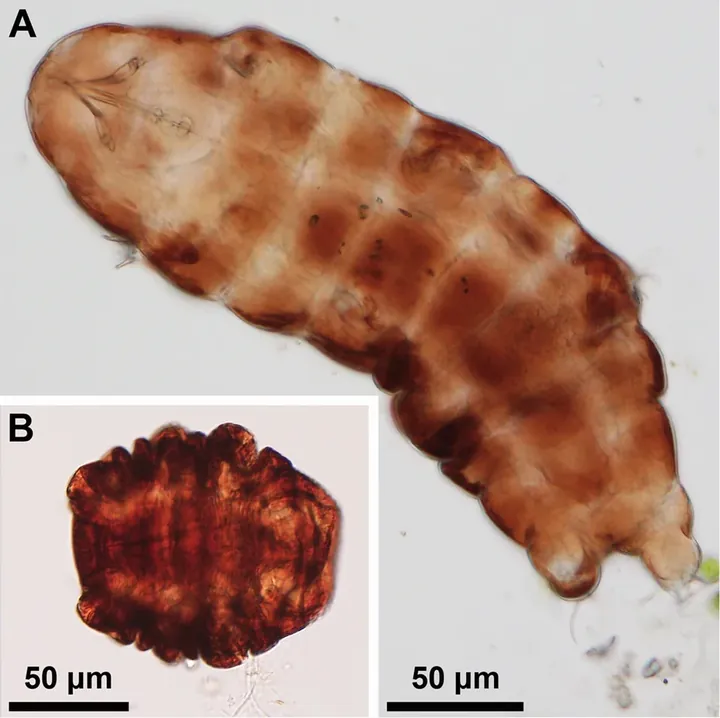

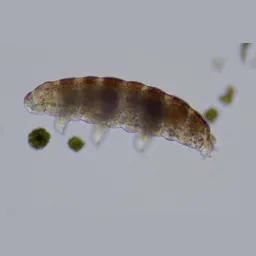
Where it has been recorded
What we have read about it
Facts we extracted from the literature into our knowledge graph, each with the source and page it came from.
- H. exemplaris and R. varieornatus each have three extradenticle paralogues (PBC domain plus homeodomain), from duplications in a common tardigrade ancestor, and single orthologues of homothorax, Distal-less and aristaless. He-AL has a homeodomain but no OAR domain; Rv-AL has one.Game & Smith 2020. Loss of intermediate regions of perpendicular body axes contributed to miniaturization of tardigrades. Proceedings. Biological sciences. p. 2–3 (Results a); Fig. 1; Fig. S1
- RNA-seq of storage cells released by dissection (GSE212632) shows SAHS transcripts 5–20× more abundant than in the whole body, about the ratio of storage-cell number to body. In H. exemplaris without preconditioning, 6 of 10 SAHS paralogues exceed 1,000 TPM, while 11 of 12 CAHS paralogues are induced at least twofold by preconditioning.Tanaka, Aoki & Arakawa 2023. In vivo expression vector derived from anhydrobiotic tardigrade genome enables live imaging in Eutardigrada. PNAS 120:e2216739120 p. 3–4; Fig. 2C, F; Methods, RNA Sequencing
- H. exemplaris has two Sp6-9 paralogues (He-Sp6-9A, proteins OQV18298/OQV18299, two isoforms; He-Sp6-9B, OQV18301), one Sp1-4 candidate and no Sp5. R. varieornatus and P. metropolitanus each have one Sp6-9, P. metropolitanus two Sp1-4 paralogues (a lineage-specific duplication), and none of the three tardigrades has Sp5, so Sp5 was lost in the tardigrade lineage.Game & Smith 2025. An Sp6-9 ortholog is expressed in developing legs in the tardigrade Hypsibius exemplaris. Arthropod structure & development. p. 3 (Results 3.1); p. 7 (Discussion 4.1); Fig. 1; Table S1
- H. exemplaris has a single pdf receptor gene, He-pdfr: 10,107 bp on the reverse strand of scaffold0129 (MTYJ01000129.1), with 13 exons and 12 introns. Cloning found two transcribed splice variants, He-pdfr-A (1581 bp) and He-pdfr-B (1557 bp); He-PDFR-B is eight amino acids shorter in the C-terminal region because of an alternative 3' acceptor site within the last exon. The orthologue of Ramazzottius varieornatus is shorter (5341 bp, 12 exons) with a transcript of comparable length.Dutta et al. 2025. Pigment-dispersing factor neuropeptides act as multifunctional hormones and modulators in tardigrades. Open biology. Open Biology 15:240242 section 2.2, p4; figure 2c; electronic supplementary material data S1
- Unstained H. exemplaris autofluoresce in the claws, stylets and midgut (birefringent granules and ingested algae) at 404, 488 and 561 nm excitation; R. varieornatus also in the cuticle at 561 nm. Starving animals before imaging reduces midgut autofluorescence.Harry et al. 2024. Protocol for fluorescent live-cell staining of tardigrades. STAR protocols. pp. 7–8 Fig. 4; p. 12 Limitations; p. 13–15 Troubleshooting 1; Fig. 11
- Genome sizes: 104 Mb for H. exemplaris, 75 Mb for M. tardigradum and 56 Mb for R. varieornatus.Goldstein 2018. The Emergence of the Tardigrade Hypsibius exemplaris as a Model System. Cold Spring Harbor protocols. p862, Related Species (citing Yoshida et al. 2017; Bemm et al. 2017)
- Desiccated Ramazzottius varieornatus tuns: 50% mortality at 82.7 °C for a 1 h exposure and 63.1 °C for 24 h.Neves et al. 2020. Thermotolerance experiments on active and desiccated states of Ramazzottius varieornatus emphasize that tardigrades are sensitive to high temperatures. Scientific Reports 10:94. abstract; Table 1
- Table 8.2 row for Ramazzottius varieornatus at 25 °C: life span 35.0 ± 16.4 days, maximum 87 days, first oviposition at 9 days, 7.85 eggs per animal, hatching success 82.5%, hatching time 5.7 ± 1.1 days, parthenogenetic.Altiero T, Suzuki AC, Rebecchi L 2018. Reproduction, Development and Life Cycles. In: Schill RO (ed.) Water Bears: The Biology of Tardigrades. Zoological Monographs 2, pp. 211–248 p. 239, Table 8.2 (ref. 13 = Horikawa et al. 2008)
- In H. exemplaris every Wnt gene lies on a different scaffold (scaffolds 95,696–1,074,739 nt long); in R. varieornatus only Wnt9 and WntA share a scaffold, 829,930 nt apart. The authors read this as dispersal of an ancestral cluster.Chavarria et al. 2021. Extensive loss of Wnt genes in Tardigrada. BMC ecology and evolution. p. 3; Table 1 (scaffold numbers); p. 9 (dispersal interpretation)
- UniProt's automatic annotation already names three of these proteins 'Condensin-2 complex subunit H2 C-terminal domain-containing protein' (A0A9X6NG78 and A0A9X6RKL3 for H. exemplaris OWA52468.1 and OWA51095.1, A0A1D1VD77 for R. varieornatus GAU96458.1); GAU88883.1 (A0A1D1UR96) is 'Uncharacterized protein'. Checked 18 September 2026.Protein FASTA for the nHd_3.1 annotation; 20,853 sequences (OQV... protein accessions, headers carry BV898 locus tags). UniProt REST query xref:embl-OWA52468 / OWA51095 / GAU96458 / GAU88883, protein_name field, 18 September 2026
- Proven diets by genus: algae for Diphascon, Isohypsibius, Acutuncus, Ramazzottius, Thulinius and Dactylobiotus; rotifers and/or nematodes for Milnesium adults with algae for juveniles; rotifers and algae for Hypsibius and Mesobiotus; nematodes and algae or rotifers and algae for Macrobiotus; nematodes, rotifers and algae for Paramacrobiotus.Degma P 2018. Field and Laboratory Methods. In: Schill RO (ed.) Water Bears: The Biology of Tardigrades. Zoological Monographs 2, pp. 349–370 pp. 355–356, §14.3
- Evo 2's training data lists five tardigrade nuclear assemblies from NCBI: H. dujardini GCA_001579985.1 (strain Sciento, 182 Mb), R. varieornatus Rvar_4.0, P. metropolitanus GCF_019649055.1, P. richtersi GCA_034698045.1 and I. dastychi GCA_034696485.1; and three tardigrade mitochondrial genomes (H. dujardini, Thulinius sp., R. varieornatus). The card does not say how much of each genome was sampled: eukaryotic data went in as mRNAs, stitched 5 kb windows and, in the long-context phase, tagged whole genomes.OpenGenome2, the training data of Evo 2 (Arc Institute): dataset card and species_metadata.csv species_metadata.csv rows with phylum Tardigrada; dataset card, Data Sources and Training Data Composition
- van Hooff et al. 2025's phylogenetic profiles list Ramazzottius varieornatus with a complete condensin II: CAPH2 = 2 copies (RAMVAR009369, RAMVAR001794), CAPG2 = 1, CAPD3 = 3, alongside SMC2 = 1, SMC4 = 3 and condensin I complete. H. exemplaris and Paramacrobiotus are not in their species set, and the text does not discuss tardigrades or Hoencamp et al.'s tardigrade call. Their two CAPH2 proteins are our GAU96458.1 and GAU88883.1: the sequences in their proteins/CAPH2/euk5_orths4.CAPH2.fa are identical to ours (702 and 617 aa), from the same proteome (GCA_001949185.1).van et al. 2025. Repeated duplications and losses shaped SMC complex evolution from archaeal ancestors to modern eukaryotes. Cell reports. GitHub jolienvanhooff/SMCevolution (commit 106af48): phylogenetic_profiles/phylogenetic_profiles.csv row RAMVAR; proteins/CAPH2/euk5_orths4.CAPH2.fa (sequences compared to ours 19 September 2026)
- In a maximum-likelihood tree of 906 metazoan opsins, He-r-opsin-v falls in a clade sister to the visual r-opsin of Ramazzottius varieornatus, confirming it as the visual photopigment. The expanded He-r-opsin-nv lineage forms a sister group to the eutardigrade visual r-opsin clade and clusters with the onychophoran visual opsins (onychopsin clade), splitting into two well-supported subclades (nv-a, nv-b). He-neuropsin paralogues likewise form two subclades (a, b) within broad protostome and deuterostome neuropsin/opsin-5 sequences, and the three c-opsins form a tardigrade-specific group inside panarthropod canonical c-opsins.Dutta et al. 2026. Extensive opsin gene expansion and non-cerebral origin of the minimalist eye in a model tardigrade. bioRxiv. bioRxiv p4, lines 117-131; Fig. 1 (p24 caption, lines 769-777); Fig. 2a; Supplementary Fig. 1
- For desiccated Ramazzottius varieornatus the 50% mortality temperature falls from 63 °C (24 h) to 56 °C (1 week).Neves et al. 2020. New insights into the limited thermotolerance of anhydrobiotic tardigrades. Communicative & Integrative Biology 13:140–146. abstract
- No nanos homolog was found in published H. exemplaris genomes or transcriptomes, nor in Ramazzottius varieornatus.Heikes et al. 2023. The embryonic origin of primordial germ cells in the tardigrade Hypsibius exemplaris. Developmental biology. p44 §2.2; p50–51 Discussion
Showing 16 of 38, taking the best-supported facts from each source in turn.
Open questions
- Were Wnt1, Wnt6, Wnt7, Wnt8 and Wnt10 lost in the ancestor of all tardigrades or only within the lineage leading to H. exemplaris and R. varieornatus?Posed by Chavarria et al. 2021. Extensive loss of Wnt genes in Tardigrada. BMC ecology and evolution. p. 9: "whether these genes were lost in an ancestor of all tardigrades, or within crown group Tardigrada is unclear"
- Has long-term laboratory culture changed H. exemplaris behaviour, such as the locomotor differences seen against Ramazzottius?Posed by Anderson et al. 2024. Comparative analysis of tardigrade locomotion across life stage, species, and disulfiram treatment. PloS one. p. 20: "The differences between H. exemplaris and Ramazzottius could potentially arise from effects of long-term culturing in the lab; further work will be required to investigate this possibility."
- Why did unedited G0 siblings of DIPA-CRISPR-injected R. varieornatus mothers show the same growth retardation as frameshift mutants?Posed by Kondo et al. 2024. Single-step generation of homozygous knockout/knock-in individuals in an extremotolerant parthenogenetic tardigrade using DIPA-CRISPR. PLoS genetics. p. 13: "It remains unclear why the unedited siblings exhibited similar growth retardation."
- Do Dsup proteins of other eutardigrades, including H. exemplaris, protect DNA in vivo as R. varieornatus Dsup does, and what do heterotardigrades without Dsup use instead?Posed by Clark-Hachtel et al. 2024. The tardigrade Hypsibius exemplaris dramatically upregulates DNA repair pathway genes in response to ionizing radiation. Current biology : CB. pp. 1819, 1826: "it is unclear whether other eutardigrade species’ Dsup proteins have the same protective abilities" … "even within those lineages it is unclear to what extent Dsup plays a role in IR"
- In which tissues are the CAHS paralogues and other tardigrade-specific protectants expressed during anhydrobiosis, and do CAHS subfamilies have different roles?Posed by Tanaka, Aoki & Arakawa 2023. In vivo expression vector derived from anhydrobiotic tardigrade genome enables live imaging in Eutardigrada. PNAS 120:e2216739120 pp. 1, 7: "little is known about the actual tissue specificity or the actual workings of these tardigrade-specific IUPs within tardigrades during anhydrobiosis" … "future studies should analyze in more detail the differences in CAHS subfamilies and their tissue specificity"
- Which of the several dicer genes of tardigrades act in development, RNAi and antiviral defence, and how does their expression vary across species?Posed by Weinberg et al. 2025. Lineage-specific expansions of the Dicer gene family in tardigrades. BMC genomics. p. 12: "it is unclear which dicers may also be involved in antiviral defense" … "it is unclear how expression may vary across the other tardigrade species we investigated" … "Future research could focus on characterizing tardigrade small RNAs across various"
Genomes and sequencing
Genome assemblies
| Accession | Name | Level | Released | Scaffold N50 (bp) |
|---|---|---|---|---|
| GCA_001949185.1 | Rvar_4.0 | Scaffold | 2017-01-12 | 4,740,345 |
Mitochondrial genomes
- NC_031407.1, 14,428 bp: Ramazzottius varieornatus mitochondrial DNA, complete genome, strain: YOKOZUNA-1
- AP017609.1, 14,428 bp: Ramazzottius varieornatus mitochondrial DNA, complete genome, strain: YOKOZUNA-1
Raw sequencing data
187 runs (342.1 Gb) in 12 projects: 155 RNA-Seq, 15 WGA, 9 WGS, 8 AMPLICON. Browse them in the SRA.
Papers
94 works in our corpus of 5,137 tardigrade papers name it in the title or abstract (27 in the title), from 1993. This is by exact name match, so it misses papers that use an older name or only the genus.
- Comparative genomics of the tardigrades Hypsibius dujardini and Ramazzottius varieornatus (2017, PLoS Biology) doi
- Establishment of a Rearing System of the Extremotolerant Tardigrade Ramazzottius varieornatus : A New Model Animal for Astrobiology (2008, Astrobiology) doi
- Analysis of DNA Repair and Protection in the Tardigrade Ramazzottius varieornatus and Hypsibius dujardini after Exposure to UVC Radiation (2013, PLoS ONE) doi
- Thermotolerance experiments on active and desiccated states of Ramazzottius varieornatus emphasize that tardigrades are sensitive to high temperatures (2020, Scientific Reports) doi
- Tolerance of Anhydrobiotic Eggs of the Tardigrade Ramazzottius varieornatus to Extreme Environments (2012, Astrobiology) doi
- Structural insights into a secretory abundant heat‐soluble protein from an anhydrobiotic tardigrade,Ramazzottius varieornatus (2017, FEBS Letters) doi
Classification
| class | Eutardigrada |
|---|---|
| order | Parachela |
| superfamily | Hypsibioidea |
| family | Ramazzottiidae |
| genus | Ramazzottius |
Other species of Ramazzottius: R. affinis, R. agannae, R. andreevi, R. anomalus, R. baumanni, R. belubellus, R. bunikowskae, R. caucasicus, R. claudii, R. conifer, R. edmondabouti, R. groenlandensis, R. horningi, R. kretschmanni, R. libycus, R. littoreus, R. montivagus, R. nivalis, R. novemcinctus, R. oberhaeuseri, R. rupeus, R. sabatiniae, R. saltensis, R. semisculptus, R. subanomalus, R. suzithuae, R. syraxi, R. szeptycki, R. theroni, R. thulini, R. tribulosus, R. valaamis.
Look it up
GBIF · NCBI Taxonomy · GenBank sequences · iNaturalist · Google Scholar
Classification, authority and notes: Degma & Guidetti 2026, Actual checklist of Tardigrada species, 45th edition (CC BY 4.0), which asks users also to cite Guidetti & Bertolani 2005 (Zootaxa 845: 1–46) and Degma & Guidetti 2007 (Zootaxa 1579: 41–53).
Records: GBIF.org, accessed 2026-09-20 through the GBIF API; each record belongs to the dataset that published it. The map shows only records released under CC0 or CC BY, with coordinates and no geospatial issue flag.
Sequence data: NCBI Assembly, Nucleotide and SRA, searched September 2026.
Papers: our corpus of tardigrade literature from OpenAlex.
How this is built
- Data
- Classification, authority and notes from Degma & Guidetti's 2026 world checklist. Records from GBIF, genomes and sequencing runs from NCBI, papers from our OpenAlex corpus of tardigrade literature, photos from Wikimedia Commons and iNaturalist (CC0 or CC BY), and facts from our knowledge graph, each with its source and page. A page shows only the parts we hold for that species.
- Built with
build_species.pywrites every species page from the checklist, joining each name by exact match to the other collections. Facts are ranked by confidence and evidence, and taken from each source in turn so no single paper fills the list. The records map is drawn as SVG from thinned GBIF coordinates.- Checked
- Only exact matches to accepted names bring in GBIF records, and fossil entries were read against their papers. The pages themselves are not tested against data.
- Limits
- Exact name matching misses papers and sequences filed under older names or only the genus. GBIF identifications are as their publishers made them. A short page means we hold little yet, not that little is known.
- More
- How the whole project is built