Ramazzottius oberhaeuseri
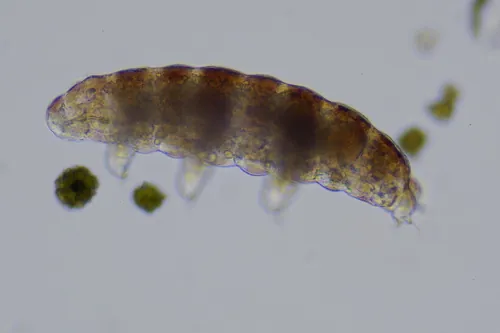
Ramazzottius oberhaeuseri is a tardigrade in the genus Ramazzottius (Ramazzottiidae, Parachela), described by Doyère in 1840. The parentheses around the authority mean it was first described in another genus.
Where it has been recorded
What we have read about it
Facts we extracted from the literature into our knowledge graph, each with the source and page it came from.
- Hypsibius oberhaeuseri (mean of 10, Marcus 1929) measured 290 µm long, 90 µm wide and 75 µm thick when active, and 90 × 80 × 40 µm as a tun.Ramazzotti & Maucci 1983. Il Phylum Tardigrada, 3rd edition (English translation by C. W. Beasley, 1995: The Phylum Tardigrada). Memorie dell'Istituto Italiano di Idrobiologia 41; translation published by the translator, McMurry University, Abilene, Texas. p. 84 (PDF p. 84): "during active life its length was 290µ, its width 90µ and its thickness (dorsoventral 75µ; the "barrel" shrinks to a length of 90µ, a width of 80µ and a thickness of 40µ"
- Fine longitudinal muscles run along the intestine: eight in M. tardigradum and Hypsibius sp., 13 in R. oberhaeuseri.Schmidt-Rhaesa & Kulessa 2007. Muscular architecture of Milnesium tardigradum and Hypsibius sp. (Eutardigrada, Tardigrada) with some data on Ramazottius oberhaeuseri. Zoomorphology. p. 278, 'Visceral musculature'; Fig. 8d–e
- Body cavity cells (coelomocytes, storage cells) float freely or attach to basement membranes in eutardigrades and echiniscoideans; they accumulate polysaccharides, proteins and lipids, decline in number with starvation, divide by mitosis and may phagocytose bacteria. Ramazzottius has about 200 (Kinchin 1994).Møbjerg et al. 2018. Morphology and Functional Anatomy. Zoological Monographs / Water Bears: The Biology of Tardigrades. p. 76, 2.4 Body cavity
- Dry eggs: 4 of 13 Richtersius (Ramazzottius) oberhaeuseri eggs hatched after 9 years (Bertolani et al. 2004); R. oberhaeuseri and Milnesium tardigradum eggs hatched after 1604 days (Rebecchi et al. 2006).Schill RO, Hengherr S 2018. Environmental Adaptations: Desiccation Tolerance. In: Schill RO (ed.) Water Bears: The Biology of Tardigrades. Zoological Monographs 2, pp. 273–294 p. 276 (PDF p. 279), section 10.2.3
- Rahm (1921) reported that dried Milnesium tardigradum and Ramazzottius oberhaeuseri survived 110–151 °C. The reviews that repeat it disagree on the exposure: "for up to 35 min" (Sadowska-Bartosz & Bartosz 2024), "for 30 min" (Neves et al. 2020), "about 150 °C (up to 15 min)" citing Rahm 1923–1926 (Erdmann & Kaczmarek 2017).Sadowska-Bartosz & Bartosz 2024. Antioxidant defense in the toughest animals on the Earth: its contribution to the extreme resistance of tardigrades. International Journal of Molecular Sciences 25:8393. section 3 (tolerance to temperature): "could survive at 110–151 °C for up to 35 min" [ref. 44, Rahm 1921]; Neves et al. 2020. Thermotolerance experiments on active and desiccated states of Ramazzottius varieornatus emphasize that tardigrades are sensitive to high temperatures. Scientific Reports 10:94. Introduction: "110–151 °C for 30 min" [ref. 35]
- Active walking disperses animals only short distances in wet conditions: Ramazzotti watched tardigrades crossing bark between moss patches in rain and measured speeds of about 12.6 cm/h for Hypsibius oberhaeuseri and 17.7 cm/h for Macrobiotus hufelandi on an agar film giving the claws good grip.Ramazzotti & Maucci 1983. Il Phylum Tardigrada, 3rd edition (English translation by C. W. Beasley, 1995: The Phylum Tardigrada). Memorie dell'Istituto Italiano di Idrobiologia 41; translation published by the translator, McMurry University, Abilene, Texas. pp. 119–120 (PDF pp. 119–120): "the speed with which they progress is about 12.6 cm/hr for Hypsibius oberhaeuseri and 17.7 cm/hr for M. hufelandi"
- In Milnesium tardigradum, Hypsibius sp. and Ramazzottius oberhaeuseri the somatic musculature consists of isolated muscle strands in dorsal, ventral, dorsoventral, ventrolateral/lateral and appendage groups; the visceral musculature comprises stylet, pharyngeal and intestinal muscles.Schmidt-Rhaesa & Kulessa 2007. Muscular architecture of Milnesium tardigradum and Hypsibius sp. (Eutardigrada, Tardigrada) with some data on Ramazottius oberhaeuseri. Zoomorphology. p. 265 Abstract; p. 267 Results, first paragraph
- Internal organs (gonad and ducts, Malpighian tubules, hindgut) are suspended by ligaments and muscles attached to the integument. Eutardigrades have fine, radially arranged longitudinal gut muscles running from the oesophagus–midgut junction to the hindgut region, anchored by attachment plaques to the gut epithelium; these seem absent in heterotardigrades. Reported numbers: six in Halobiotus crispae, eight in Milnesium tardigradum and Hypsibius sp., 13 in Ramazzottius oberhaeuseri.Møbjerg et al. 2018. Morphology and Functional Anatomy. Zoological Monographs / Water Bears: The Biology of Tardigrades. p. 83, 2.6.2 'Visceral musculature'
- In 1983 Macrobiotus hufelandi, Hypsibius oberhaeuseri and Milnesium tardigradum were regarded as cosmopolitan, recorded from the Arctic to the Antarctic, while other species were known from few or single localities; data were judged too scarce for sound biogeography.Ramazzotti & Maucci 1983. Il Phylum Tardigrada, 3rd edition (English translation by C. W. Beasley, 1995: The Phylum Tardigrada). Memorie dell'Istituto Italiano di Idrobiologia 41; translation published by the translator, McMurry University, Abilene, Texas. pp. 18–19 (PDF pp. 18–19): "Various species are cosmopolitan, for example Macrobiotus hufelandi, Hypsibius oberhaeuseri, Milnesium tardigradum, etc., which have been observed almost everywhere, from the Arctic to the Antarctic"
- Hypsibius convergens reared from eggs first moulted 3–6 days after hatching, a second time at about 9 days and a third at about 17 days (Baumann 1961); well-fed females laid eggs after the second moult. H. oberhaeuseri moults first within four days of hatching and likewise lays early (Baumann 1966).Ramazzotti & Maucci 1983. Il Phylum Tardigrada, 3rd edition (English translation by C. W. Beasley, 1995: The Phylum Tardigrada). Memorie dell'Istituto Italiano di Idrobiologia 41; translation published by the translator, McMurry University, Abilene, Texas. pp. 76–77 (PDF pp. 76–77): "Baumann (1961) observed that specimens of H. convergens which had hatched out of their eggs during rearing had their first molt after three to six days, their second after about nine days, and their third after about 17 days."
- In captive Macrobiotus hufelandi, Dactylobiotus dispar and Hypsibius oberhaeuseri (Marcus 1929): buccal parts expelled about 6 days before ecdysis; no buccal apparatus for 1–3 days; rebuilding 2–4 days; then 0–2 days to moult; shedding the old cuticle 0–3 days. In total 3–9 days plus 0–3 for shedding, which is probably quicker in nature, where the animal can anchor the old cuticle.Ramazzotti & Maucci 1983. Il Phylum Tardigrada, 3rd edition (English translation by C. W. Beasley, 1995: The Phylum Tardigrada). Memorie dell'Istituto Italiano di Idrobiologia 41; translation published by the translator, McMurry University, Abilene, Texas. p. 76 (PDF p. 76): "Expulsion of the buccal parts: about 6 days before molting. --Period of absence of buccal parts: from 1 to 3 days. --Duration of the reconstruction of the buccal apparatus: from 2 to 4 days. --Period following, up to molting: from 0 to 2 days. --Time needed to shed the old cuticle: 0 to 3 days."
- Egg development time: minimum five days in Hypsibius convergens at 18 °C (mean of 100 eggs from 10 exuviae; Marcus 1929); maximum about 30–40 days for eggs of several Macrobiotus species and Hypsibius oberhaeuseri; Milnesium tardigradum 7–12 days at an unstable temperature (Baumann 1964); H. oberhaeuseri 8–20 days (Baumann 1966). Development time varies within a species even at constant temperature.Ramazzotti & Maucci 1983. Il Phylum Tardigrada, 3rd edition (English translation by C. W. Beasley, 1995: The Phylum Tardigrada). Memorie dell'Istituto Italiano di Idrobiologia 41; translation published by the translator, McMurry University, Abilene, Texas. pp. 69–70 (PDF pp. 69–70): "the minimum development time, observed in tardigrades, reared at a temperature of 18°C, was five days for Hypsibius convergens (average time for 100 eggs taken from 10 old cuticles (Marcus, 1929), whereas the maximum was about 30 to 40 days for eggs from several species of Macrobiotus and Hypsibius oberhaeuseri"
- Apparent colour has three sources: gut contents (yellow, green, brown, blackish, rarely blue; blue seen by Marcus in the gut or gut cells of Hypsibius dujardini among others); carotenoid granules in body cavity cells or free in the body fluid (yellow-orange Macrobiotus, red Echiniscidae); and epidermal or cuticular pigment (brown stripes of Hypsibius oberhaeuseri, pink/yellow/brown Milnesium tardigradum), which turns bright purple in dilute KOH.Ramazzotti & Maucci 1983. Il Phylum Tardigrada, 3rd edition (English translation by C. W. Beasley, 1995: The Phylum Tardigrada). Memorie dell'Istituto Italiano di Idrobiologia 41; translation published by the translator, McMurry University, Abilene, Texas. pp. 25–26 (PDF pp. 25–26): "As far as the tardigrade’s apparent coloring is concerned, one must keep in mind that it can have different sources"
- Parthenogenetic and bisexual "biotypes", possibly sibling species distinguished by reproduction and karyotype, can coexist in one habitat (Bertolani): Macrobiotus hufelandi and M. richtersi have diploid bisexual (2n = 12) and triploid parthenogenetic (3n = 18) biotypes; Hypsibius oberhaeuseri has a diploid bisexual (2n = 12), a triploid (3n = 18) and a tetraploid (4n = 24) parthenogenetic biotype; Hypsibius dujardini (2n = 10) and Dactylobiotus dispar (2n = 10) are diploid parthenogens.Ramazzotti & Maucci 1983. Il Phylum Tardigrada, 3rd edition (English translation by C. W. Beasley, 1995: The Phylum Tardigrada). Memorie dell'Istituto Italiano di Idrobiologia 41; translation published by the translator, McMurry University, Abilene, Texas. p. 68 (PDF p. 68): "In Hypsibius oberhaeuseri there are three biotypes, one diploid bisexual (2n= 12) and two parthenogenetic, one triploid (3n= 18), the other tetraploid (4n=24)."
- The number of moults in a lifetime was unsettled: about six in many species by some authors; about twelve for M. hufelandi, D. dispar and H. oberhaeuseri (Marcus 1929) and for M. hufelandi (Franceschi-Crippa & Lattes 1967); seven for about 800 Macrobiotus islandicus in Colorado from size-frequency (Higgins 1959); Ramazzotti’s measurements of over 1,000 M. areolatus in Pallanza suggested close to twelve. Summary: probably 6–12 in some Macrobiotus and Hypsibius. Size-frequency methods depend on class width and are confounded by sexes and cryptic races.Ramazzotti & Maucci 1983. Il Phylum Tardigrada, 3rd edition (English translation by C. W. Beasley, 1995: The Phylum Tardigrada). Memorie dell'Istituto Italiano di Idrobiologia 41; translation published by the translator, McMurry University, Abilene, Texas. pp. 77–78 (PDF pp. 77–78): "To sum up our present knowledge on the number of molts during the tardigrade’s life, one can say that it is probably somewhere between six and twelve in certain species of Macrobiotus and Hypsibius"
- Secondary sexual characters are few: in several heterotardigrades females have a rosette gonopore midway between legs III and IV and males a protruding one nearer the anus; Halechiniscus males have a clava as long as or longer than cirrus A; males of Milnesium tardigradum, Pseudobiotus augusti and P. megalonyx have modified claws on leg I; Hypsibius oberhaeuseri males have a small hump on leg IV. Both sexes mature before reaching full size (egg-bearing Echiniscus exuviae can be half adult length or less); Milnesium males are often smaller than females.Ramazzotti & Maucci 1983. Il Phylum Tardigrada, 3rd edition (English translation by C. W. Beasley, 1995: The Phylum Tardigrada). Memorie dell'Istituto Italiano di Idrobiologia 41; translation published by the translator, McMurry University, Abilene, Texas. pp. 66–67 (PDF pp. 66–67): "one should always keep in mind that the sexual maturity is in general attained in the two sexes, and in all the tardigrades, before the maximum size is attained"
Showing 16 of 19, taking the best-supported facts from each source in turn.
Papers
21 works in our corpus of 5,137 tardigrade papers name it in the title or abstract (2 in the title), from 1993. This is by exact name match, so it misses papers that use an older name or only the genus.
- Unmasking hidden species diversity within the Ramazzottius oberhaeuseri complex, with an integrative redescription of the nominal species for the family Ramazzottiidae (Tardigrada: Eutardigrada: Parachela) (2018, Systematics and Biodiversity) doi
- Anhydrobiotic Survival in Populations of the Tardigrades Richtersius coronifer and Ramazzottius oberhaeuseri from Italy and Sweden (2001, Zoologischer Anzeiger) doi
- Long‐term anhydrobiotic survival in semi‐terrestrial micrometazoans (2002, Journal of Zoology) doi
- Ultraviolet radiation tolerance in hydrated and desiccated eutardigrades (2011, Journal of Zoological Systematics & Evolutionary Research) doi
- Comparative Investigation of Copper Tolerance and Identification of Putative Tolerance Related Genes in Tardigrades (2017, Frontiers in Physiology) doi
- Variation in anhydrobiotic survival of two eutardigrade morphospecies: a story of cryptic species and their dispersal (2008, Journal of Zoology) doi
Classification
| class | Eutardigrada |
|---|---|
| order | Parachela |
| superfamily | Hypsibioidea |
| family | Ramazzottiidae |
| genus | Ramazzottius |
Changes: Amended by Stec et al. 2018.
Other species of Ramazzottius: R. affinis, R. agannae, R. andreevi, R. anomalus, R. baumanni, R. belubellus, R. bunikowskae, R. caucasicus, R. claudii, R. conifer, R. edmondabouti, R. groenlandensis, R. horningi, R. kretschmanni, R. libycus, R. littoreus, R. montivagus, R. nivalis, R. novemcinctus, R. rupeus, R. sabatiniae, R. saltensis, R. semisculptus, R. subanomalus, R. suzithuae, R. syraxi, R. szeptycki, R. theroni, R. thulini, R. tribulosus, R. valaamis, R. varieornatus.
Look it up
GBIF · NCBI Taxonomy · GenBank sequences · iNaturalist · Google Scholar
Classification, authority and notes: Degma & Guidetti 2026, Actual checklist of Tardigrada species, 45th edition (CC BY 4.0), which asks users also to cite Guidetti & Bertolani 2005 (Zootaxa 845: 1–46) and Degma & Guidetti 2007 (Zootaxa 1579: 41–53).
Records: GBIF.org, accessed 2026-09-20 through the GBIF API; each record belongs to the dataset that published it. The map shows only records released under CC0 or CC BY, with coordinates and no geospatial issue flag.
Papers: our corpus of tardigrade literature from OpenAlex.
How this is built
- Data
- Classification, authority and notes from Degma & Guidetti's 2026 world checklist. Records from GBIF, genomes and sequencing runs from NCBI, papers from our OpenAlex corpus of tardigrade literature, photos from Wikimedia Commons and iNaturalist (CC0 or CC BY), and facts from our knowledge graph, each with its source and page. A page shows only the parts we hold for that species.
- Built with
build_species.pywrites every species page from the checklist, joining each name by exact match to the other collections. Facts are ranked by confidence and evidence, and taken from each source in turn so no single paper fills the list. The records map is drawn as SVG from thinned GBIF coordinates.- Checked
- Only exact matches to accepted names bring in GBIF records, and fossil entries were read against their papers. The pages themselves are not tested against data.
- Limits
- Exact name matching misses papers and sequences filed under older names or only the genus. GBIF identifications are as their publishers made them. A short page means we hold little yet, not that little is known.
- More
- How the whole project is built