Mesobiotus philippinicus
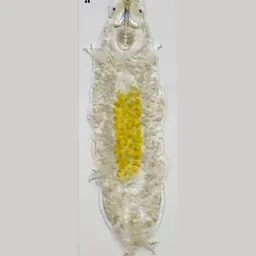
Mesobiotus philippinicus is a tardigrade in the genus Mesobiotus (Macrobiotidae, Parachela), described by Mapalo, Stec, Mirano-Bascos & Michalczyk in 2016.
Records
GBIF holds 1 records of it, none of them both georeferenced and openly licensed, so there is no map. See them on GBIF.
What we have read about it
Facts we extracted from the literature into our knowledge graph, each with the source and page it came from.
- Proven diets by genus: algae for Diphascon, Isohypsibius, Acutuncus, Ramazzottius, Thulinius and Dactylobiotus; rotifers and/or nematodes for Milnesium adults with algae for juveniles; rotifers and algae for Hypsibius and Mesobiotus; nematodes and algae or rotifers and algae for Macrobiotus; nematodes, rotifers and algae for Paramacrobiotus.Degma P 2018. Field and Laboratory Methods. In: Schill RO (ed.) Water Bears: The Biology of Tardigrades. Zoological Monographs 2, pp. 349–370 pp. 355–356, §14.3
- Dutta et al. extend the scenario for pdf evolution: one pdf gene in the protostome ancestor, duplicated to pdf-I and pdf-II in the ecdysozoan ancestor (both retained in priapulids, nematodes and onychophorans), with pdf-II lost and pdf-I retained and independently duplicated in tardigrades and arthropods. Screening found two to three pdf homologues per eutardigrade species (two in Ramazzottius varieornatus, Mesobiotus philippinicus and Milnesium tardigradum; three in Richtersius coronifer, Paramacrobiotus richtersi and Paramacrobiotus metropolitanus), and parachelan PDFs fall into two clades (PDF-1 and PDF-2/3), suggesting the eutardigrade ancestor had two pdf-I paralogues, one of which duplicated again in Parachela with later losses. Eutardigrade PDFs nest within the arthropod PDF/PDH clade.Dutta et al. 2025. Pigment-dispersing factor neuropeptides act as multifunctional hormones and modulators in tardigrades. Open biology. Open Biology 15:240242 section 2.1, p2 and section 3.1, p11; figure 1a,b; electronic supplementary material figure S1
Genomes and sequencing
Raw sequencing data
1 runs (7.0 Gb) in 1 projects: 1 RNA-Seq. Browse them in the SRA.
Papers
5 works in our corpus of 5,137 tardigrade papers name it in the title or abstract (2 in the title), from 2016. This is by exact name match, so it misses papers that use an older name or only the genus.
- Mesobiotus philippinicus sp. nov., the first limnoterrestrial tardigrade from the Philippines (2016, Zootaxa) doi
- Putative Toll-binding proteins mined from Mesobiotus philippinicus are likely RNA-binding proteins (2024, Biophysical Journal) doi
- The Unique Antimicrobial Recognition and Signaling Pathways in Tardigrades with a Comparison Across Ecdysozoa (2020, G3 Genes Genomes Genetics) doi
- Trinity-assembled Transcriptomes of Tardigrades, Onychophoran, and Nematomorph (2020, Harvard Dataverse) doi
- Mesobiotus_philippinicus_TRINITY.fasta (2020, Harvard Dataverse) doi
Classification
| class | Eutardigrada |
|---|---|
| order | Parachela |
| superfamily | Macrobiotoidea |
| family | Macrobiotidae |
| genus | Mesobiotus |
Other species of Mesobiotus: M. altitudinalis, M. anastasiae, M. aradasi, M. arguei, M. armatus, M. australis, M. baltatus, M. barabanovi, M. barbarae, M. binieki, M. blocki, M. bockebodicus, M. contii, M. coronatus, M. creber, M. datanlanicus, M. diegoi, M. diffusus, M. diguensis, M. dilimanensis, M. dimentmani, M. divergens, M. efa, M. emiliae, M. erminiae, M. ethiopicus, M. fiedleri, M. furciger, M. harmsworthi, M. helenae, M. hieronimi, M. hilariae, M. huecoensis, M. getae, M. insanis, M. insuetus, M. joenssoni, M. kovalevi, M. krynauwi, M. krystynae, and 45 more.
Look it up
GBIF · NCBI Taxonomy · GenBank sequences · iNaturalist · Google Scholar
Classification, authority and notes: Degma & Guidetti 2026, Actual checklist of Tardigrada species, 45th edition (CC BY 4.0), which asks users also to cite Guidetti & Bertolani 2005 (Zootaxa 845: 1–46) and Degma & Guidetti 2007 (Zootaxa 1579: 41–53).
Records: GBIF.org, accessed 2026-09-20 through the GBIF API; each record belongs to the dataset that published it. The map shows only records released under CC0 or CC BY, with coordinates and no geospatial issue flag.
Sequence data: NCBI Assembly, Nucleotide and SRA, searched September 2026.
Papers: our corpus of tardigrade literature from OpenAlex.
How this is built
- Data
- Classification, authority and notes from Degma & Guidetti's 2026 world checklist. Records from GBIF, genomes and sequencing runs from NCBI, papers from our OpenAlex corpus of tardigrade literature, photos from Wikimedia Commons and iNaturalist (CC0 or CC BY), and facts from our knowledge graph, each with its source and page. A page shows only the parts we hold for that species.
- Built with
build_species.pywrites every species page from the checklist, joining each name by exact match to the other collections. Facts are ranked by confidence and evidence, and taken from each source in turn so no single paper fills the list. The records map is drawn as SVG from thinned GBIF coordinates.- Checked
- Only exact matches to accepted names bring in GBIF records, and fossil entries were read against their papers. The pages themselves are not tested against data.
- Limits
- Exact name matching misses papers and sequences filed under older names or only the genus. GBIF identifications are as their publishers made them. A short page means we hold little yet, not that little is known.
- More
- How the whole project is built