Mesobiotus harmsworthi
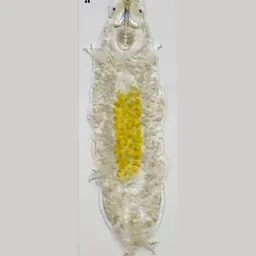
Mesobiotus harmsworthi is a tardigrade in the genus Mesobiotus (Macrobiotidae, Parachela), described by Murray in 1907. The parentheses around the authority mean it was first described in another genus.
Where it has been recorded
What we have read about it
Facts we extracted from the literature into our knowledge graph, each with the source and page it came from.
Includes populations recorded as Mesobiotus cf. harmsworthi.
- The brain of Macrobiotus cf. harmsworthi contains about 200 nuclei (DNA labelling, confocal z-series), so fewer than ~200 neurons since some nuclei are likely glia.Martin et al. 2017. The nervous and visual systems of onychophorans and tardigrades: learning about arthropod evolution from their closest relatives. Journal of comparative physiology. A, Neuroethology, sensory, neural, and behavioral physiology. p574 left col. ('~200 cells') and right col. ('approximately 200 [neurons] as judged from counting stained nuclei'); Mayer et al. 2013. Neural markers reveal a one-segmented head in tardigrades (water bears). PloS one. p3, 'Organisation of the brain' para ('contains ~200 nuclei'; some likely glia)
- No suboesophageal ganglion was found in 21 critically inspected anti-FMRFamide preparations; the distal buccal tube was serotonin-immunoreactive in all 12 anti-serotonin specimens.Mayer et al. 2013. Neural markers reveal a one-segmented head in tardigrades (water bears). PloS one. p4 right col. ('21 critically inspected preparations'); p3 right col. ('n = 12')
- In the three tardigrade species studied the brain is a dorsal, bilaterally symmetric ganglion bearing a central neuropil and a defined number of immunoreactive somata: about 14 serotonin-like and about 26 RFamide-like (Macrobiotus cf. harmsworthi), about 12 allatostatin-like (Paramacrobiotus richtersi) and 2 perisulfakinin-like (Hypsibius dujardini).Mayer et al. 2013. Selective neuronal staining in tardigrades and onychophorans provides insights into the evolution of segmental ganglia in panarthropods. BMC evolutionary biology. p3 right col., Results 'Organisation of the central and peripheral nervous system in the three tardigrade species studied'; Fig. 3 (p4) and its caption
- Species can be classed by habitat wetness: xerophilous (dry mosses IV–V: most Echiniscus including E. testudo, Adorybiotus coronifer, Macrobiotus islandicus, Hypsibius oberhaeuseri, Milnesium tardigradum); eurytopic (all categories: Macrobiotus areolatus, M. hufelandi, M. richtersi, M. harmsworthi and others); hygrophilous (moist mosses II–III: Hypsibius dujardini, H. convergens, most Diphascon); hydrophilous (wet mosses and water: all Dactylobiotus and Pseudobiotus). Physiological races of one species may occupy different habitats. About 80% of known species and varieties are found in moss.Ramazzotti & Maucci 1983. Il Phylum Tardigrada, 3rd edition (English translation by C. W. Beasley, 1995: The Phylum Tardigrada). Memorie dell'Istituto Italiano di Idrobiologia 41; translation published by the translator, McMurry University, Abilene, Texas. pp. 109–111 (PDF pp. 109–111): "Hygrophilous species: - Macrobiotus hibernicus, M. intermedius. - Hypsibius pallidus, H. convergens, H. microps, H. dujardini."
- A stomatogastric ganglion of at least four cells lies at the oesophagus–midgut junction in Mesobiotus cf. harmsworthi, sending three neurites back along the midgut and one forward along the oesophagus, ending blindly behind the pharynx (Mayer et al. 2013a).Møbjerg et al. 2018. Morphology and Functional Anatomy. Zoological Monographs / Water Bears: The Biology of Tardigrades. p. 87, 2.7.2
- Ventral commissures within the trunk ganglia are present in both heterotardigrade and eutardigrade species, including Mesobiotus cf. harmsworthi and H. dujardini, and are therefore ancestral for Tardigrada; their absence in Macrobiotus hufelandi (Zantke et al. 2008) is the exception rather than the rule. Extra-ganglionic interpedal commissures are likewise present in H. dujardini, M. cf. harmsworthi, Paramacrobiotus richtersi and Echiniscus testudo, taxa spanning the basal split of Tardigrada, so they too are ancestral components of the tardigrade nervous system.Smith & Jockusch 2014. The metameric pattern of Hypsibius dujardini(Eutardigrada) and its relationship to that of other panarthropods. Frontiers in Zoology. Frontiers in Zoology 11:66, p12, Discussion
- RFamide-like immunoreactivity labels the region surrounding the central brain neuropil in Macrobiotus cf. harmsworthi.Martin et al. 2017. The nervous and visual systems of onychophorans and tardigrades: learning about arthropod evolution from their closest relatives. Journal of comparative physiology. A, Neuroethology, sensory, neural, and behavioral physiology. p574 left col.; Fig. 6c
- Each trunk ganglion is an aggregation of tiny nuclei (~2 µm diameter) with a total diameter of 15-25 µm, positioned just anterior to its pair of legs (legs also visible as nuclear aggregations).Mayer et al. 2013. Neural markers reveal a one-segmented head in tardigrades (water bears). PloS one. p3 left col.; Fig. 2A-C (p4)
- In Macrobiotus cf. harmsworthi the first three trunk ganglia are similar in size, whereas the fourth is smaller and contains fewer cells, as shown by DNA labelling.Mayer et al. 2013. Selective neuronal staining in tardigrades and onychophorans provides insights into the evolution of segmental ganglia in panarthropods. BMC evolutionary biology. p3 right col.; Figs 2B, 3 (pp3-4)
- Culture attempts mostly failed in 1983 because animals vanish in moss or detritus and artificial conditions differ from nature. Methods tried: bell jars with a little water and a moss stalk from the source (or algae or macrophytes), partly covered and set over water against evaporation, detritus or rough varnish or gelatine on the bottom, first the water squeezed from the moss, then tap or rain water changed daily; a fairly low temperature, 3–10 °C, seemed best. Adults lived weeks to over 16 months (Macrobiotus harmsworthi), but young died soon after hatching. Culture on agar with Chlorella failed because the algae overgrew and hid the animals.Ramazzotti & Maucci 1983. Il Phylum Tardigrada, 3rd edition (English translation by C. W. Beasley, 1995: The Phylum Tardigrada). Memorie dell'Istituto Italiano di Idrobiologia 41; translation published by the translator, McMurry University, Abilene, Texas. p. 136 (PDF p. 136): "Attempts made by various authors and the writers to culture the tardigrades on agar and the like, using algae as food (of the genus Chlorella) in addition to the usual leaflets of moss, have been negative, due to the excessive development of the algae which in no time obstructed visibility."
- Comparing their result with published descriptions, Smith & Jockusch conclude that a differentiated fourth ganglion is ancestral for Eutardigrada and probably for Tardigrada: the fourth ganglion is the most distinct in Halobiotus crispae (one transverse commissure against two in ganglia 1-3), the smallest and least populous in Macrobiotus hufelandi and Mesobiotus cf. harmsworthi, and in the heterotardigrade Echiniscus testudo the first and fourth ganglia are narrower than the second and third, which raises the possibility that the first was also differentiated ancestrally. RFamide immunostaining in M. cf. harmsworthi shows consistent morphological differences between all four ganglia.Smith & Jockusch 2014. The metameric pattern of Hypsibius dujardini(Eutardigrada) and its relationship to that of other panarthropods. Frontiers in Zoology. Frontiers in Zoology 11:66, p12, Discussion
- Strong serotonin-like immunoreactivity in the tardigrade head is concentrated in structures surrounding the mouth opening and in the region surrounding the central brain neuropil.Martin et al. 2017. The nervous and visual systems of onychophorans and tardigrades: learning about arthropod evolution from their closest relatives. Journal of comparative physiology. A, Neuroethology, sensory, neural, and behavioral physiology. p574 left col.; Fig. 6b (anterior right, scale 10 µm)
- The CNS is a dorsally placed anterior brain and a 200-250 µm long chain of four ventral trunk ganglia, linked by paired somata-free connectives, with an additional pair of outer connectives joining trunk ganglion 1 to the brain (tubulin-labelled, only weak RFamide-like signal).Mayer et al. 2013. Neural markers reveal a one-segmented head in tardigrades (water bears). PloS one. p3 left col. (Results, first para.); Fig. 2A-B (p4); Fig. 3A-D (p5)
- Each tardigrade trunk ganglion carries a set of serotonin-like and RFamide-like immunoreactive cell bodies arranged bilaterally symmetrically, with essentially the same arrangement in different specimens of the same species: serially repeated, individually recognisable neurons.Mayer et al. 2013. Selective neuronal staining in tardigrades and onychophorans provides insights into the evolution of segmental ganglia in panarthropods. BMC evolutionary biology. p3 right col.; Fig. 3 (arrowheads) and Additional file 1
- Active life span was estimated at 18–30 months for Macrobiotus harmsworthi and Hypsibius convergens (Marcus 1929, 1936); for some freshwater Macrobiotus and Hypsibius 12–24 months (Pollock proposed 3–4 months from Franceschi and co-workers’ 1962–63 data); the authors stress that all life-span estimates are theoretical and unreliable.Ramazzotti & Maucci 1983. Il Phylum Tardigrada, 3rd edition (English translation by C. W. Beasley, 1995: The Phylum Tardigrada). Memorie dell'Istituto Italiano di Idrobiologia 41; translation published by the translator, McMurry University, Abilene, Texas. pp. 78–80 (PDF pp. 78–80): "Marcus (1929 and 1936) reached the conclusion that active life (in M. harmsworthi and H. convergens) ranges over 18 to 30 months"
- Consecutive tardigrade trunk ganglia are joined by a single pair of somata-free connectives.Martin et al. 2017. The nervous and visual systems of onychophorans and tardigrades: learning about arthropod evolution from their closest relatives. Journal of comparative physiology. A, Neuroethology, sensory, neural, and behavioral physiology. p569 right col.; Fig. 2c ('cn'), 2d
Showing 16 of 59, taking the best-supported facts from each source in turn.
Open questions
- Do the anterior Hox expression boundaries in tardigrade embryos match the one-segment head alignment predicted by Mayer et al. 2013 (labial boundary between leg-bearing segments 1 and 2, Deformed between 2 and 3)?Posed by Mayer et al. 2013. Neural markers reveal a one-segmented head in tardigrades (water bears). PloS one. p. 9: "the validity of this proposed alignment of head segments between tardigrades and other panarthropods can be readily tested in future studies by analysing the expression patterns of the anterior Hox genes in tardigrades" answered
Papers
5 works in our corpus of 5,137 tardigrade papers name it in the title or abstract (2 in the title), from 2017. This is by exact name match, so it misses papers that use an older name or only the genus.
- An integrative redescription of the nominal taxon for the Mesobiotus harmsworthi group (Tardigrada: Macrobiotidae) leads to descriptions of two new Mesobiotus species from Arctic (2018, PLoS ONE) doi
- Mesobiotus datanlanicus sp. nov., a new tardigrade species (Macrobiotidae: Mesobiotus harmsworthi group) from Lâm Đồng Province in Vietnam (2019, Zootaxa) doi
- An integrative description of Mesobiotus ethiopicus sp. nov. (Tardigrada: Eutardigrada: Parachela: Macrobiotidae: harmsworthi group) from the northern Afrotropic region (2017, TURKISH JOURNAL OF ZOOLOGY) doi
- Mesobiotus nikolaevae sp.n. (Eutardigrada: Macrobiotidae), a new species of Tardigrada from Croatia (2018, Invertzool) doi
- Water Bears From The Caribbean Island Of Antigua, With The Description Of A New Macrobiotus Species (Tardigrada: Eutardigrada: Macrobiotidae) (2017, Zenodo (CERN European Organization for Nuclear Research)) doi
Classification
| class | Eutardigrada |
|---|---|
| order | Parachela |
| superfamily | Macrobiotoidea |
| family | Macrobiotidae |
| genus | Mesobiotus |
Synonyms: Mesobiotus harmsworthi obscurus (Dastych, 1985) according to Kaczmarek et al. 2018.
Changes: Transferred from Macrobiotus by Vecchi et al. 2016a; Redescribed by Kaczmarek et al. 2018 based on Macrobiotus harmsworthi obscurus paratypes.
Other species of Mesobiotus: M. altitudinalis, M. anastasiae, M. aradasi, M. arguei, M. armatus, M. australis, M. baltatus, M. barabanovi, M. barbarae, M. binieki, M. blocki, M. bockebodicus, M. contii, M. coronatus, M. creber, M. datanlanicus, M. diegoi, M. diffusus, M. diguensis, M. dilimanensis, M. dimentmani, M. divergens, M. efa, M. emiliae, M. erminiae, M. ethiopicus, M. fiedleri, M. furciger, M. helenae, M. hieronimi, M. hilariae, M. huecoensis, M. getae, M. insanis, M. insuetus, M. joenssoni, M. kovalevi, M. krynauwi, M. krystynae, M. liviae, and 45 more.
Look it up
GBIF · NCBI Taxonomy · GenBank sequences · iNaturalist · Google Scholar
Classification, authority and notes: Degma & Guidetti 2026, Actual checklist of Tardigrada species, 45th edition (CC BY 4.0), which asks users also to cite Guidetti & Bertolani 2005 (Zootaxa 845: 1–46) and Degma & Guidetti 2007 (Zootaxa 1579: 41–53).
Records: GBIF.org, accessed 2026-09-20 through the GBIF API; each record belongs to the dataset that published it. The map shows only records released under CC0 or CC BY, with coordinates and no geospatial issue flag.
Papers: our corpus of tardigrade literature from OpenAlex.
How this is built
- Data
- Classification, authority and notes from Degma & Guidetti's 2026 world checklist. Records from GBIF, genomes and sequencing runs from NCBI, papers from our OpenAlex corpus of tardigrade literature, photos from Wikimedia Commons and iNaturalist (CC0 or CC BY), and facts from our knowledge graph, each with its source and page. A page shows only the parts we hold for that species.
- Built with
build_species.pywrites every species page from the checklist, joining each name by exact match to the other collections. Facts are ranked by confidence and evidence, and taken from each source in turn so no single paper fills the list. The records map is drawn as SVG from thinned GBIF coordinates.- Checked
- Only exact matches to accepted names bring in GBIF records, and fossil entries were read against their papers. The pages themselves are not tested against data.
- Limits
- Exact name matching misses papers and sequences filed under older names or only the genus. GBIF identifications are as their publishers made them. A short page means we hold little yet, not that little is known.
- More
- How the whole project is built