Dactylobiotus dispar
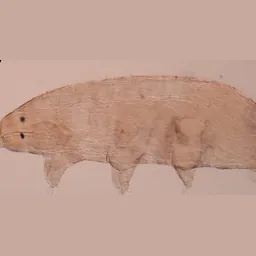
Dactylobiotus dispar is a tardigrade in the genus Dactylobiotus (Murrayidae, Parachela), described by Murray in 1907. The parentheses around the authority mean it was first described in another genus.
Where it has been recorded
What we have read about it
Facts we extracted from the literature into our knowledge graph, each with the source and page it came from.
- In captive Macrobiotus hufelandi, Dactylobiotus dispar and Hypsibius oberhaeuseri (Marcus 1929): buccal parts expelled about 6 days before ecdysis; no buccal apparatus for 1–3 days; rebuilding 2–4 days; then 0–2 days to moult; shedding the old cuticle 0–3 days. In total 3–9 days plus 0–3 for shedding, which is probably quicker in nature, where the animal can anchor the old cuticle.Ramazzotti & Maucci 1983. Il Phylum Tardigrada, 3rd edition (English translation by C. W. Beasley, 1995: The Phylum Tardigrada). Memorie dell'Istituto Italiano di Idrobiologia 41; translation published by the translator, McMurry University, Abilene, Texas. p. 76 (PDF p. 76): "Expulsion of the buccal parts: about 6 days before molting. --Period of absence of buccal parts: from 1 to 3 days. --Duration of the reconstruction of the buccal apparatus: from 2 to 4 days. --Period following, up to molting: from 0 to 2 days. --Time needed to shed the old cuticle: 0 to 3 days."
- Parthenogenetic and bisexual "biotypes", possibly sibling species distinguished by reproduction and karyotype, can coexist in one habitat (Bertolani): Macrobiotus hufelandi and M. richtersi have diploid bisexual (2n = 12) and triploid parthenogenetic (3n = 18) biotypes; Hypsibius oberhaeuseri has a diploid bisexual (2n = 12), a triploid (3n = 18) and a tetraploid (4n = 24) parthenogenetic biotype; Hypsibius dujardini (2n = 10) and Dactylobiotus dispar (2n = 10) are diploid parthenogens.Ramazzotti & Maucci 1983. Il Phylum Tardigrada, 3rd edition (English translation by C. W. Beasley, 1995: The Phylum Tardigrada). Memorie dell'Istituto Italiano di Idrobiologia 41; translation published by the translator, McMurry University, Abilene, Texas. p. 68 (PDF p. 68): "In Hypsibius oberhaeuseri there are three biotypes, one diploid bisexual (2n= 12) and two parthenogenetic, one triploid (3n= 18), the other tetraploid (4n=24)."
- Ammermann raised Hypsibius dujardini for more than six years (to 1967) at 21–23 °C on sessile Chlorococcales algae (probably Chlorella) in a dilute soil decoction (after Hämmerling); it reproduced by obligatory parthenogenesis and males never appeared. The authors found this surprising because natural H. dujardini populations include males. Parthenogenesis was also shown in Milnesium tardigradum (Baumann 1964) and Dactylobiotus dispar (Ammermann, unpublished), and excluded in H. convergens (Baumann 1961).Ramazzotti & Maucci 1983. Il Phylum Tardigrada, 3rd edition (English translation by C. W. Beasley, 1995: The Phylum Tardigrada). Memorie dell'Istituto Italiano di Idrobiologia 41; translation published by the translator, McMurry University, Abilene, Texas. pp. 67–68 (PDF pp. 67–68): "Ammermann observed that H. dujardini, in culture conditions, presents obligatory parthenogenesis: males never appeared (the culture lasted six years, when these results were given in 1967)."
- The number of moults in a lifetime was unsettled: about six in many species by some authors; about twelve for M. hufelandi, D. dispar and H. oberhaeuseri (Marcus 1929) and for M. hufelandi (Franceschi-Crippa & Lattes 1967); seven for about 800 Macrobiotus islandicus in Colorado from size-frequency (Higgins 1959); Ramazzotti’s measurements of over 1,000 M. areolatus in Pallanza suggested close to twelve. Summary: probably 6–12 in some Macrobiotus and Hypsibius. Size-frequency methods depend on class width and are confounded by sexes and cryptic races.Ramazzotti & Maucci 1983. Il Phylum Tardigrada, 3rd edition (English translation by C. W. Beasley, 1995: The Phylum Tardigrada). Memorie dell'Istituto Italiano di Idrobiologia 41; translation published by the translator, McMurry University, Abilene, Texas. pp. 77–78 (PDF pp. 77–78): "To sum up our present knowledge on the number of molts during the tardigrade’s life, one can say that it is probably somewhere between six and twelve in certain species of Macrobiotus and Hypsibius"
- Węglarska’s D. dispar encysted within 12 h in water with many cyanobacteria or decaying leaves, but not in frequently changed water (where they lived over nine months and laid eggs in November and February) nor after four weeks’ starvation in tap water: she concluded that cysts are triggered by gradual worsening of conditions (rapid worsening gives no cyst, or asphyxy), and that encystment is not an obligatory life stage. Cysts emerged in 6–48 h once the cause was removed, even under nitrogen or at about 6 °C. At 20–25 °C encysted animals lived about ten weeks against four to five weeks for starved active ones; in nature cysts may last over a year.Ramazzotti & Maucci 1983. Il Phylum Tardigrada, 3rd edition (English translation by C. W. Beasley, 1995: The Phylum Tardigrada). Memorie dell'Istituto Italiano di Idrobiologia 41; translation published by the translator, McMurry University, Abilene, Texas. p. 93 (PDF p. 93): "In her rearing of D. dispar duly encysted regularly within 12 hours, if placed in water containing many cyanophyceae or decomposing leaves, whereas this did not occur in frequently changed water"
- In Dactylobiotus dispar (Węglarska 1957, about a year of observation) animals feed heavily before encysting, shed the buccal apparatus, empty the gut, and within about 12 h form a first, wrinkled whitish cyst membrane that becomes smooth and completely black by 96 h; six days later a thinner second membrane without leg folds forms; brown granules (probably excretory) appear in the midgut after about 12 days. Sections every 6 days for 2 months and every 15 days for 7 more months showed all organs intact: no histolysis. Fat is not visibly used for months but falls sharply after 8 months; glycogen falls greatly by 3 months; reserves are used in the order sugars, fats, proteins.Ramazzotti & Maucci 1983. Il Phylum Tardigrada, 3rd edition (English translation by C. W. Beasley, 1995: The Phylum Tardigrada). Memorie dell'Istituto Italiano di Idrobiologia 41; translation published by the translator, McMurry University, Abilene, Texas. pp. 91–93 (PDF pp. 91–93): "within about 12 hours the first cyst membrane is formed, which at first is wrinkled and whitish, but gradually becomes smooth and darker until, after 96 hours, it is completely black"
- Encysted Dactylobiotus dispar consume 2.4 × 10⁻⁴ µl O₂ per hour against 1 × 10⁻³ for active animals of the same species (Pigón & Węglarska 1957), only about fourfold less; the authors conclude that encystment and cryptobiosis differ greatly in metabolism.Ramazzotti & Maucci 1983. Il Phylum Tardigrada, 3rd edition (English translation by C. W. Beasley, 1995: The Phylum Tardigrada). Memorie dell'Istituto Italiano di Idrobiologia 41; translation published by the translator, McMurry University, Abilene, Texas. p. 94 (PDF p. 94): "the consumption of O2 by an encysted D. dispar is 2.4 x 10⁻⁴ microliters/hour, while it is of 1 x 10⁻³ microliters/hour for an individual of the same species in active life"
- Strictly aquatic species of permanent lakes and ponds (e.g. Dactylobiotus dispar, D. ambiguus) cannot survive desiccation; eurytopic species living in both moss and water (Hypsibius dujardini, Macrobiotus hufelandi) might form physiological races that do or do not tolerate drying, depending on habitat.Ramazzotti & Maucci 1983. Il Phylum Tardigrada, 3rd edition (English translation by C. W. Beasley, 1995: The Phylum Tardigrada). Memorie dell'Istituto Italiano di Idrobiologia 41; translation published by the translator, McMurry University, Abilene, Texas. pp. 84–85 (PDF pp. 84–85): "distinctly aquatic species, that is to say, those found only in lakes and ponds which do not dry up... are unable to withstand desiccation, or rather do not undergo periods of cryptobiosis (for instance D. dispar, D. ambiguus, etc.)"
- Active animals survive about five weeks without food (Marcus), using up their reserves: storage cells are reabsorbed and, in egg-bearing females, the ovary contents (probably yolk). Starved D. dispar at 20–25 °C die within four to five weeks. The lateral Malpighian glands also shrink with starvation (e.g. from 128 to 60 µm long).Ramazzotti & Maucci 1983. Il Phylum Tardigrada, 3rd edition (English translation by C. W. Beasley, 1995: The Phylum Tardigrada). Memorie dell'Istituto Italiano di Idrobiologia 41; translation published by the translator, McMurry University, Abilene, Texas. p. 47 (PDF p. 47): "Marcus observed that specimens gathered from good feeding conditions were observed to survive without food for five weeks."
- Active animals consume about 1 × 10⁻³ µl O₂ per hour, for both the moss-dwelling Macrobiotus hufelandi and the freshwater Dactylobiotus dispar (Pigón & Węglarska 1953, 1954, 1957). There are no respiratory organs; gas exchange is across the whole cuticle in naked species and mainly across thin cuticle between plates in armoured ones, aided by body-fluid circulation driven by the animal’s movements.Ramazzotti & Maucci 1983. Il Phylum Tardigrada, 3rd edition (English translation by C. W. Beasley, 1995: The Phylum Tardigrada). Memorie dell'Istituto Italiano di Idrobiologia 41; translation published by the translator, McMurry University, Abilene, Texas. p. 44 (PDF p. 44): "during active life oxygen consumption is of about 1 x 10⁻³ microliters per hour for either the moss-inhabiting tardigrade Macrobiotus hufelandi or for the freshwater species Dactylobiotus dispar"
- Phototaxis results conflicted: positive in Hypsibius dujardini (von Erlanger 1895); positive in diffuse and negative in intense light in Pseudobiotus augusti (von Wenck 1914); indifferent in others; distinct, nearly immediate negative phototaxis in Dactylobiotus dispar (Marcus 1928). Newly hatched H. convergens are positively phototactic, which is lost after the second moult (Baumann 1961). Interstitial Batillipes show thigmotaxis among sand grains and rheotaxis to strong water movement.Ramazzotti & Maucci 1983. Il Phylum Tardigrada, 3rd edition (English translation by C. W. Beasley, 1995: The Phylum Tardigrada). Memorie dell'Istituto Italiano di Idrobiologia 41; translation published by the translator, McMurry University, Abilene, Texas. p. 63 (PDF p. 63): "in certain cases tardigrades have shown positive phototropism (Von Erlanger, 1895, for Hypsibius dujardini) in others it was positive under diffuse lighting and negative under intense lighting (Von Wenck, 1914, for Pseudobiotus augusti)"
Papers
8 works in our corpus of 5,137 tardigrade papers name it in the title or abstract (5 in the title), from 1989. This is by exact name match, so it misses papers that use an older name or only the genus.
- The ovary structure, previtellogenic and vitellogenic stages in parthenogenetic species Dactylobiotus dispar (Murray, 1907) (Tardigrada: Eutardigrada) (2005, Tissue and Cell) doi
- The Structure and the Formation of Egg Shells in the Parthenogenetic Species Dactylobiotus dispar Murray, 1907 (Tardigrada: Eutardigrada) (2005, Folia Biologica) doi
- Encystment in the tardigrade Dactylobiotus dispar [Murray, 1907] [Tardigrada: Eutardigrada] Part 1: Observation of living animals and structure of cyst (1995, Zoologica Poloniae)
- Aversive conditioning in the tardigrade, Dactylobiotus dispar. (2019, Journal of Experimental Psychology Animal Learning and Cognition) doi
- Ultrastructure of tardigrade Dactylobiotus dispar (Murray 1907) cuticle (1989, Acta Biologica Cracoviensia. Series Zoologia)
- Freshwater tardigrades from Hopen, Svalbard (76°31'N) (2024, Fauna norvegica) doi
Classification
| class | Eutardigrada |
|---|---|
| order | Parachela |
| superfamily | Macrobiotoidea |
| family | Murrayidae |
| genus | Dactylobiotus |
Other species of Dactylobiotus: D. ambiguus, D. ampullaceus, D. aquatilis, D. caldarellai, D. dervizi, D. grandipes, D. haplonyx, D. henanensis, D. kansae, D. lombardoi, D. luci, D. macronyx, D. octavi, D. ovimutans, D. parthenogeneticus, D. selenicus, D. taiwanensis, D. vulcanus.
Look it up
GBIF · NCBI Taxonomy · GenBank sequences · iNaturalist · Google Scholar
Classification, authority and notes: Degma & Guidetti 2026, Actual checklist of Tardigrada species, 45th edition (CC BY 4.0), which asks users also to cite Guidetti & Bertolani 2005 (Zootaxa 845: 1–46) and Degma & Guidetti 2007 (Zootaxa 1579: 41–53).
Records: GBIF.org, accessed 2026-09-20 through the GBIF API; each record belongs to the dataset that published it. The map shows only records released under CC0 or CC BY, with coordinates and no geospatial issue flag.
Papers: our corpus of tardigrade literature from OpenAlex.
How this is built
- Data
- Classification, authority and notes from Degma & Guidetti's 2026 world checklist. Records from GBIF, genomes and sequencing runs from NCBI, papers from our OpenAlex corpus of tardigrade literature, photos from Wikimedia Commons and iNaturalist (CC0 or CC BY), and facts from our knowledge graph, each with its source and page. A page shows only the parts we hold for that species.
- Built with
build_species.pywrites every species page from the checklist, joining each name by exact match to the other collections. Facts are ranked by confidence and evidence, and taken from each source in turn so no single paper fills the list. The records map is drawn as SVG from thinned GBIF coordinates.- Checked
- Only exact matches to accepted names bring in GBIF records, and fossil entries were read against their papers. The pages themselves are not tested against data.
- Limits
- Exact name matching misses papers and sequences filed under older names or only the genus. GBIF identifications are as their publishers made them. A short page means we hold little yet, not that little is known.
- More
- How the whole project is built