Thulinius stephaniae
Thulinius stephaniae is a tardigrade in the genus Thulinius (Doryphoribiidae, Parachela), described by Pilato in 1974. The parentheses around the authority mean it was first described in another genus.
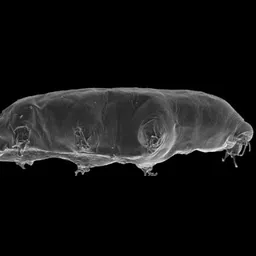
Where it has been recorded
What we have read about it
Facts we extracted from the literature into our knowledge graph, each with the source and page it came from.
- Thulinia stephaniae eggs are oval, about 50 µm long and 43 µm in diameter, and completely filled by the embryo.Hejnol & Schnabel 2005. The eutardigrade Thulinia stephaniae has an indeterminate development and the potential to regulate early blastomere ablations. Development (Cambridge, England). p1350, Results: "The oval shaped eggs, which are about 50 µm long and 43 µm in diameter are completely filled by the embryo"
- In Thulinius stephaniae, Hejnol & Schnabel (2005) did not detect a stereotyped cleavage pattern that would allow cells to be reproducibly identified in early embryos.Gabriel et al. 2007. The tardigrade Hypsibius dujardini, a new model for studying the evolution of development. Developmental biology. p546
- In the eutardigrade Thulinius stephaniae each ganglion arises from a neural progenitor cell, these cells are never part of a unitary structure, and brain progenitor cells immigrate before those of the trunk ganglia (Hejnol & Schnabel 2005).Martin et al. 2017. The nervous and visual systems of onychophorans and tardigrades: learning about arthropod evolution from their closest relatives. Journal of comparative physiology. A, Neuroethology, sensory, neural, and behavioral physiology. p580 right col.
- Proven diets by genus: algae for Diphascon, Isohypsibius, Acutuncus, Ramazzottius, Thulinius and Dactylobiotus; rotifers and/or nematodes for Milnesium adults with algae for juveniles; rotifers and algae for Hypsibius and Mesobiotus; nematodes and algae or rotifers and algae for Macrobiotus; nematodes, rotifers and algae for Paramacrobiotus.Degma P 2018. Field and Laboratory Methods. In: Schill RO (ed.) Water Bears: The Biology of Tardigrades. Zoological Monographs 2, pp. 349–370 pp. 355–356, §14.3
- The chapter describes tardigrade cleavage generally as irregular and indeterminate without early fate determination (first cleavage total and equal, asynchronous from the second cleavage in Halobiotus crispae and Echiniscoides sigismundi; Eibye-Jacobsen 1996/97), but describes H. dujardini as having a stereotyped, highly regulative cleavage with nuclear migrations predicting the embryonic axis and stem cell-like asymmetric divisions.Altiero T, Suzuki AC, Rebecchi L 2018. Reproduction, Development and Life Cycles. In: Schill RO (ed.) Water Bears: The Biology of Tardigrades. Zoological Monographs 2, pp. 211–248 pp. 232–233, §8.7.1
- At the 124-cell stage before gastrulation (T. stephaniae embryo 2) there are nine mesodermal precursors, four endodermal precursors and a pair of PGCs surrounded by them at the anterior blastopore; all remaining blastomeres become ectoderm.Hejnol & Schnabel 2005. The eutardigrade Thulinia stephaniae has an indeterminate development and the potential to regulate early blastomere ablations. Development (Cambridge, England). p1353, Fig. 3F caption: "Nine mesodermal precursors (mes)... including four endodermal (end) precursors"
- No subpharyngeal ganglion exists in tardigrade adults (Mayer et al. 2013b; Schulze et al. 2014; Smith & Jockusch 2014) or embryos (Hejnol & Schnabel 2005; Gross & Mayer 2015); the structure called subpharyngeal ganglion is probably the ventral-most part of the horseshoe-shaped median brain lobe.Martin et al. 2017. The nervous and visual systems of onychophorans and tardigrades: learning about arthropod evolution from their closest relatives. Journal of comparative physiology. A, Neuroethology, sensory, neural, and behavioral physiology. p574 right col.
- After ablation of one lateral or polar blastomere at the four-cell stage, 10 of 11 T. stephaniae embryos hatched as normal juveniles with two germ cells; after ablation of two non-sibling blastomeres, 2 of 2 hatched normally but developed more slowly (delayed pyramidal cell formation).Hejnol & Schnabel 2005. The eutardigrade Thulinia stephaniae has an indeterminate development and the potential to regulate early blastomere ablations. Development (Cambridge, England). p1354, Results, Ablations in the four-cell stage embryo; p1356 Table 1; Figs 8, 9
- After laser ablation of one blastomere at the two-cell stage, 9 of 14 T. stephaniae embryos hatched as normal but smaller juveniles, with all tissues and two PGCs; the ablated cell divided twice before degrading into cytoplasts, no compensatory extra cell generation was seen, and the ectodermal cells were much larger than in controls. Controls: 12 of 12 hatched.Hejnol & Schnabel 2005. The eutardigrade Thulinia stephaniae has an indeterminate development and the potential to regulate early blastomere ablations. Development (Cambridge, England). p1353–1354, Results, Laser ablation of one blastomere in the two-cell stage; p1356 Table 1; Fig. 7; Fig. 10C,D
- No cavities were detected inside T. stephaniae somites in vivo, and the mesoderm does not form by enterocoely from the gut (against Marcus 1928, 1929 and von Erlanger 1895).Hejnol & Schnabel 2005. The eutardigrade Thulinia stephaniae has an indeterminate development and the potential to regulate early blastomere ablations. Development (Cambridge, England). p1352, Results: "no cavities were detectable inside these somites during our in vivo observations"; p1355 Discussion
- In T. stephaniae both spindles of the second division are first perpendicular to the long axis of the egg, then rotate by 45°, so the two blastomeres cleave parallel to each other.Hejnol & Schnabel 2005. The eutardigrade Thulinia stephaniae has an indeterminate development and the potential to regulate early blastomere ablations. Development (Cambridge, England). p1350, Results; Fig. 1C
- In T. stephaniae embryo 2, gastrulation begins 9 h after egg deposition (at 24 °C) at two separate ventral regions; about 2 h later the pores of the prospective mouth (blastopore) and anus are visible.Hejnol & Schnabel 2005. The eutardigrade Thulinia stephaniae has an indeterminate development and the potential to regulate early blastomere ablations. Development (Cambridge, England). p1353, Fig. 3A,B caption: "Gastrulation initiates 9 hours after egg deposition"; p1351 Results
- In T. stephaniae mesodermal cells proliferate into the limb buds by 34 h after egg deposition, and somite cells inside the limb bud form muscle; the remaining somite cells become small cells that could not be traced.Hejnol & Schnabel 2005. The eutardigrade Thulinia stephaniae has an indeterminate development and the potential to regulate early blastomere ablations. Development (Cambridge, England). p1352, Results; p1354 Fig. 4H caption: "Embryo 34 hours after egg deposition. Mesodermal cells proliferate into the limb buds"
- In T. stephaniae the germ layer precursors have variable lineage origins with no detectable pattern; in embryo 2 the mesoderm and endoderm precursors descend from different blastomeres, indicating non-autonomous regional specification.Hejnol & Schnabel 2005. The eutardigrade Thulinia stephaniae has an indeterminate development and the potential to regulate early blastomere ablations. Development (Cambridge, England). p1351, Results: "The origin of the germ layer precursors is variable and follows no detectable pattern in the cell lineage"; Fig. 3C
- In T. stephaniae the zygote nucleus sits at the egg pole where the polar body is extruded; the first cleavage is total and equal with the spindle perpendicular to the long axis, and during furrowing the embryo and polar body rotate by ~90°.Hejnol & Schnabel 2005. The eutardigrade Thulinia stephaniae has an indeterminate development and the potential to regulate early blastomere ablations. Development (Cambridge, England). p1350, Results; Fig. 1A,B; supplementary Movie 1
- Up to the 32-cell stage all T. stephaniae blastomeres contact the eggshell (mitoses tangential to the surface); occasional 32-cell divisions perpendicular to the surface put a cell inside, but it always returns to the surface, so this is not gastrulation.Hejnol & Schnabel 2005. The eutardigrade Thulinia stephaniae has an indeterminate development and the potential to regulate early blastomere ablations. Development (Cambridge, England). p1350, Results; Fig. 1E,F
Showing 16 of 30, taking the best-supported facts from each source in turn.
Open questions
- How many neural progenitor cells build the brain in tardigrade embryos (T. stephaniae; H. exemplaris), and when do they delaminate relative to the ganglion progenitors?Posed by Hejnol & Schnabel 2005. The eutardigrade Thulinia stephaniae has an indeterminate development and the potential to regulate early blastomere ablations. Development (Cambridge, England). p. 1353: "Although we could not determine the number of cells forming the brain"
Classification
| class | Eutardigrada |
|---|---|
| order | Parachela |
| superfamily | Isohypsibioidea |
| family | Doryphoribiidae |
| genus | Thulinius |
Other species of Thulinius: T. augusti, T. gustavi, T. itoi, T. romanoi, T. ruffoi, T. saltursus.
Look it up
GBIF · NCBI Taxonomy · GenBank sequences · iNaturalist · Google Scholar
Classification, authority and notes: Degma & Guidetti 2026, Actual checklist of Tardigrada species, 45th edition (CC BY 4.0), which asks users also to cite Guidetti & Bertolani 2005 (Zootaxa 845: 1–46) and Degma & Guidetti 2007 (Zootaxa 1579: 41–53).
Records: GBIF.org, accessed 2026-09-20 through the GBIF API; each record belongs to the dataset that published it. The map shows only records released under CC0 or CC BY, with coordinates and no geospatial issue flag.
How this is built
- Data
- Classification, authority and notes from Degma & Guidetti's 2026 world checklist. Records from GBIF, genomes and sequencing runs from NCBI, papers from our OpenAlex corpus of tardigrade literature, photos from Wikimedia Commons and iNaturalist (CC0 or CC BY), and facts from our knowledge graph, each with its source and page. A page shows only the parts we hold for that species.
- Built with
build_species.pywrites every species page from the checklist, joining each name by exact match to the other collections. Facts are ranked by confidence and evidence, and taken from each source in turn so no single paper fills the list. The records map is drawn as SVG from thinned GBIF coordinates.- Checked
- Only exact matches to accepted names bring in GBIF records, and fossil entries were read against their papers. The pages themselves are not tested against data.
- Limits
- Exact name matching misses papers and sequences filed under older names or only the genus. GBIF identifications are as their publishers made them. A short page means we hold little yet, not that little is known.
- More
- How the whole project is built