Richtersius coronifer
Richtersius coronifer is a tardigrade in the genus Richtersius (Richtersiusidae, Parachela), described by Richters in 1903. The parentheses around the authority mean it was first described in another genus.
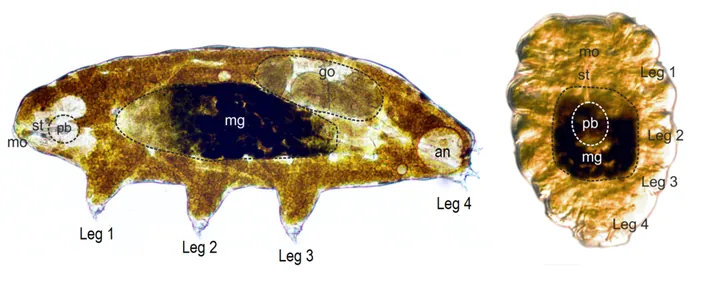

Where it has been recorded
What we have read about it
Facts we extracted from the literature into our knowledge graph, each with the source and page it came from.
- Richtersius coronifer (vegetarian, ventral-anterior mouth) has a buccal tube diameter of 7–8%, a ventral lamina of 30–35% and stylet support insertion at 62–65% of buccal tube length, with large placoid margins, buccal crown and stylet furca and small stylet curvature.Guidetti et al. 2012. Form and function of the feeding apparatus in Eutardigrada (Tardigrada). Zoomorphology. p129, Table 2 row 'Richterius coronifer' (sic)
- Seven paired but partly or entirely fused ventromedian muscle attachment sites are visible as seven depressions along the ventral midline of the cuticle in SEM (Richtersius coronifer); alternate sites connect to similar muscles.Møbjerg et al. 2018. Morphology and Functional Anatomy. Zoological Monographs / Water Bears: The Biology of Tardigrades. p. 59 Fig. 2.1a caption; p. 81, 2.6.1
- Active adult H. exemplaris and Richtersius cf. coronifer held at under 1 ppm oxygen (measured 0.2–0.75 ppm) for 1–24 h at 20–22 °C recovered well after short exposures but almost none recovered after 24 h; H. exemplaris was less tolerant.Hagelbäck & Jönsson 2023. An experimental study on tolerance to hypoxia in tardigrades. Frontiers in Physiology 14:1249773. abstract; Methods 2.3; Results, Fig. 3
- Tardigrade body length (excluding leg IV) ranges from about 50 µm (Bryodelphax parvulus at hatching) to about 1,200 µm (exceptionally large Adorybiotus coronifer and Milnesium tardigradum); adult averages are 250–300 µm in Echiniscidae and 350–500 µm in Macrobiotidae; marine species are usually smaller. Other families generally 120–750 µm.Ramazzotti & Maucci 1983. Il Phylum Tardigrada, 3rd edition (English translation by C. W. Beasley, 1995: The Phylum Tardigrada). Memorie dell'Istituto Italiano di Idrobiologia 41; translation published by the translator, McMurry University, Abilene, Texas. p. 17 (PDF p. 17): "varies between a minimum of about 50µ for Bryodelphax parvulus when it has just hatched, and a maximum of about 1,200µ for exceptionally large members of Adorybiotus coronifer and Milnesium tardigradum; the average measurements vary from 250-300µ for members of the family Echiniscidae and from 350-500µ for members of the family Macrobiotidae"
- Hydrated (active) Richtersius coronifer survived cooling to −196 °C (Ramløv & Westh 1992), with lower survival at very fast cooling (about 1500 °C/min).Hengherr S, Schill RO 2018. Environmental Adaptations: Cryobiosis. In: Schill RO (ed.) Water Bears: The Biology of Tardigrades. Zoological Monographs 2, pp. 295–310 pp. 296, 298 (PDF pp. 298, 300); Sadowska-Bartosz & Bartosz 2024. Antioxidant defense in the toughest animals on the Earth: its contribution to the extreme resistance of tardigrades. International Journal of Molecular Sciences 25:8393. section 3 (tolerance to temperature)
- TARDIS: eggs of R. coronifer and M. tardigradum exposed to vacuum, cosmic radiation and UV together did not hatch; vacuum plus cosmic radiation had no significant effect on hatching.Jönsson 2019. Radiation tolerance in tardigrades: current knowledge and potential applications in medicine. Cancers 11:1333. section 2.4
- Richtersius coronifer, gamma: LD50 one day after irradiation 3.0 kGy anhydrobiotic and 4.7 kGy hydrated; 1 kGy did not affect survival or egg laying but the eggs did not develop (Jönsson et al. 2005).Jönsson KI, Levine EB, Wojcik A, Haghdoost S, Harms-Ringdahl M 2018. Environmental Adaptations: Radiation Tolerance. In: Schill RO (ed.) Water Bears: The Biology of Tardigrades. Zoological Monographs 2, pp. 311–330 pp. 316–317 (PDF pp. 318–319)
- Trehalose in tardigrades is low: up to 2.3% of dry weight in Richtersius coronifer (Westh & Ramløv 1991), at most 0.472 ± 0.037% in a Paramacrobiotus species, none detected in Milnesium tardigradum (Hengherr et al. 2008); for comparison Artemia cysts reach 15–18%, Polypedilum vanderplanki larvae about 18%, nematodes 4–15%.Schill RO, Hengherr S 2018. Environmental Adaptations: Desiccation Tolerance. In: Schill RO (ed.) Water Bears: The Biology of Tardigrades. Zoological Monographs 2, pp. 273–294 pp. 281–282 (PDF pp. 284–285), section 10.4.1.1; Hengherr et al. 2008. Trehalose and anhydrobiosis in tardigrades: evidence for divergence in responses to dehydration. FEBS Journal 275:281–288. abstract
- Dutta et al. extend the scenario for pdf evolution: one pdf gene in the protostome ancestor, duplicated to pdf-I and pdf-II in the ecdysozoan ancestor (both retained in priapulids, nematodes and onychophorans), with pdf-II lost and pdf-I retained and independently duplicated in tardigrades and arthropods. Screening found two to three pdf homologues per eutardigrade species (two in Ramazzottius varieornatus, Mesobiotus philippinicus and Milnesium tardigradum; three in Richtersius coronifer, Paramacrobiotus richtersi and Paramacrobiotus metropolitanus), and parachelan PDFs fall into two clades (PDF-1 and PDF-2/3), suggesting the eutardigrade ancestor had two pdf-I paralogues, one of which duplicated again in Parachela with later losses. Eutardigrade PDFs nest within the arthropod PDF/PDH clade.Dutta et al. 2025. Pigment-dispersing factor neuropeptides act as multifunctional hormones and modulators in tardigrades. Open biology. Open Biology 15:240242 section 2.1, p2 and section 3.1, p11; figure 1a,b; electronic supplementary material figure S1
- The pharyngeal cuticular lining continues into the narrow cylindrical oesophagus, and folds at the pharynx–oesophagus transition work as a valve.Guidetti et al. 2012. Form and function of the feeding apparatus in Eutardigrada (Tardigrada). Zoomorphology. p136, first paragraph; Fig. 16g
- Dorsal, ventral and lateral muscle groups contract the body into the tun, legs are withdrawn by leg muscles, and in Richtersius coronifer tun formation reduces body volume by 87% (Halberg et al. 2013a).Møbjerg et al. 2018. Morphology and Functional Anatomy. Zoological Monographs / Water Bears: The Biology of Tardigrades. p. 83, 2.6.1
- Eggs laid into exuviae are the smallest, from about 42 × 30 µm (Hypsibius indicus) and 42 × 36 µm (Bryodelphax parvulus) to about 135 × 90 µm (Milnesium tardigradum), given as the axes of the best-fitting ellipse of rotation; free Macrobiotus eggs are larger and more often round, from about 40 µm (M. intermedius) to over 210 µm (M. spertii) and 235 µm (M. coronifer) including processes. Size varies even within one population.Ramazzotti & Maucci 1983. Il Phylum Tardigrada, 3rd edition (English translation by C. W. Beasley, 1995: The Phylum Tardigrada). Memorie dell'Istituto Italiano di Idrobiologia 41; translation published by the translator, McMurry University, Abilene, Texas. p. 72 (PDF p. 72): "these range from a minimum of about 42 by 30µ for Hypsibius indicus, and 42 by 36µ for Bryodelphax parvulus, to a maximum of about 135 by 90µ for Milnesium tardigradum"
- TARDIS (FOTON-M3, 2007): desiccated Richtersius coronifer and Milnesium tardigradum spent 10 days in low Earth orbit. Space vacuum (10⁻⁶ Pa) and cosmic radiation (100 mGy) had no significant effect; no animal of either species survived the full solar UV (116.5–400 nm, 7577 kJ/m²); 12% of M. tardigradum survived UVA+B (280–400 nm, 7095 kJ/m²).Jönsson 2019. Radiation tolerance in tardigrades: current knowledge and potential applications in medicine. Cancers 11:1333. section 2.3; Jönsson KI, Levine EB, Wojcik A, Haghdoost S, Harms-Ringdahl M 2018. Environmental Adaptations: Radiation Tolerance. In: Schill RO (ed.) Water Bears: The Biology of Tardigrades. Zoological Monographs 2, pp. 311–330 p. 322 (PDF p. 324)
- The buccal tube is a rigid cylinder whose diameter differs between species; it is straight in Milnesium cf. tardigradum and generally has an anterior-ventral bend in the parachelan species.Guidetti et al. 2012. Form and function of the feeding apparatus in Eutardigrada (Tardigrada). Zoomorphology. p130, 'Buccal tube'
- Species can be classed by habitat wetness: xerophilous (dry mosses IV–V: most Echiniscus including E. testudo, Adorybiotus coronifer, Macrobiotus islandicus, Hypsibius oberhaeuseri, Milnesium tardigradum); eurytopic (all categories: Macrobiotus areolatus, M. hufelandi, M. richtersi, M. harmsworthi and others); hygrophilous (moist mosses II–III: Hypsibius dujardini, H. convergens, most Diphascon); hydrophilous (wet mosses and water: all Dactylobiotus and Pseudobiotus). Physiological races of one species may occupy different habitats. About 80% of known species and varieties are found in moss.Ramazzotti & Maucci 1983. Il Phylum Tardigrada, 3rd edition (English translation by C. W. Beasley, 1995: The Phylum Tardigrada). Memorie dell'Istituto Italiano di Idrobiologia 41; translation published by the translator, McMurry University, Abilene, Texas. pp. 109–111 (PDF pp. 109–111): "Hygrophilous species: - Macrobiotus hibernicus, M. intermedius. - Hypsibius pallidus, H. convergens, H. microps, H. dujardini."
- The cuticular eutardigrade buccal-pharyngeal apparatus can be divided into four parts, buccal ring, buccal tube, stylet system and pharynx, followed by the cuticle-lined oesophagus, all part of the foregut.Guidetti et al. 2012. Form and function of the feeding apparatus in Eutardigrada (Tardigrada). Zoomorphology. p130, Results 'Anatomy of the buccal–pharyngeal apparatus'; Fig. 1a (p131)
Showing 16 of 28, taking the best-supported facts from each source in turn.
Genomes and sequencing
Raw sequencing data
3 runs (7.0 Gb) in 3 projects: 2 RNA-Seq, 1 EST. Browse them in the SRA.
Papers
40 works in our corpus of 5,137 tardigrade papers name it in the title or abstract (26 in the title), from 2001. This is by exact name match, so it misses papers that use an older name or only the genus.
- Radiation tolerance in the eutardigradeRichtersius coronifer (2005, International Journal of Radiation Biology) doi
- Induction of Hsp70 by desiccation, ionising radiation and heat-shock in the eutardigrade Richtersius coronifer (2006, Comparative Biochemistry and Physiology Part B Biochemistry and Molecular Biology) doi
- Desiccation Tolerance in the Tardigrade Richtersius coronifer Relies on Muscle Mediated Structural Reorganization (2013, PLoS ONE) doi
- Transcriptome survey of the anhydrobiotic tardigrade Milnesium tardigradum in comparison with Hypsibius dujardini and Richtersius coronifer (2010, BMC Genomics) doi
- Experimentally induced anhydrobiosis in the tardigrade Richtersius coronifer: phenotypic factors affecting survival (2002, Journal of Experimental Zoology) doi
- Anhydrobiotic Survival in Populations of the Tardigrades Richtersius coronifer and Ramazzottius oberhaeuseri from Italy and Sweden (2001, Zoologischer Anzeiger) doi
Classification
| class | Eutardigrada |
|---|---|
| order | Parachela |
| superfamily | Macrobiotoidea |
| family | Richtersiusidae |
| genus | Richtersius |
Changes: Redescribed by Stec et al. 2020a; neotype (from one of the original type locality Klaas Billen Bay, Svalbard, Norway) designated by Stec & Michalczyk 2020.
Other species of Richtersius: R. ingemari, R. mazepi, R. nicolai, R. tertius, R. ziemowiti.
Look it up
GBIF · NCBI Taxonomy · GenBank sequences · iNaturalist · Google Scholar
Classification, authority and notes: Degma & Guidetti 2026, Actual checklist of Tardigrada species, 45th edition (CC BY 4.0), which asks users also to cite Guidetti & Bertolani 2005 (Zootaxa 845: 1–46) and Degma & Guidetti 2007 (Zootaxa 1579: 41–53).
Records: GBIF.org, accessed 2026-09-20 through the GBIF API; each record belongs to the dataset that published it. The map shows only records released under CC0 or CC BY, with coordinates and no geospatial issue flag.
Sequence data: NCBI Assembly, Nucleotide and SRA, searched September 2026.
Papers: our corpus of tardigrade literature from OpenAlex.
How this is built
- Data
- Classification, authority and notes from Degma & Guidetti's 2026 world checklist. Records from GBIF, genomes and sequencing runs from NCBI, papers from our OpenAlex corpus of tardigrade literature, photos from Wikimedia Commons and iNaturalist (CC0 or CC BY), and facts from our knowledge graph, each with its source and page. A page shows only the parts we hold for that species.
- Built with
build_species.pywrites every species page from the checklist, joining each name by exact match to the other collections. Facts are ranked by confidence and evidence, and taken from each source in turn so no single paper fills the list. The records map is drawn as SVG from thinned GBIF coordinates.- Checked
- Only exact matches to accepted names bring in GBIF records, and fossil entries were read against their papers. The pages themselves are not tested against data.
- Limits
- Exact name matching misses papers and sequences filed under older names or only the genus. GBIF identifications are as their publishers made them. A short page means we hold little yet, not that little is known.
- More
- How the whole project is built