Milnesium tardigradum
Milnesium tardigradum is a tardigrade in the genus Milnesium (Milnesiidae, Apochela), described by Doyère in 1840.
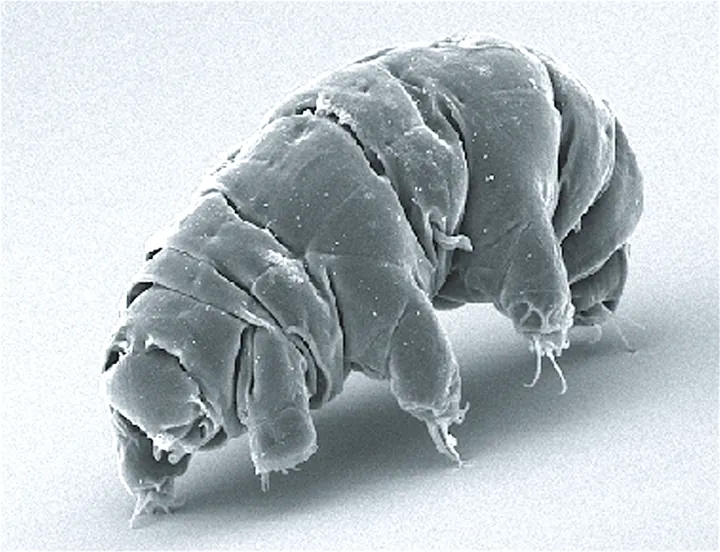

Where it has been recorded
What we have read about it
Facts we extracted from the literature into our knowledge graph, each with the source and page it came from.
- In M. cf. tardigradum calcium was detected only in the piercing stylets (100% of 5 apparatuses), not in the buccal ring, buccal tube, stylet furca or pharynx.Guidetti et al. 2012. Form and function of the feeding apparatus in Eutardigrada (Tardigrada). Zoomorphology. p130, Table 3 column 'Milnesium cf. tardigradum'; p139
- Fine longitudinal muscles run along the intestine: eight in M. tardigradum and Hypsibius sp., 13 in R. oberhaeuseri.Schmidt-Rhaesa & Kulessa 2007. Muscular architecture of Milnesium tardigradum and Hypsibius sp. (Eutardigrada, Tardigrada) with some data on Ramazottius oberhaeuseri. Zoomorphology. p. 278, 'Visceral musculature'; Fig. 8d–e
- Transcriptomes of Paramacrobiotus richtersi and Milnesium tardigradum contain the same set of Hox orthologs as H. dujardini (lab, Hox3, Dfd, ftz, Abd-B) but a single copy of Abd-B each.Smith et al. 2016. The compact body plan of tardigrades evolved by the loss of a large body region. Curr Biol 26:224–229 p224; Fig. 2; Fig. S1B; Table S1 (P. richtersi KT991397–KT991401; M. tardigradum KT991404–KT991408)
- Tardigrades are scarce or absent in muddy or dusty mosses, in towns, industrial zones and along busy roads; in dusty moss or moss exposed to industrial and car fumes often only Milnesium tardigradum and Echiniscus testudo remain.Ramazzotti & Maucci 1983. Il Phylum Tardigrada, 3rd edition (English translation by C. W. Beasley, 1995: The Phylum Tardigrada). Memorie dell'Istituto Italiano di Idrobiologia 41; translation published by the translator, McMurry University, Abilene, Texas. p. 125 (PDF p. 125): "in powdery mosses, or those exposed to industrial and automobile fumes, there are often only two species to be found, which are: Milnesium tardigradum and Echiniscus testudo, which obviously resist this type of interference best"
- Total fibres in legs I–IV (ventral + lateral + dorsal groups): Milnesium cf. tardigradum 12, 13, 13, 4; Acutuncus antarcticus 14, 13, 13, 5; Bertolanius volubilis 11, 11, 12, 6; Paramacrobiotus richtersi and Dactylobiotus parthenogeneticus 10, 11, 12, 5; Echiniscus testudo 9, 10, 11, 4. Only the ventral group was resolved in Batillipes bullacaudatus (5, 6, 6, 3).Marchioro et al. 2013. Somatic musculature of Tardigrada: phylogenetic signal and metameric patterns. Zoological Journal of the Linnean Society. Table 3 pp. 595–596, rows 'Total fibres within each leg'
- Genome sizes: 104 Mb for H. exemplaris, 75 Mb for M. tardigradum and 56 Mb for R. varieornatus.Goldstein 2018. The Emergence of the Tardigrade Hypsibius exemplaris as a Model System. Cold Spring Harbor protocols. p862, Related Species (citing Yoshida et al. 2017; Bemm et al. 2017)
- Milnesium tardigradum tuns in Fluorinert PC77 (a perfluorocarbon) survived 7.5 GPa for up to 13 h; all 20 animals held for 3 h were alive and moving and lived as long as controls.Ono et al. 2012. Effect of very high pressure on life of plants and animals. Journal of Physics: Conference Series 377:012053. pp. 1–3, sections 2 and 3.1, Fig. 1
- Internal organs (gonad and ducts, Malpighian tubules, hindgut) are suspended by ligaments and muscles attached to the integument. Eutardigrades have fine, radially arranged longitudinal gut muscles running from the oesophagus–midgut junction to the hindgut region, anchored by attachment plaques to the gut epithelium; these seem absent in heterotardigrades. Reported numbers: six in Halobiotus crispae, eight in Milnesium tardigradum and Hypsibius sp., 13 in Ramazzottius oberhaeuseri.Møbjerg et al. 2018. Morphology and Functional Anatomy. Zoological Monographs / Water Bears: The Biology of Tardigrades. p. 83, 2.6.2 'Visceral musculature'
- After 20 GPa for 30 min, Milnesium tardigradum tuns rehydrated without visible injury but were dead.Ono et al. 2016. Effect of ultra-high pressure on small animals, tardigrades and Artemia. Cogent Biology 2:1167575. abstract
- 1.2 GPa for 20 min killed hydrated Milnesium tardigradum but did not affect the survival of anhydrobiotic ones.Horikawa et al. 2009. High hydrostatic pressure tolerance of four different anhydrobiotic animal species. Zoological Science 26:238–242. abstract
- TARDIS: eggs of R. coronifer and M. tardigradum exposed to vacuum, cosmic radiation and UV together did not hatch; vacuum plus cosmic radiation had no significant effect on hatching.Jönsson 2019. Radiation tolerance in tardigrades: current knowledge and potential applications in medicine. Cancers 11:1333. section 2.4
- Milnesium tardigradum adults, 48 h LD50: hydrated 5000 Gy (gamma) and 6200 Gy (heavy ions); anhydrobiotic 4400 Gy (gamma) and 5200 Gy (heavy ions). Doses above 1000 Gy made them sterile.Horikawa et al. 2006. Radiation tolerance in the tardigrade Milnesium tardigradum. International Journal of Radiation Biology 82:843–848. abstract; Jönsson KI, Levine EB, Wojcik A, Haghdoost S, Harms-Ringdahl M 2018. Environmental Adaptations: Radiation Tolerance. In: Schill RO (ed.) Water Bears: The Biology of Tardigrades. Zoological Monographs 2, pp. 311–330 p. 317 (PDF p. 319)
- Milnesium tardigradum kept active lived 82.7 ± 2.7 days; animals dried for 7-day spells lived 79.7 ± 5.7 active days, 133.2 ± 11.7 days in all: time dry did not count as age (Hengherr et al. 2008).Schill RO, Hengherr S 2018. Environmental Adaptations: Desiccation Tolerance. In: Schill RO (ed.) Water Bears: The Biology of Tardigrades. Zoological Monographs 2, pp. 273–294 p. 276 (PDF p. 279), section 10.2.2
- Active animals of nine species cooled at 9, 7, 5, 3 or 1 °C/h to −30 °C and rewarmed at 10 °C/h: survival was higher after the fastest and slowest rates; Macrobiotus sapiens and M. tonollii did not survive 3, 5 or 7 °C/h.Hengherr et al. 2009. Freeze tolerance, supercooling points and ice formation: comparative studies on the subzero temperature survival of limno-terrestrial tardigrades. Journal of Experimental Biology 212:802–807. abstract; Hengherr S, Schill RO 2018. Environmental Adaptations: Cryobiosis. In: Schill RO (ed.) Water Bears: The Biology of Tardigrades. Zoological Monographs 2, pp. 295–310 p. 299 (PDF p. 301), Table 11.1
- Tuns of nine species held for 1 h at up to 110 °C: survival fell moderately up to 80 °C and steeply above it; no Macrobiotidae or Echiniscidae survived 100 °C, while Milnesium tardigradum survived 100 °C at 91.7 ± 6.9% and 110 °C at 1 ± 2%.Hengherr et al. 2009. High-temperature tolerance in anhydrobiotic tardigrades is limited by glass transition. Physiological and Biochemical Zoology 82:749–755. abstract; Schill RO, Hengherr S 2018. Environmental Adaptations: Desiccation Tolerance. In: Schill RO (ed.) Water Bears: The Biology of Tardigrades. Zoological Monographs 2, pp. 273–294 pp. 283–284 (PDF pp. 286–287), section 10.4.2
- Dutta et al. extend the scenario for pdf evolution: one pdf gene in the protostome ancestor, duplicated to pdf-I and pdf-II in the ecdysozoan ancestor (both retained in priapulids, nematodes and onychophorans), with pdf-II lost and pdf-I retained and independently duplicated in tardigrades and arthropods. Screening found two to three pdf homologues per eutardigrade species (two in Ramazzottius varieornatus, Mesobiotus philippinicus and Milnesium tardigradum; three in Richtersius coronifer, Paramacrobiotus richtersi and Paramacrobiotus metropolitanus), and parachelan PDFs fall into two clades (PDF-1 and PDF-2/3), suggesting the eutardigrade ancestor had two pdf-I paralogues, one of which duplicated again in Parachela with later losses. Eutardigrade PDFs nest within the arthropod PDF/PDH clade.Dutta et al. 2025. Pigment-dispersing factor neuropeptides act as multifunctional hormones and modulators in tardigrades. Open biology. Open Biology 15:240242 section 2.1, p2 and section 3.1, p11; figure 1a,b; electronic supplementary material figure S1
- Rahm (1921) reported that dried Milnesium tardigradum and Ramazzottius oberhaeuseri survived 110–151 °C. The reviews that repeat it disagree on the exposure: "for up to 35 min" (Sadowska-Bartosz & Bartosz 2024), "for 30 min" (Neves et al. 2020), "about 150 °C (up to 15 min)" citing Rahm 1923–1926 (Erdmann & Kaczmarek 2017).Sadowska-Bartosz & Bartosz 2024. Antioxidant defense in the toughest animals on the Earth: its contribution to the extreme resistance of tardigrades. International Journal of Molecular Sciences 25:8393. section 3 (tolerance to temperature): "could survive at 110–151 °C for up to 35 min" [ref. 44, Rahm 1921]; Neves et al. 2020. Thermotolerance experiments on active and desiccated states of Ramazzottius varieornatus emphasize that tardigrades are sensitive to high temperatures. Scientific Reports 10:94. Introduction: "110–151 °C for 30 min" [ref. 35]
- Milnesium cf. tardigradum (carnivorous, anterior mouth) has a buccal tube diameter of 40–50% of buccal tube length, stylet supports inserted at 58–63% of tube length, no ventral lamina, no placoids and no buccal crown.Guidetti et al. 2012. Form and function of the feeding apparatus in Eutardigrada (Tardigrada). Zoomorphology. p129, Table 2 row 'Milnesium cf. tardigradum'
- Dorsal appendage muscles per leg: Hypsibius sp. 12, 10, 9 and 4 in legs 1–4; M. tardigradum 9, 9, 8 and 1. In Hypsibius sp. leg 4 receives u2, v1 and w1 from the three posterior dorsal points U, V, W and w′1 from a point near W; v1 and w′1 fuse and end in the leg tip.Schmidt-Rhaesa & Kulessa 2007. Muscular architecture of Milnesium tardigradum and Hypsibius sp. (Eutardigrada, Tardigrada) with some data on Ramazottius oberhaeuseri. Zoomorphology. pp. 272–275, 'Dorsal appendage musculature'; Figs. 5, 6a–f; Table 1 pp. 279–280
- There is no mastication; eutardigrades with wide buccal tubes swallow whole organisms: Milnesium tardigradum (tube > 25 µm wide) sucks in diatoms and rotifers, and the author found a whole nematode in the gut of a Macrobiotus richtersi whose buccal tube was about 12 µm wide. Buccal tube width ranges from about 1 µm (some Diphascon) to over 25 µm (Milnesium).Ramazzotti & Maucci 1983. Il Phylum Tardigrada, 3rd edition (English translation by C. W. Beasley, 1995: The Phylum Tardigrada). Memorie dell'Istituto Italiano di Idrobiologia 41; translation published by the translator, McMurry University, Abilene, Texas. p. 47 (PDF p. 47): "I myself observed a whole nematode in the intestine of a moss-inhabiting Macrobiotus richtersi, the buccal tube of which had a diameter of about 12µ"
- The dorsal region of each leg receives fibres only from the dorsal group, the ventral region from all three groups. Legs I–III have similar fibre numbers (e.g. Bertolanius volubilis: three ventral, two lateral, six or seven dorsal per leg). Leg IV has only two attachment points, P1 and P2, reached by two or three fibres: one or two dorsal (to P2) and one lateral (to P1).Marchioro et al. 2013. Somatic musculature of Tardigrada: phylogenetic signal and metameric patterns. Zoological Journal of the Linnean Society. pp. 592–596, 'General remarks on leg musculature'; Table 3
- Males have not been reported from parthenogenetic H. exemplaris, whereas males arise rarely in otherwise parthenogenetic M. tardigradum and H. dujardini cultures.Goldstein 2018. The Emergence of the Tardigrade Hypsibius exemplaris as a Model System. Cold Spring Harbor protocols. p862, Related Species: "males have not yet been reported from the otherwise parthenogenetic H. exemplaris"
- Milnesium tardigradum was shown to survive 0.6 GPa (Seki & Toyoshima 1998, as cited by Ono et al. 2012).Ono et al. 2012. Effect of very high pressure on life of plants and animals. Journal of Physics: Conference Series 377:012053. p. 1, Introduction, ref. [2]
- TARDIS (FOTON-M3, 2007): desiccated Richtersius coronifer and Milnesium tardigradum spent 10 days in low Earth orbit. Space vacuum (10⁻⁶ Pa) and cosmic radiation (100 mGy) had no significant effect; no animal of either species survived the full solar UV (116.5–400 nm, 7577 kJ/m²); 12% of M. tardigradum survived UVA+B (280–400 nm, 7095 kJ/m²).Jönsson 2019. Radiation tolerance in tardigrades: current knowledge and potential applications in medicine. Cancers 11:1333. section 2.3; Jönsson KI, Levine EB, Wojcik A, Haghdoost S, Harms-Ringdahl M 2018. Environmental Adaptations: Radiation Tolerance. In: Schill RO (ed.) Water Bears: The Biology of Tardigrades. Zoological Monographs 2, pp. 311–330 p. 322 (PDF p. 324)
Showing 24 of 84, taking the best-supported facts from each source in turn.
Open questions
- Do tardigrade adults and embryos survive subzero temperatures by the same mechanisms, and can tardigrades tolerate intracellular freezing?Posed by Hengherr S, Schill RO 2018. Environmental Adaptations: Cryobiosis. In: Schill RO (ed.) Water Bears: The Biology of Tardigrades. Zoological Monographs 2, pp. 295–310 pp. 302, 307 (PDF pp 304, 309): "It is not known yet whether adult tardigrades and embryos use similar mechanisms to survive subzero temperatures." … "It is still not known if tardigrades tolerate intracellular freezing."
- Do heterotardigrades share the H. exemplaris pattern in which left and right ventromedian muscle attachment sites meet at the midline only in some segments, and is it ancestral for Tardigrada?Posed by Smith & Jockusch 2014. The metameric pattern of Hypsibius dujardini(Eutardigrada) and its relationship to that of other panarthropods. Frontiers in Zoology. PDF p 13: "Whether or not the pattern revealed in H. dujardini and M. tardigradum exists among heterotardigrade species has not been reported"
- Do the cephalic sensory structures of the apochelan eutardigrade Milnesium, which has both sensory fields and a pair of cephalic papillae, settle the homologies between heterotardigrade sensilla and eutardigrade sensory fields?Posed by Gross et al. 2021. Organization of the central nervous system and innervation of cephalic sensory structures in the water bear Echiniscus testudo (Tardigrada: Heterotardigrada) revisited. Journal of morphology. J Morphol 282:1310: "Future immunohistochemical studies on the apochelan eutardigrade Milnesium tardigradum, which exhibits sensory fields in addition to a pair of cephalic papillae, may help clarify putative homologies of the cephalic sensory structures between heterotardigrades and eutardigrades"
Genomes and sequencing
Raw sequencing data
11 runs (7.7 Gb) in 6 projects: 5 RNA-Seq, 2 AMPLICON, 2 EST, 1 Hi-C, 1 WGS. Browse them in the SRA.
Papers
108 works in our corpus of 5,137 tardigrade papers name it in the title or abstract (33 in the title), from 1959. This is by exact name match, so it misses papers that use an older name or only the genus.
- Radiation tolerance in the tardigradeMilnesium tardigradum (2006, International Journal of Radiation Biology) doi
- Stress gene (hsp70) sequences and quantitative expression inMilnesium tardigradum(Tardigrada) during active and cryptobiotic stages (2004, Journal of Experimental Biology) doi
- Life History of Milnesium tardigradum Doyère (Tardigrada) under a Rearing Environment (2003, ZOOLOGICAL SCIENCE) doi
- Milnesium tardigradum Doyère, 1840: The first integrative study of interpopulation variability in a tardigrade species (2018, Journal of Zoological Systematics & Evolutionary Research) doi
- Towards Decrypting Cryptobiosis—Analyzing Anhydrobiosis in the Tardigrade Milnesium tardigradum Using Transcriptome Sequencing (2014, PLoS ONE) doi
- Transcriptome survey of the anhydrobiotic tardigrade Milnesium tardigradum in comparison with Hypsibius dujardini and Richtersius coronifer (2010, BMC Genomics) doi
Classification
| class | Eutardigrada |
|---|---|
| order | Apochela |
| family | Milnesiidae |
| genus | Milnesium |
Changes: Redescribed and neotype (from Zeesen, Wildau, Germany) designated by Michalczyk et al. 2012 (original type locality Saint-Maur- des-Fossés, France); Amended by Morek et al. 2019a.
Listed as the nominotypical subspecies Milnesium tardigradum tardigradum.
Subspecies: Milnesium tardigradum trispinosa Rahm, 1931 (nomen dubium according to Morek et al. 2016; Not valid according to Suzuki 2016).
Other species of Milnesium: M. alabamae, M. almatyense, M. alpigenum, M. antarcticum, M. argentinum, M. asiaticum, M. barbadosense, M. beasleyi, M. beatae, M. berladnicorum, M. bohleberi, M. brachyungue, M. burgessi, M. cassandrae, M. decorum, M. dornensis, M. dujiangensis, M. eurystomum, M. fridae, M. grandicupula, M. granulatum, M. guanyinensis, M. inceptum, M. iniquum, M. irenae, M. jacobi, M. katarzynae, M. kogui, M. krzysztofi, M. lagniappe, M. longiungue, M. matheusi, M. milenae, M. minutum, M. myriae, M. pacificum, M. pelufforum, M. pentapapillatum, M. pseudotardigradum, M. quadrifidum, and 17 more.
Look it up
GBIF · NCBI Taxonomy · GenBank sequences · iNaturalist · Google Scholar
Classification, authority and notes: Degma & Guidetti 2026, Actual checklist of Tardigrada species, 45th edition (CC BY 4.0), which asks users also to cite Guidetti & Bertolani 2005 (Zootaxa 845: 1–46) and Degma & Guidetti 2007 (Zootaxa 1579: 41–53).
Records: GBIF.org, accessed 2026-09-20 through the GBIF API; each record belongs to the dataset that published it. The map shows only records released under CC0 or CC BY, with coordinates and no geospatial issue flag.
Sequence data: NCBI Assembly, Nucleotide and SRA, searched September 2026.
Papers: our corpus of tardigrade literature from OpenAlex.
How this is built
- Data
- Classification, authority and notes from Degma & Guidetti's 2026 world checklist. Records from GBIF, genomes and sequencing runs from NCBI, papers from our OpenAlex corpus of tardigrade literature, photos from Wikimedia Commons and iNaturalist (CC0 or CC BY), and facts from our knowledge graph, each with its source and page. A page shows only the parts we hold for that species.
- Built with
build_species.pywrites every species page from the checklist, joining each name by exact match to the other collections. Facts are ranked by confidence and evidence, and taken from each source in turn so no single paper fills the list. The records map is drawn as SVG from thinned GBIF coordinates.- Checked
- Only exact matches to accepted names bring in GBIF records, and fossil entries were read against their papers. The pages themselves are not tested against data.
- Limits
- Exact name matching misses papers and sequences filed under older names or only the genus. GBIF identifications are as their publishers made them. A short page means we hold little yet, not that little is known.
- More
- How the whole project is built