Echiniscoides sigismundi
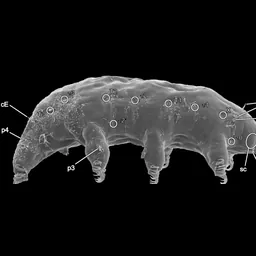
Echiniscoides sigismundi is a tardigrade in the genus Echiniscoides (Echiniscoididae, Echiniscoidea), described by M. Schultze in 1865. The parentheses around the authority mean it was first described in another genus.
Where it has been recorded
What we have read about it
Facts we extracted from the literature into our knowledge graph, each with the source and page it came from.
- Some freshwater species sometimes carry the egg-bearing exuvium until the eggs hatch: Isohypsibius annulatus attached to the head, Pseudobiotus augusti and P. megalonyx to leg IV; the marine Echiniscoides sigismundi often does the same.Ramazzotti & Maucci 1983. Il Phylum Tardigrada, 3rd edition (English translation by C. W. Beasley, 1995: The Phylum Tardigrada). Memorie dell'Istituto Italiano di Idrobiologia 41; translation published by the translator, McMurry University, Abilene, Texas. p. 70 (PDF p. 70): "Some freshwater species (Isohypsibius annulatus, Pseudobiotus augusti, and P. megalonyx) carry -- but not always -- for a certain time (up to the time of the opening of the eggs) the egg-bearing exuvium attached to the head (I. annulatus) or to the 4th pair of legs (the two species of Pseudobiotus)."
- The chapter describes tardigrade cleavage generally as irregular and indeterminate without early fate determination (first cleavage total and equal, asynchronous from the second cleavage in Halobiotus crispae and Echiniscoides sigismundi; Eibye-Jacobsen 1996/97), but describes H. dujardini as having a stereotyped, highly regulative cleavage with nuclear migrations predicting the embryonic axis and stem cell-like asymmetric divisions.Altiero T, Suzuki AC, Rebecchi L 2018. Reproduction, Development and Life Cycles. In: Schill RO (ed.) Water Bears: The Biology of Tardigrades. Zoological Monographs 2, pp. 211–248 pp. 232–233, §8.7.1
- Hydrated adults of the marine Echiniscoides sigismundi: gamma LD50 about 1.5 kGy 7 days after irradiation, lower than limno-terrestrial species.Jönsson KI, Levine EB, Wojcik A, Haghdoost S, Harms-Ringdahl M 2018. Environmental Adaptations: Radiation Tolerance. In: Schill RO (ed.) Water Bears: The Biology of Tardigrades. Zoological Monographs 2, pp. 311–330 p. 317 (PDF p. 319)
- The marine tidal tardigrade Echiniscoides sigismundi forms a tun in saturated seawater (osmobiosis) and in seawater with the mitochondrial uncoupler DNP (chemobiosis).Hvidepil & Møbjerg 2023. New insights into osmobiosis and chemobiosis in tardigrades. Frontiers in Physiology 14:1274522. abstract
- Searches of genomes and transcriptomes found two putative pdfr homologues in the eutardigrade Paramacrobiotus metropolitanus and one each in the heterotardigrades Echiniscus testudo, Echiniscoides sigismundi and an unpublished Batillipes sp. genome; a maximum-likelihood tree of about 1,000 class B GPCRs places all of them, and both H. exemplaris splice variants, inside the protostome PDF receptor clade, sister to the corticotropin-releasing hormone receptors.Dutta et al. 2025. Pigment-dispersing factor neuropeptides act as multifunctional hormones and modulators in tardigrades. Open biology. Open Biology 15:240242 section 2.2, p4; figure 1c; electronic supplementary material figure S2 and table S2
- Young Echiniscidae ("larvae") have two claws per leg, corresponding to the adult’s two internal claws, and an incomplete dentate collar; adults have four claws. Juvenile Echiniscoides sigismundi have five claws against nine to eleven in adults (Marcus 1927); young Batillipes mirus have four digits instead of six (McGinty & Higgins 1968).Ramazzotti & Maucci 1983. Il Phylum Tardigrada, 3rd edition (English translation by C. W. Beasley, 1995: The Phylum Tardigrada). Memorie dell'Istituto Italiano di Idrobiologia 41; translation published by the translator, McMurry University, Abilene, Texas. pp. 70–71 (PDF pp. 70–71): "the young (larvae) of the family Echiniscidae have a still incomplete dentate collar, two claws for each leg (corresponding to the adult’s two central claws) instead of four"
- The marine Echiniscoides sigismundi transferred to fresh water swells into asphyxy and can survive three days so; returned to sea water it recovers at once, while asphyxy from distilled or boiled water takes a few hours to reverse (Marcus 1929), supporting an osmotic cause.Ramazzotti & Maucci 1983. Il Phylum Tardigrada, 3rd edition (English translation by C. W. Beasley, 1995: The Phylum Tardigrada). Memorie dell'Istituto Italiano di Idrobiologia 41; translation published by the translator, McMurry University, Abilene, Texas. pp. 81–82 (PDF pp. 81–82): "The marine tardigrade Echiniscoides sigismundi, transferred to freshwater, goes into an asphyxial state swelling up considerably, and can stay like that for three days without dying."
- Among marine heterotardigrades Echiniscoides sigismundi (on Enteromorpha) survives limited drying: about 42% alive after ten days, all dead within four weeks; Batillipes mirus cannot survive desiccation (Marcus 1927); Styraconyx haploceros perhaps briefly. Eggs of E. sigismundi developed after four days dry on Enteromorpha.Ramazzotti & Maucci 1983. Il Phylum Tardigrada, 3rd edition (English translation by C. W. Beasley, 1995: The Phylum Tardigrada). Memorie dell'Istituto Italiano di Idrobiologia 41; translation published by the translator, McMurry University, Abilene, Texas. p. 84 (PDF p. 84): "can withstand limited periods of desiccation: after about ten days 42% of the population is still alive, but within four weeks, death is complete"
- Parasitism and commensalism were known only in marine species: Tetrakentron synaptae (100–200 µm, flat) lives only on the peribuccal tentacles of the holothurian Leptosynapta galliennei, two or three per host; Pleocola limnoriae on the isopod Limnoria lignorum (also found free); Echiniscoides sigismundi once on Mytilus mantle; Actinarctus doryphorus perhaps a facultative parasite of Echinocyamus pusillus (disputed).Ramazzotti & Maucci 1983. Il Phylum Tardigrada, 3rd edition (English translation by C. W. Beasley, 1995: The Phylum Tardigrada). Memorie dell'Istituto Italiano di Idrobiologia 41; translation published by the translator, McMurry University, Abilene, Texas. pp. 47–48 (PDF pp. 47–48): "In general there are two or three Tetrakentron on each holothurian, moving about slowly, keeping a tight grasp on their host with their claws."
- Aquatic densities: Echiniscoides sigismundi up to 60 per cm³ of water with Enteromorpha (Marcus 1929); up to 350 per 75 cm³ of beach sand at Arcachon, mostly Stygarctus bradypus (Renaud-Debyser 1959); about 3,000 Batillipes mirus in 100 cm³ of April sand at Sandy Point, Virginia, but under 6 in other samples nearby (McGinty & Higgins 1968); 100–150 per cm³ of water with algae in the Wannsee (Marcus 1929); up to 675 per 80 cm³ of lake psammon in Wisconsin (Pennak 1940), found up to more than 1.5 m from the water’s edge.Ramazzotti & Maucci 1983. Il Phylum Tardigrada, 3rd edition (English translation by C. W. Beasley, 1995: The Phylum Tardigrada). Memorie dell'Istituto Italiano di Idrobiologia 41; translation published by the translator, McMurry University, Abilene, Texas. p. 107 (PDF p. 107): "McGinty and Higgins (1968) observed a sample of 100 cc of sand at Sandy Point (Virginia, U.S.A.) which contained about 3,000 tardigrades of the species Ba. mirus, during the month of April"
Open questions
- Does the heterotardigrade Echiniscoides sigismundi really lack all p53-family genes?Posed by Kamilari et al. 2019. Comparative transcriptomics suggest unique molecular adaptations within tardigrade lineages. BMC genomics. PDF p 10: "We state the latter with caution and acknowledge that this finding needs further investigation."
Genomes and sequencing
Raw sequencing data
6 runs (328.7 Gb) in 2 projects: 5 Hi-C, 1 RNA-Seq. Browse them in the SRA.
Papers
23 works in our corpus of 5,137 tardigrade papers name it in the title or abstract (7 in the title), from 1950. This is by exact name match, so it misses papers that use an older name or only the genus.
- Tolerance to Gamma Radiation in the Marine Heterotardigrade, Echiniscoides sigismundi (2016, PLoS ONE) doi
- Tun formation is not a prerequisite for desiccation tolerance in the marine tidal tardigradeEchiniscoides sigismundi (2016, Zoological Journal of the Linnean Society) doi
- First record of cysts in the tidal tardigrade Echiniscoides sigismundi (2014, Helgoland Marine Research) doi
- LXVIII.—A note on the habitat of the marine tardigrade Echiniscoides sigismundi (Schultze) (1954, Annals and Magazine of Natural History) doi
- Habits of the Marine Tardigrade, Echiniscoides sigismundi (1950, Nature) doi
- Comparative myoanatomy of Tardigrada: new insights from the heterotardigrades Actinarctus doryphorus (Tanarctidae) and Echiniscoides sigismundi (Echiniscoididae) (2019, BMC Evolutionary Biology) doi
Classification
| class | Heterotardigrada |
|---|---|
| order | Echiniscoidea |
| family | Echiniscoididae |
| subfamily | Echiniscoidinae |
| genus | Echiniscoides |
Other species of Echiniscoides: E. andamanensis, E. basalticus, E. bruni, E. bufocephalus, E. costaricensis, E. galliensis, E. groenlandicus, E. hispaniensis, E. hoepneri, E. lichenophilus, E. mediterranicus, E. musa, E. polynesiensis, E. porphyrae, E. ritavargasae, E. rugostellatus, E. testudolapis, E. travei, E. trichosus, E. verrucariae, E. wyethi.
Look it up
GBIF · NCBI Taxonomy · GenBank sequences · iNaturalist · Google Scholar
Classification, authority and notes: Degma & Guidetti 2026, Actual checklist of Tardigrada species, 45th edition (CC BY 4.0), which asks users also to cite Guidetti & Bertolani 2005 (Zootaxa 845: 1–46) and Degma & Guidetti 2007 (Zootaxa 1579: 41–53).
Records: GBIF.org, accessed 2026-09-20 through the GBIF API; each record belongs to the dataset that published it. The map shows only records released under CC0 or CC BY, with coordinates and no geospatial issue flag.
Sequence data: NCBI Assembly, Nucleotide and SRA, searched September 2026.
Papers: our corpus of tardigrade literature from OpenAlex.
How this is built
- Data
- Classification, authority and notes from Degma & Guidetti's 2026 world checklist. Records from GBIF, genomes and sequencing runs from NCBI, papers from our OpenAlex corpus of tardigrade literature, photos from Wikimedia Commons and iNaturalist (CC0 or CC BY), and facts from our knowledge graph, each with its source and page. A page shows only the parts we hold for that species.
- Built with
build_species.pywrites every species page from the checklist, joining each name by exact match to the other collections. Facts are ranked by confidence and evidence, and taken from each source in turn so no single paper fills the list. The records map is drawn as SVG from thinned GBIF coordinates.- Checked
- Only exact matches to accepted names bring in GBIF records, and fossil entries were read against their papers. The pages themselves are not tested against data.
- Limits
- Exact name matching misses papers and sequences filed under older names or only the genus. GBIF identifications are as their publishers made them. A short page means we hold little yet, not that little is known.
- More
- How the whole project is built