Batillipes mirus
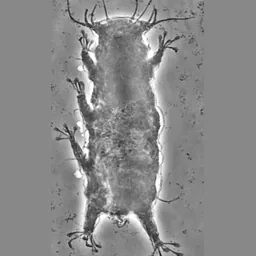
Batillipes mirus is a tardigrade in the genus Batillipes (Batillipedidae, Arthrotardigrada), described by Richters in 1909.

Where it has been recorded
What we have read about it
Facts we extracted from the literature into our knowledge graph, each with the source and page it came from.
- Young Echiniscidae ("larvae") have two claws per leg, corresponding to the adult’s two internal claws, and an incomplete dentate collar; adults have four claws. Juvenile Echiniscoides sigismundi have five claws against nine to eleven in adults (Marcus 1927); young Batillipes mirus have four digits instead of six (McGinty & Higgins 1968).Ramazzotti & Maucci 1983. Il Phylum Tardigrada, 3rd edition (English translation by C. W. Beasley, 1995: The Phylum Tardigrada). Memorie dell'Istituto Italiano di Idrobiologia 41; translation published by the translator, McMurry University, Abilene, Texas. pp. 70–71 (PDF pp. 70–71): "the young (larvae) of the family Echiniscidae have a still incomplete dentate collar, two claws for each leg (corresponding to the adult’s two central claws) instead of four"
- Among marine heterotardigrades Echiniscoides sigismundi (on Enteromorpha) survives limited drying: about 42% alive after ten days, all dead within four weeks; Batillipes mirus cannot survive desiccation (Marcus 1927); Styraconyx haploceros perhaps briefly. Eggs of E. sigismundi developed after four days dry on Enteromorpha.Ramazzotti & Maucci 1983. Il Phylum Tardigrada, 3rd edition (English translation by C. W. Beasley, 1995: The Phylum Tardigrada). Memorie dell'Istituto Italiano di Idrobiologia 41; translation published by the translator, McMurry University, Abilene, Texas. p. 84 (PDF p. 84): "can withstand limited periods of desiccation: after about ten days 42% of the population is still alive, but within four weeks, death is complete"
- Aquatic densities: Echiniscoides sigismundi up to 60 per cm³ of water with Enteromorpha (Marcus 1929); up to 350 per 75 cm³ of beach sand at Arcachon, mostly Stygarctus bradypus (Renaud-Debyser 1959); about 3,000 Batillipes mirus in 100 cm³ of April sand at Sandy Point, Virginia, but under 6 in other samples nearby (McGinty & Higgins 1968); 100–150 per cm³ of water with algae in the Wannsee (Marcus 1929); up to 675 per 80 cm³ of lake psammon in Wisconsin (Pennak 1940), found up to more than 1.5 m from the water’s edge.Ramazzotti & Maucci 1983. Il Phylum Tardigrada, 3rd edition (English translation by C. W. Beasley, 1995: The Phylum Tardigrada). Memorie dell'Istituto Italiano di Idrobiologia 41; translation published by the translator, McMurry University, Abilene, Texas. p. 107 (PDF p. 107): "McGinty and Higgins (1968) observed a sample of 100 cc of sand at Sandy Point (Virginia, U.S.A.) which contained about 3,000 tardigrades of the species Ba. mirus, during the month of April"
Papers
5 works in our corpus of 5,137 tardigrade papers name it in the title or abstract (1 in the title), from 1971. This is by exact name match, so it misses papers that use an older name or only the genus.
- First observation of the marine tardigradesBatillipes mirusandBatillipes noerrevangi(Arthrotardigrada, Batillipedidae) from a strongly brackish part of the Polish Baltic Sea coast (2015, Marine Biology Research) doi
- On Some British Marine Tardigrada, Including two New Species of Batillipes (1971, Journal of the Marine Biological Association of the United Kingdom) doi
- Marine Interstitial Heterotardigrada from the Pacific Coast of the United States, including a Description of Batillipes tridentatus n. sp. (1989, Transactions of the American Microscopical Society) doi
- ПЕРШІ ДОСЛІДЖЕННЯ ФАУНИ МОРСЬКИХ ТИХОХОДІВ (TARDIGRADA) ШЕЛЬФУ ПІВДЕННО-СХІДНОГО КРИМУ (ЧОРНЕ МОРЕ) (2013, Морський екологічний журнал)
- Marine meiofauna of a New York City beach, with particular reference to tardigrada (1974, University of New Hampshire Scholars Repository (University of New Hampshire at Manchester)) doi
Classification
| class | Heterotardigrada |
|---|---|
| order | Arthrotardigrada |
| family | Batillipedidae |
| genus | Batillipes |
Synonyms: Batillipes caudatus Hay, 1917.
Other species of Batillipes: B. acaudatus, B. acuticauda, B. adriaticus, B. africanus, B. algharbensis, B. amblypyge, B. annulatus, B. brasiliensis, B. bullacaudatus, B. carnonensis, B. chandrayaani, B. crassipes, B. dandarae, B. dicrocercus, B. friaufi, B. gilmartini, B. homocercus, B. ichthyocercus, B. kalami, B. lesteri, B. lingularum, B. littoralis, B. longispinosus, B. lusitanus, B. malaysianus, B. marcelli, B. minius, B. nioensis, B. noerrevangi, B. orientalis, B. pennaki, B. philippinensis, B. phreaticus, B. potiguarensis, B. roscoffensis, B. rotundiculus, B. similis, B. solitarius, B. spinicauda, B. tridentatus, and 2 more.
Look it up
GBIF · NCBI Taxonomy · GenBank sequences · iNaturalist · Google Scholar
Classification, authority and notes: Degma & Guidetti 2026, Actual checklist of Tardigrada species, 45th edition (CC BY 4.0), which asks users also to cite Guidetti & Bertolani 2005 (Zootaxa 845: 1–46) and Degma & Guidetti 2007 (Zootaxa 1579: 41–53).
Records: GBIF.org, accessed 2026-09-20 through the GBIF API; each record belongs to the dataset that published it. The map shows only records released under CC0 or CC BY, with coordinates and no geospatial issue flag.
Papers: our corpus of tardigrade literature from OpenAlex.
How this is built
- Data
- Classification, authority and notes from Degma & Guidetti's 2026 world checklist. Records from GBIF, genomes and sequencing runs from NCBI, papers from our OpenAlex corpus of tardigrade literature, photos from Wikimedia Commons and iNaturalist (CC0 or CC BY), and facts from our knowledge graph, each with its source and page. A page shows only the parts we hold for that species.
- Built with
build_species.pywrites every species page from the checklist, joining each name by exact match to the other collections. Facts are ranked by confidence and evidence, and taken from each source in turn so no single paper fills the list. The records map is drawn as SVG from thinned GBIF coordinates.- Checked
- Only exact matches to accepted names bring in GBIF records, and fossil entries were read against their papers. The pages themselves are not tested against data.
- Limits
- Exact name matching misses papers and sequences filed under older names or only the genus. GBIF identifications are as their publishers made them. A short page means we hold little yet, not that little is known.
- More
- How the whole project is built