A preprint, a DNA tree, and a museum batch we had to report
We published our first paper, modelled the missing piece of the condensin ring onto the ring it closes, gave the species tree a drawing for every genus in one hand, and built a tree of 412 species from their DNA to set against the official names. Screening that tree turned up sequences that cannot be what they are labelled, including a 2026 museum batch — we sent the evidence to the lab that deposited it, and they replied the same day. We also wrote down, in advance, everything our embryo model predicts about gene expression, and then went and checked.
Condensin II, published
Our first preprint is out: Tardigrades have a complete condensin II, with the code and data on GitHub.
The background: a 2021 study of how genomes fold used twenty-four species, and found that those lacking part of the condensin II complex fold their chromosomes in an older, simpler arrangement. The tardigrade was the only species in which they could find neither complex's accessory parts, and they said so plainly — the subunits "could have evolved beyond recognition with our methods", or the animal had lost both. Losing both would be extraordinary for an animal, so we looked again with a tool built for divergent sequences.
Each of three tardigrade species has two copies of the clasp protein CAP-H2, from one old duplication: the copies keep the same neighbouring genes across species, which dates the duplication before those species split. Both carry the right protein domains, score against the right family and not its sibling, and form a single tardigrade branch inside CAP-H2 on a tree of 68 clasps. Van Hooff and colleagues had already listed the two copies in one of our three species, in a survey across all eukaryotes; the paper says so, and credits them.
Overnight, a laptop graphics card modelled each clasp end together with the ring protein it should hold. Five of the six tardigrade clasps sit on their own SMC4 head about as confidently as the human one does; given the wrong partner, or scrambled, they do not. You can turn the models in 3D on the genomics page.
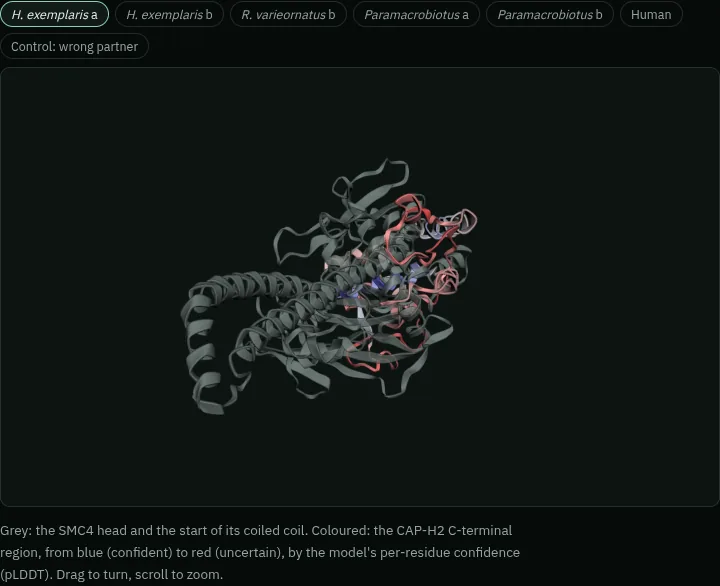
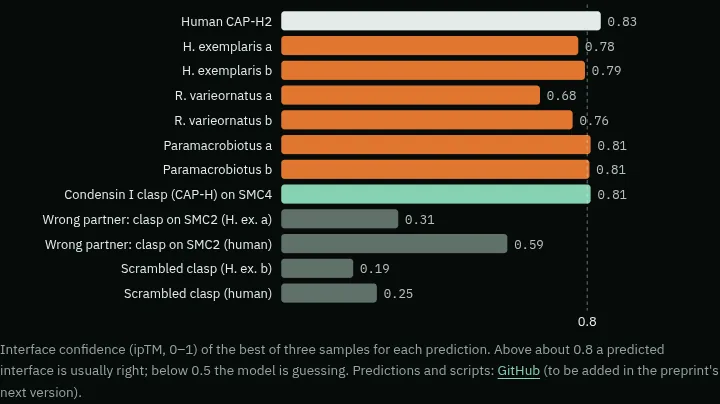
Later the same day, given the full head and neck of the other ring protein, the clasp's other end found its grip too, in all five samples: copy b closes the ring at both ends, as the human one does. That became version 3. With the tardigrade reclassified, we recomputed the original study's own statistical test: their link between condensin II and genome folding still holds.
02 · the species treeOne hand for every genus
A list of names says very little about what the animals look like, so every genus on the species tree now carries a picture: type-slide photographs from museums, open photographs from observers, whole-animal panels from open-access papers, and line drawings we traced into a single consistent style from public-domain plates — Doyère 1840, Richters, Murray, Thulin — and from CC BY figures.
Drawing them in one hand is the point. Photographs of tardigrades vary wildly in stain, squash and focus, so two genera can look more different than they are because of how they were mounted. A consistent line removes that. The line-up view puts every genus side by side, family by family, so body plans can actually be compared.
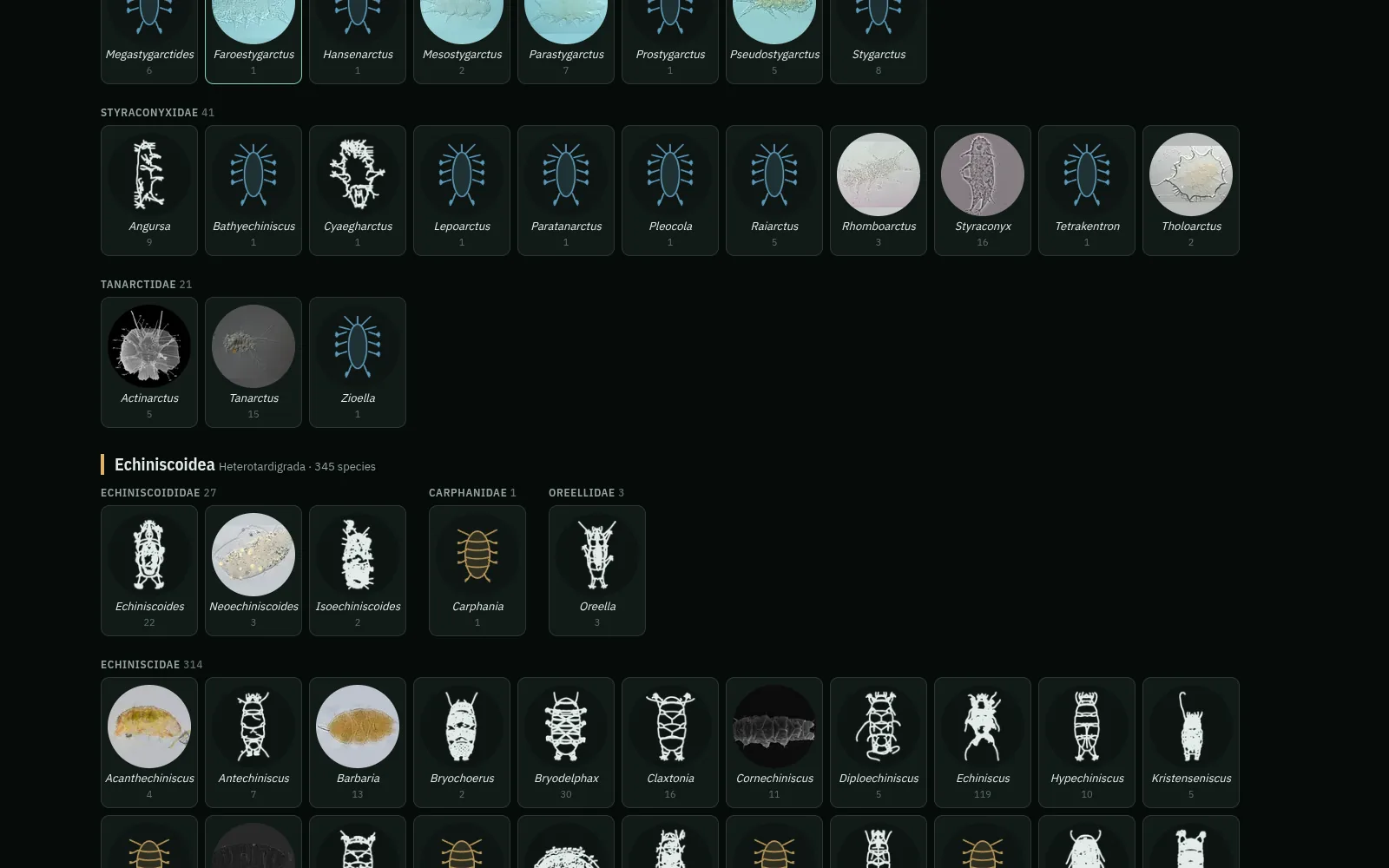
By the end of the day 1,291 species pages carried a picture. Tracings we made from copyrighted book plates stay on our own machine; only the openly licensed ones are published, and every tip records where its image came from and under what licence.
03 · DNA against namesA tree from every public sequence
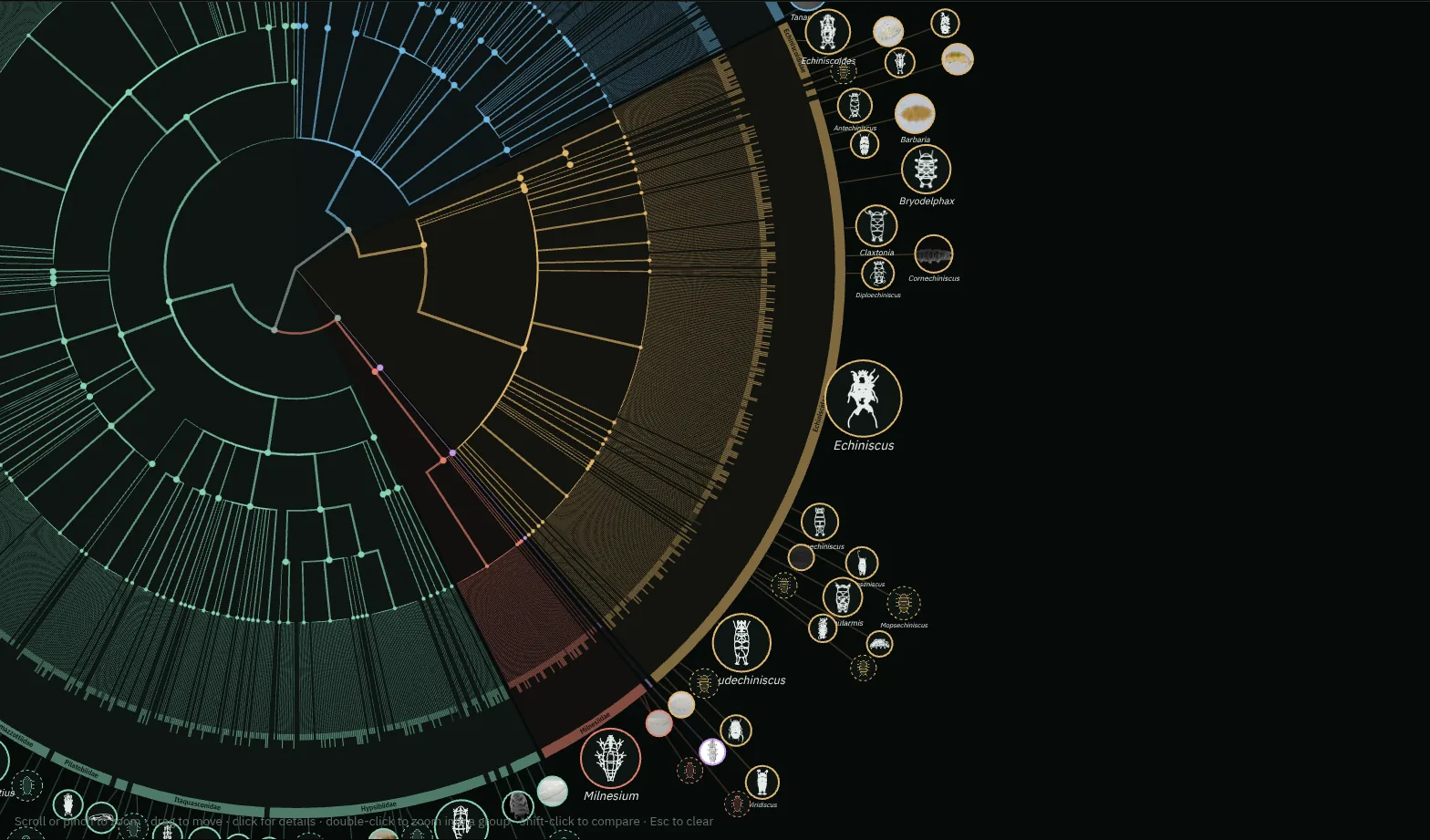
We downloaded every public 18S, 28S and COI record for tardigrades and built one tree of 412 named species — a quarter of all 1,546 described. The classes come out right, the two orders come out right, and the four superfamilies within the larger order come out right, with the root confirmed three separate ways.
But a tree built from public sequence is only as good as the labels on the sequences, so before trusting it we checked every record against the other records of its own species from other studies. That screen set aside 176 records, each with its evidence written down.
On the DNA tree the official families form a coloured ring; where DNA and names disagree, the colours break up. Twenty-seven names are contradicted with strong support, twenty-four of them stable under a second statistical test, and twelve are backed by two or three genes independently — including Macrobiotus, Hypsibius and Echiniscus as currently drawn. The tree also produces a gap map: eight families and sixty genera, 115 species between them, have no named sequence at all.
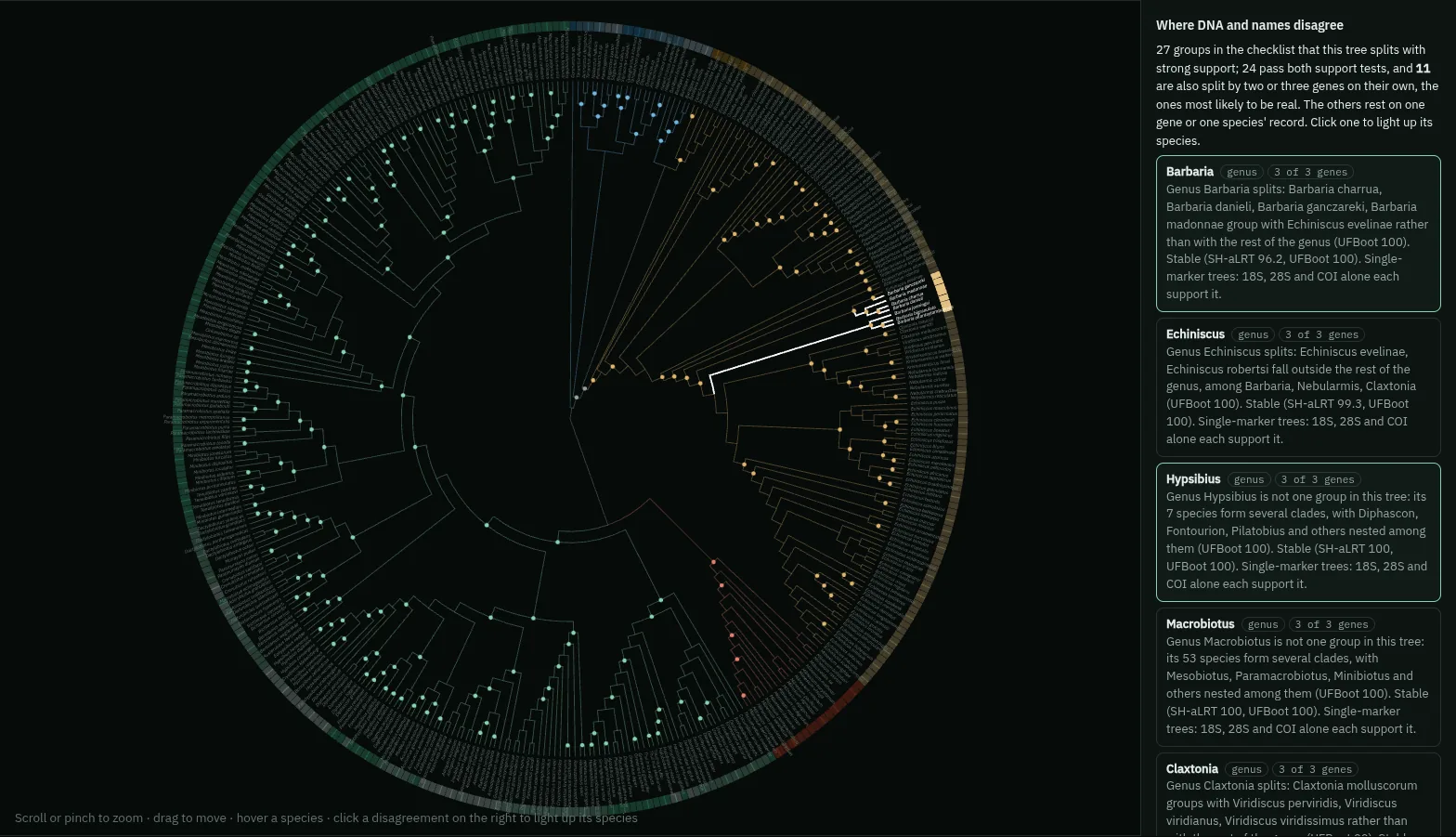
Sequences that cannot be what they say
Most of the 176 excluded records are hidden lineages sitting under the names of species complexes — real biology, badly labelled. A few are something else.
One 2026 batch deposited by a museum contains the same Macrobiotus 18S sequence filed under three unrelated species, two of them in a different class from Macrobiotus, with the same pattern in the other two markers. Thirteen records from that batch are excluded. It has the signature of cross-contamination during pooled sorting rather than anything else.
Others are older and simpler: a 2012 specimen labelled as one genus whose three markers belong to three different genera; a barcode filed under one armoured genus that matches another; a 1996 sequence still labelled with a name its own DNA contradicts.
Meow-Ludo sent the evidence table to the submitting lab. They replied the same day — "mistakes are indeed possible, as most of these specimens were student identified; or other explanations may also be considered" — and will revisit it on the 28th. That is the outcome we wanted: the screen exists to fix records, not to score points, and every excluded record can be put back if the evidence turns.
05 · predictions firstWe wrote down what the model predicts, then looked
Our embryo model implies things about genes. If cells divide on a particular schedule, then the genes that run cell division should rise and fall on that schedule; if the outer layer becomes an epithelium at a particular hour, its genes should switch on around then. Those are checkable against published single-embryo RNA.
The temptation is to look at the data first and then decide what the model predicted. So we wrote all seven predictions down, with numbers and hours, committed them, and only then went to the data.
Two held, one partly, four failed — and the biggest failure was the most useful thing we did that day. The model had cells stopping division at about 16 hours. The transcriptome says they keep dividing until about 48 hours. That is not a small correction: it changes how the animal gets from five hundred cells to a thousand. The embryo's late divisions now follow the data, and the hatchling count moved with it.
Writing predictions down before testing them costs nothing and it is the only way we could have been sure this was a correction rather than a fit. All seven, right and wrong, are on the record.
06 · open dataThe whole graph, public
Everything the project knows now sits in the open on the graph page: 2,524 facts, sources, open questions, tests and assumptions, joined by 7,635 links, each citing the page, figure, table or record it came from. Search it in the browser, follow any fact to what supports or contradicts it, or download the lot. The failed tests and our own guesses are in there too, labelled as such — an assumption we invented to make the simulation run is marked as an assumption, and the tool that lists them will not let us hide one.
Alongside it, every page on this site now says how it was built: open the panel under any section for its data, its code, its tests with their verdicts, and its limits. Forty-five of those notes across twenty-three pages, plus the template that appears on 1,550 species pages. If a number here came from a script, that panel names the script.
07 · a 1983 monographReading the book everyone cites
Ramazzotti and Maucci's 1983 monograph is the work half the modern literature cites for anything historical, and most citations of it are second-hand. We read parts I–III properly: 140 claims, 18 questions the authors themselves leave open, and 11 contradictions with later work, all kept rather than resolved.
Some of it changed pages here. The life cycle page gains a timeline of what happens inside a moult. Cryptobiosis gains cysts and the rule about water films. Keeping gains drying times for moss and how to read gut colour. And on extremes, the famous "15 minutes at 151 °C" turns out to be a possible misreading: the 1983 summary describes dried animals raised "suddenly, within 15 minutes, to 151 °C" — a fifteen-minute ramp across 340 degrees, not a fifteen-minute hold. Reviews have repeated it as a hold ever since. We have flagged it rather than settled it; the original 1921 and 1937 reports are in German and not yet in our hands.
08 · also todayAnd the rest
- Every cell with its own skin: the embryo's first eight hours with a membrane around every cell, computed on a graphics card and turnable in 3D.
- Where tardigrade research happens: every institution on every tardigrade paper since 2016, placed on a map. Poland leads by a wide margin. Institutions the citation database could not place were found through a second source rather than dropped.
- The history page now charts species described per year: more tardigrades have been named since 2020 than in the whole of the 2010s. It also gains Eichhorn's 1767 sighting, the first recorded revival from drying in 1774, and the Paris commission of 1859 convened to decide whether the revival was real.
- The hatchling cell budget: with divisions running to 48 hours, the model reaches 988–1,002 cells against a measured 1,140 ± 60. A close miss, recorded as a miss. The leading hypothesis is an extra round in the neural precursors, which is testable.
- The home page gains the glass tardigrade turntable video, and the build refuses to deploy unless the build itself completed — a small guard added after a partial upload.