THE BRAIN IS THREE HUNDREDTHS OF A GRAIN OF SALT
And nobody had bothered to measure the rest of it, so we did
1,389µm³ = 1,386µm³
The brain. And the four ganglia added together. Nobody knows why.
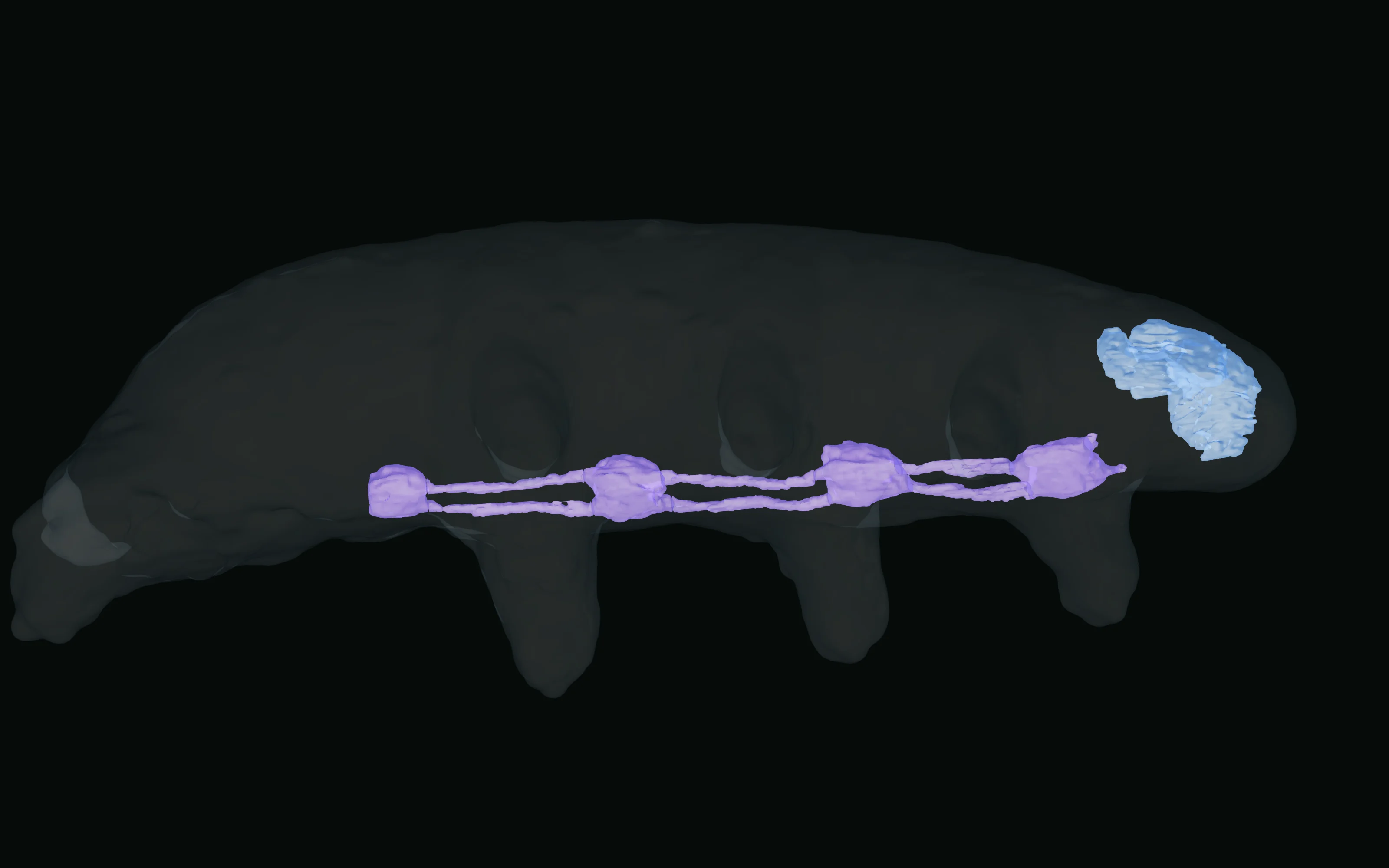
Here is a thing that happens all the time and nobody talks about. In 2019 a group of people put a water bear in a synchrotron and took the highest resolution X-ray of a tardigrade that had ever been taken. Then they published it. Not the pictures — the whole scan, every voxel, under a licence that says do what you like.
And then, for seven years, essentially nobody did.
We downloaded it. It took an afternoon to rebuild the animal in three dimensions. Behind the brain there are four lumps of nerve, one for each pair of legs, and when we went looking for their sizes in the paper we found this sentence: they did not measure them.
So we measured them. You cut the nerve cord wherever it gets fatter than ten square micrometres — the cables never get above six, the lumps never drop below forty-seven, so there's no argument about where the cut goes. 385, 430, 379, 194. Front to back. The back one is half the size and stays half the size no matter how you cut it.
Add them up: 1,386. The brain: 1,389. Three cubic micrometres apart, out of fourteen hundred. We have no idea what that means and we're not going to pretend we do.
Then we asked when it gets built
Sixty-two embryos. Somebody killed each one at a known minute between being laid and hatching, and read every gene in it. That was 2016. Also open. Also mostly untouched.
The genes that lay out the nervous system all go off together between 41 and 53 hours — twelve hours out of four days — and then shut up. We got this wrong first: we tested whether they trended, they didn't, we published a null. A pulse doesn't trend. The null was about our ruler, not the animal.
And inside that window, one gene comes on 288 times over, from basically nothing. It's this animal's unc-86 — in a worm that's the gene that decides which cell becomes which neuron. Nobody has ever reported a gene from that family in any tardigrade.
Things we got wrong, printed on purpose
→ Published a null that was our statistic's fault, not the animal's. Fixed it. Left both in.
→ Said a gene cluster wasn't conserved. It is. We'd measured how good the annotation was and called it biology.
→ Ran a whole week on a clock that was half speed. Every stated hour was wrong. Nothing calculated was.