One block = one voxel
608 blocks = one bear
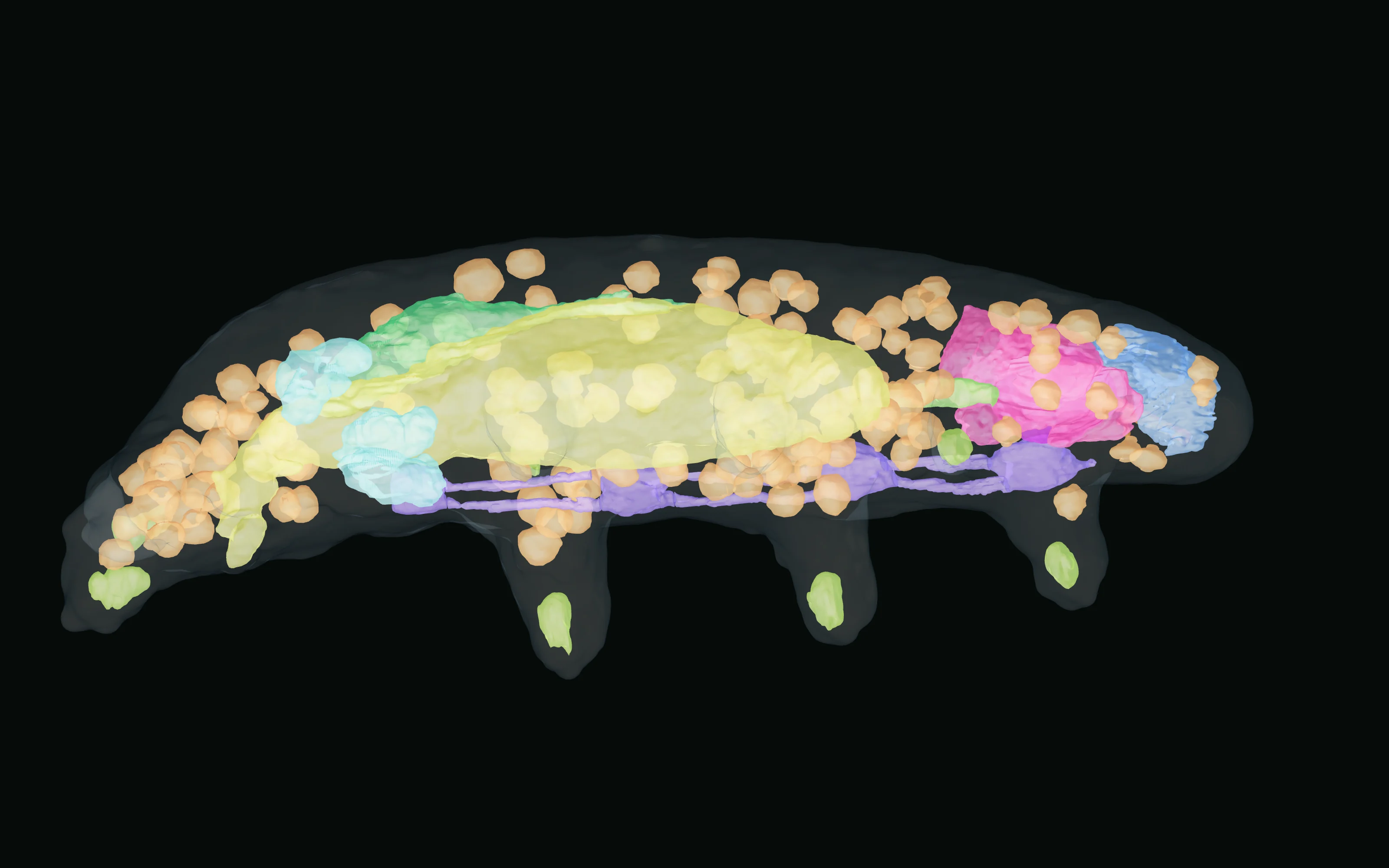
An X-ray scan is a grid of cubes. So is a Minecraft world. So is this page. The animal below is 152 micrometres long and is made of 27 labelled regions — and four of its parts had never been measured by anyone until we counted the cubes.
▸ Inventory: the nerve cord, split into four
The cord is one connected strand of 1,607 µm³ that swells four times, once per pair of legs. Cut it wherever the cross-section passes 10 µm² — the cables never exceed 6, the swellings never drop below 47 — and you get four discrete blocks.
| Slot | Part | Volume | vs slot 1 |
|---|---|---|---|
| 1 | Ganglion I | 385 µm³ | 1.00 |
| 2 | Ganglion II | 430 µm³ | 1.12 |
| 3 | Ganglion III | 379 µm³ | 0.98 |
| 4 | Ganglion IV | 194 µm³ | 0.50 |
The source study says it did not measure these. The four of them together come to 1,386 µm³; the brain is 1,389. Three cubes apart out of fourteen hundred. We are not going to invent a reason.
▸ Build order
Sixty-two embryos, each sequenced once at a known hour between laying and hatching at ~101 h. Each block above is about two and a half hours. The pattern is placed fast and the wiring is run slowly — you can count it off the bars.
Recipe: zero new experiments
A 2019 scan and a 2016 transcriptome, both open, both mostly untouched. Nothing here was measured in a lab by us.
Achievement: first POU gene
Sister to unc-86 at 93% bootstrap. No POU gene has ever been reported in any tardigrade.
Known bug: one adult
Fixed and dried. Bulk embryo expression. Cannot say which cells anything is in.
Known bug: a threshold
Volumes depend on where the cord is cut. Swept 8–25 µm²: under 10% movement, order unchanged.